Contactless payment in London: your 2026 visitor guide
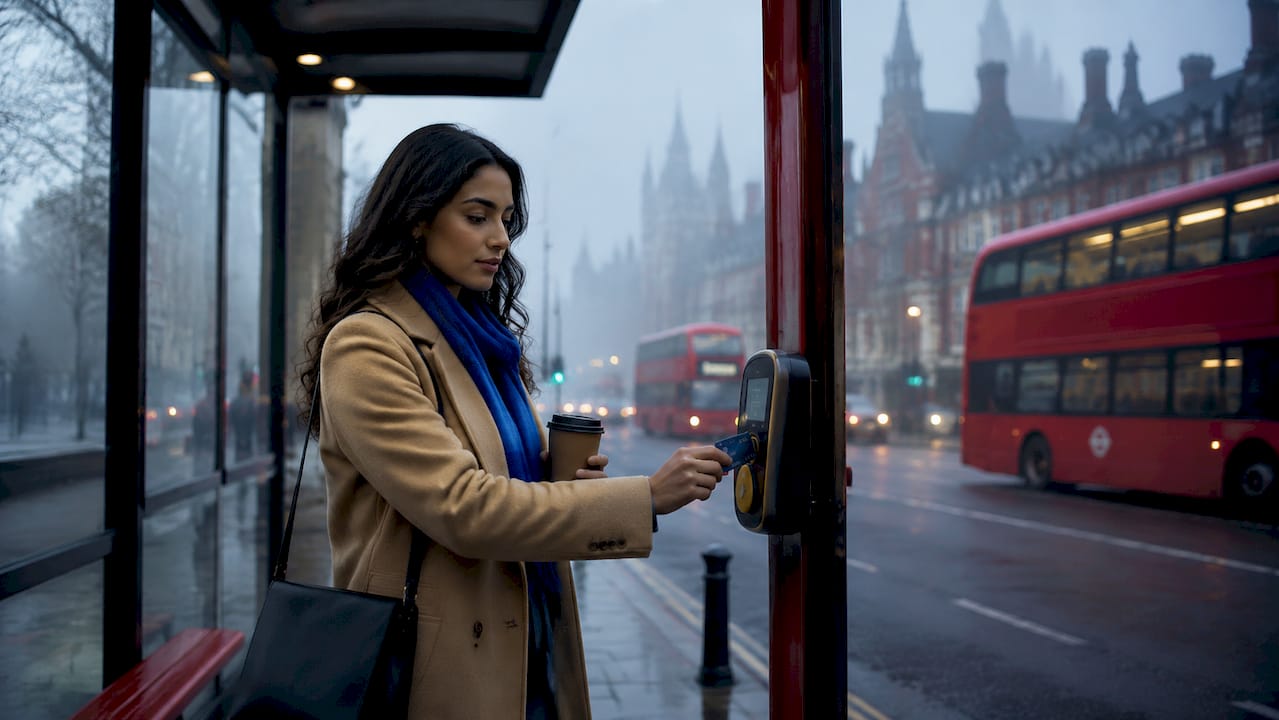
Contactless payment in London is defined as a method of making fast, secure transactions by tapping a bank card, smartphone, or wearable device on a reader, without entering a PIN. Transport for London (TfL) accepts contactless across its entire network, including the Tube, buses, trams, the DLR, the Overground, the Elizabeth line, and most National Rail services within London zones. Major retailers, restaurants, and attractions across the city accept it too. For visitors, understanding how contactless payment works in London is the single most useful piece of travel knowledge you can have before you arrive.
What is contactless payment in London and how does it work?
Contactless payment uses Near Field Communication (NFC) technology. NFC is a short-range wireless signal that passes data between your card or device and a payment reader when they are held within a few centimetres of each other. The transaction completes in under a second, with no PIN required for most payments.
In London, two systems use contactless payments: retail point-of-sale terminals and TfL’s transport network. Retail terminals are found in supermarkets like Tesco and Sainsbury’s, coffee shops like Pret a Manger and Costa Coffee, department stores like Selfridges and John Lewis, and attractions like the London Eye on the South Bank. TfL’s yellow card readers are installed at every Tube gate, bus door, tram stop, and rail platform within the network.
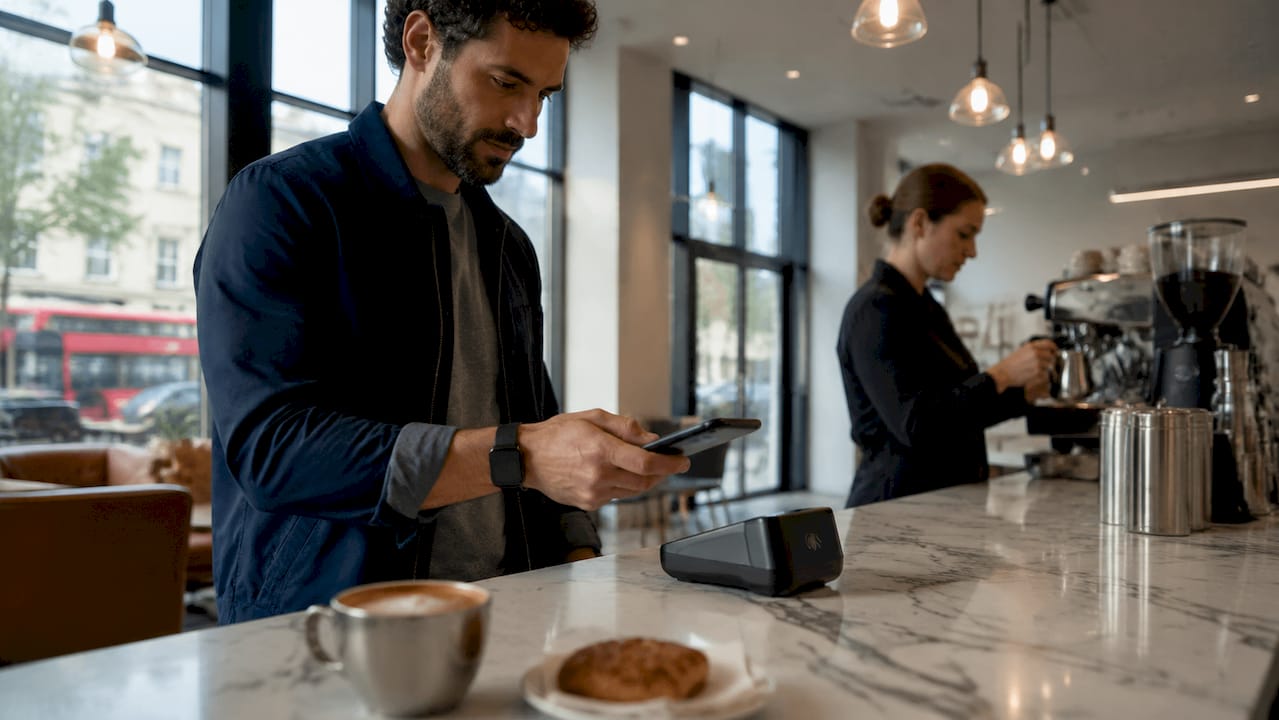
Accepted payment methods include Visa and Mastercard contactless debit and credit cards, Apple Pay, Google Pay, Samsung Pay, and compatible smartwatches. The card or device does not need to be registered in advance. You simply tap and go.
Where and how to use contactless payment on London transport and in shops
Contactless is accepted across the full TfL network as of 2026, covering every mode of public transport in the city. That reach makes it the most practical payment option for visitors who want to move freely without buying a separate card.
Using contactless on the Tube, Overground, and Elizabeth line
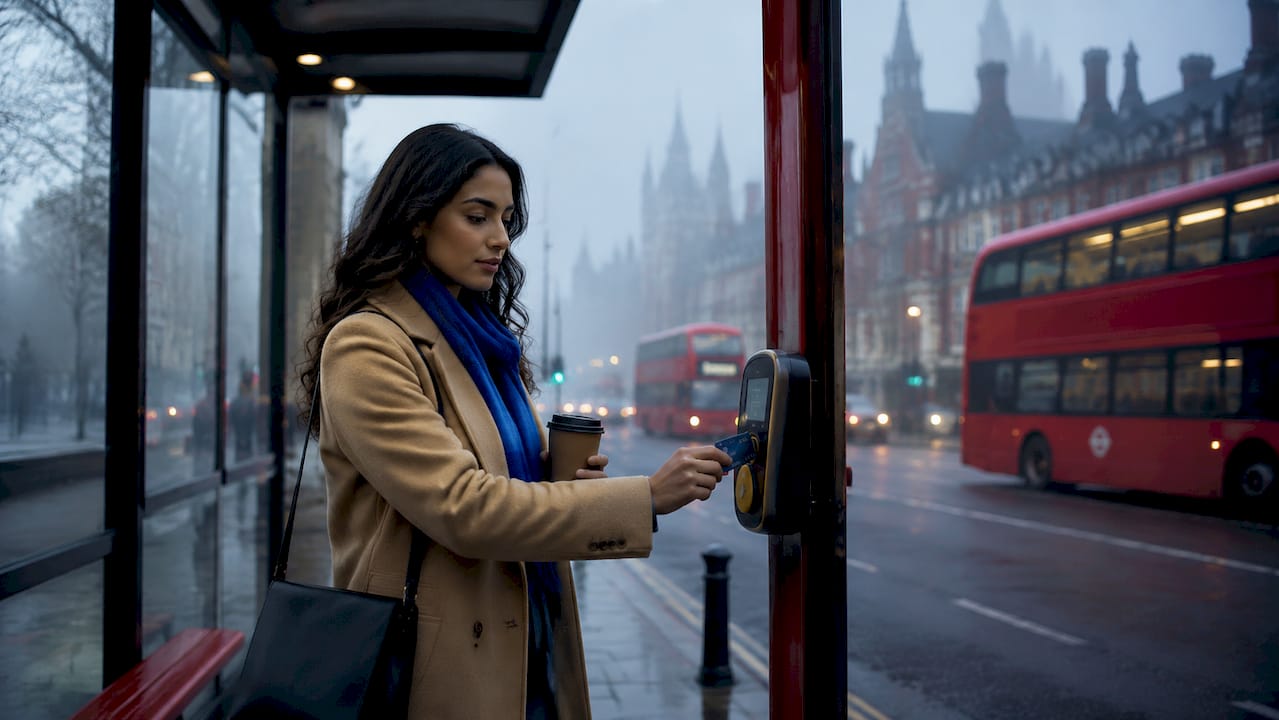
On underground and rail services, you must tap your card or device on the yellow reader when you enter the station and again when you exit. Both taps are required for accurate fare calculation. Even when barriers are open, you must still tap in and tap out. Skipping either tap results in a maximum fare charge for that journey, which is significantly higher than the correct fare.
The process is straightforward:
- Tap your card or device on the yellow reader at the entry barrier
- Walk through and board your train
- Tap the same card or device on the yellow reader at the exit barrier when you arrive
The Elizabeth line, which runs from Reading and Heathrow in the west to Shenfield and Abbey Wood in the east, follows the same tap in and tap out process. The DLR and London Overground work identically.
Using contactless on buses and trams
Buses and trams require one tap only. Tap your card or device on the reader when you board. There is no tap out. Tapping out on a bus or tram triggers an additional charge, which is one of the most common and avoidable mistakes visitors make.
Contactless in London shops and restaurants
Beyond transport, contactless payment is accepted at the vast majority of London’s retail and hospitality venues. Restaurants like Dishoom Covent Garden and Borough Market Kitchen accept contactless at the till. Most street food stalls, museum gift shops, and theatre box offices do too. If a venue accepts card payments, it almost certainly accepts contactless.
Pro Tip: Always carry a physical contactless card as a backup. Mobile wallets rely on battery power and a working phone. A dead phone at a Tube gate is a genuine inconvenience.
Contactless versus Oyster card: which is better for visitors?
The Oyster card is TfL’s own prepaid travel card, loaded with credit or a Travelcard. Contactless bank cards and mobile wallets offer an alternative that TfL recommends as the simplest option for most adult travellers. The right choice depends on your trip length, travel style, and bank.
| Feature | Contactless bank card | Oyster card |
|---|---|---|
| Setup required | None | Purchase and top up |
| Fare capping | Automatic daily and weekly | Automatic daily and weekly |
| Child and young visitor discounts | Not available | Available |
| Foreign transaction fees | Possible (1–3%) | None |
| Refund if unused | Automatic | Requires manual claim |
| Travelcard option | No | Yes |
Contactless wins on convenience. You use the card already in your wallet, with no queuing at a ticket machine and no minimum top-up. Fare capping applies automatically, so you never pay more than the daily or weekly maximum regardless of how many journeys you make.
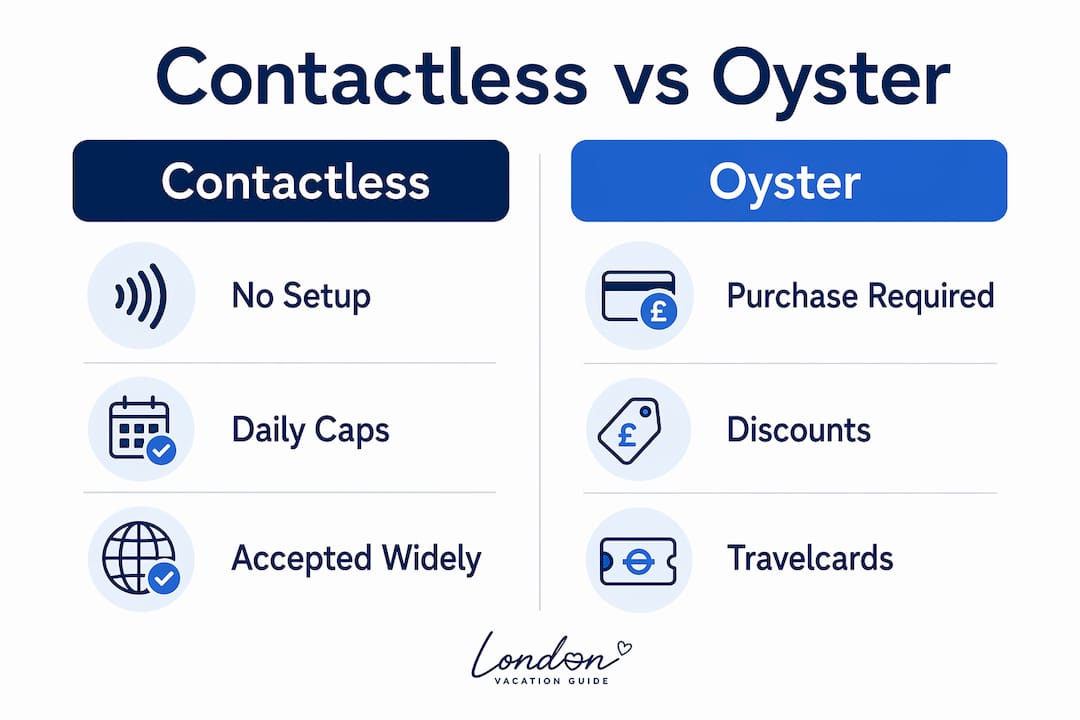
The Oyster card wins on discounts. Special fares like Young Visitor discounts are only available on Oyster, not on contactless. If you are travelling with children aged 11 to 15, an Oyster card is the better choice because it unlocks reduced child fares that contactless cannot access.
Pro Tip: If your bank charges foreign transaction fees, check whether those fees would exceed the cost of buying and loading an Oyster card before you travel. For a week of heavy sightseeing, the maths can favour Oyster.
Fare capping, charges, and how to avoid paying too much
Fare capping is the mechanism that limits how much you pay per day and per week when using contactless on TfL. It works automatically. You do not need to register or activate anything.
The daily fare cap for Zone 1 in 2026 is £8.90 for adult contactless payments. The weekly cap for Zone 1 is £44.70, running from monday to sunday. Once your taps reach the cap, all further journeys within that zone that day or week are free. Caps apply per card or device, not per person.
The most common mistakes that trigger extra charges
Visitors overpay on TfL for a small number of predictable reasons. Knowing them in advance costs nothing and saves real money.
- Switching cards or devices mid-day. Using different cards or switching between a physical card and a digital wallet during the same day breaks journey continuity. TfL treats each card or device as a separate account. Your fare cap resets, and you may be charged maximum fares on the second card.
- Forgetting to tap out at Tube or rail stations. Missing the exit tap results in a maximum fare charge. TfL calculates the longest possible journey from your entry point and charges accordingly.
- Tapping out on a bus or tram. Buses and trams charge a flat fare on entry. A second tap registers as a new journey and adds another charge.
- Using a card that gets declined. Some non-UK bank cards are declined by TfL readers due to fraud protection settings. If your card is declined at a barrier, you may be unable to exit without assistance.
- Ignoring foreign transaction fees. Non-UK cards may incur fees of 1–3% per transaction. Over a week of daily travel, that adds up to a meaningful extra cost.
Pro Tip: Before your trip, call your bank and ask them to note that you will be using your card on London transport. This reduces the risk of fraud blocks triggering a decline at a barrier.
The weekly cap is calculated from monday to sunday, not from your first day of travel. If you arrive on a wednesday, your weekly cap resets the following monday. Plan accordingly if you are visiting across a week boundary.
Practical advice for using contactless payment smoothly in London
Getting the most from contactless payment in London comes down to a few consistent habits. Follow these and you will avoid the charges that catch most visitors out.
- Use one card or device for the entire day. Pick your contactless card or mobile wallet at the start of the day and stick with it for every journey. Mixing payment methods breaks fare capping and can trigger maximum charges.
- Each traveller needs their own payment method. One card cannot cover multiple passengers. Every person aged 11 and over must tap their own card or device individually.
- Do not tap out on buses or trams. Board, tap once, and sit down. That is the complete process.
- Always tap out at Tube, DLR, Overground, Elizabeth line, and National Rail stations. Even if the barrier is open, tap the reader on your way out.
- Use Apple Pay or Google Pay with confidence. Mobile wallets work identically to physical cards on TfL readers. Hold your phone or watch near the yellow reader until it beeps and shows a green light.
- Check your journey history online. TfL’s website lets you view your contactless payment history by registering your card at tfl.gov.uk. This is useful for spotting any incorrect charges and requesting refunds.
- Confirm your bank’s foreign fee policy before you travel. A quick call or check in your banking app before departure can save you from unexpected charges across a week of sightseeing.
London’s contactless infrastructure extends well beyond transport. Venues like Sketch Gallery in Mayfair and Gordon’s Wine Bar in Covent Garden accept contactless at the bar and the till. Cash is increasingly rare in central London, and contactless is the expected payment method at most venues.
Key takeaways
Contactless payment in London works automatically across TfL’s entire network and most retail venues, provided you use one card or device consistently throughout each travel day.
| Point | Details |
|---|---|
| Tap in and tap out on rail | Always tap both entry and exit on Tube, Overground, DLR, and Elizabeth line to avoid maximum fare charges. |
| Buses and trams: one tap only | Tap once when boarding; never tap out, or you will be charged for a second journey. |
| Daily and weekly fare caps | The Zone 1 daily cap is £8.90 and the weekly cap is £44.70 in 2026, applied automatically per card or device. |
| One payment method per person | Each traveller aged 11 and over must use their own card or device; sharing is not permitted. |
| Check foreign transaction fees | Non-UK cards may incur fees of 1–3% per tap; compare this against the cost of an Oyster card before travelling. |
Why contactless is the smartest choice for most London visitors
Tourists often arrive in London expecting to queue at a ticket machine and load an Oyster card, because that is what travel guides told them to do a decade ago. The reality in 2026 is different. The contactless system has matured to the point where most visitors are better served by simply using the card already in their wallet.
The one mistake I see repeatedly is visitors switching between their physical card and their phone’s digital wallet during the same day, not realising they are effectively using two separate accounts. They end up paying maximum fares on the second device and cannot understand why their bill is so high. The fix is simple: decide before you leave your hotel whether you are using your card or your phone, and do not switch.
For short visits of two to four days, contactless is almost always the right call. You avoid the Oyster card purchase fee, you avoid the top-up queues, and the fare cap protects you from overpaying. For visitors travelling with children aged 11 to 15, an Oyster card is worth the extra step because the child fare savings are genuine and significant.
London’s transport payment infrastructure is genuinely one of the best in the world. The Elizabeth line alone, running from Heathrow directly into the heart of the city, accepts your contactless card the moment you land. That kind of frictionless arrival sets the tone for a visit where payment is never the thing you are thinking about. It should be invisible. With the right preparation, it will be.
— Matt
Plan your London visit with London Vacation Guide
London Vacation Guide has put together a first-time visitor essential guide that covers transport payment, neighbourhood choices, and day-by-day itinerary planning for visitors arriving in the city. If you want to go deeper on saving money in London, the site includes practical advice on fare caps, free attractions, and budget dining across every part of the city. Whether you are planning a long weekend or a two-week stay, London Vacation Guide gives you the local knowledge to spend less time worrying about logistics and more time enjoying the city.
FAQ
Does contactless payment work on all London buses?
Yes. Contactless bank cards, Apple Pay, Google Pay, and compatible wearables are accepted on every TfL bus. Tap once when boarding and do not tap out.
Can I use my foreign bank card on the London Underground?
Most foreign Visa and Mastercard contactless cards work on the Tube. Some cards may be declined due to fraud protection settings, and non-UK cards may incur foreign transaction fees of 1–3% per tap.
What happens if I forget to tap out at a Tube station?
TfL charges you the maximum fare for the longest possible journey from your entry point. You can apply for a refund through your contactless journey history at tfl.gov.uk if the charge was an error.
Is contactless payment safe to use in London?
Yes. NFC payments use encrypted data and do not transmit your card number. TfL’s readers are secure, and standard bank fraud protection applies to all contactless transactions.
Can one contactless card pay for multiple people on the Tube?
No. Each person aged 11 and over must tap their own card or device. One payment method cannot cover multiple passengers on any TfL service.
Recommended
- Tips for visiting london in 2026: your expert guide - The London Journal | London Vacation Guide
- London restaurant tips: your 2026 insider guide - The London Journal | London Vacation Guide
- London for First-Time Visitors: The Essential Guide | London Vacation Guide
- Your essential London travel guide: tips and local experiences - The London Journal | London Vacation Guide