How to plan themed tours in London: a complete guide

A themed tour is a curated sightseeing experience built around one clear narrative, transforming a list of London landmarks into a coherent, memorable story. Knowing how to plan themed tours in London gives you a powerful advantage over standard sightseeing: every stop earns its place, every story connects, and guests leave with something they could not have found on a generic bus tour. Whether you are drawn to the literary haunts of Charles Dickens in Bloomsbury, the detective trails of Sherlock Holmes in Marylebone, or the street art of Shoreditch, the method for building a great themed tour is the same. This guide walks you through theme selection, itinerary building, pacing, and execution.
How to plan themed tours in London: choosing the right theme
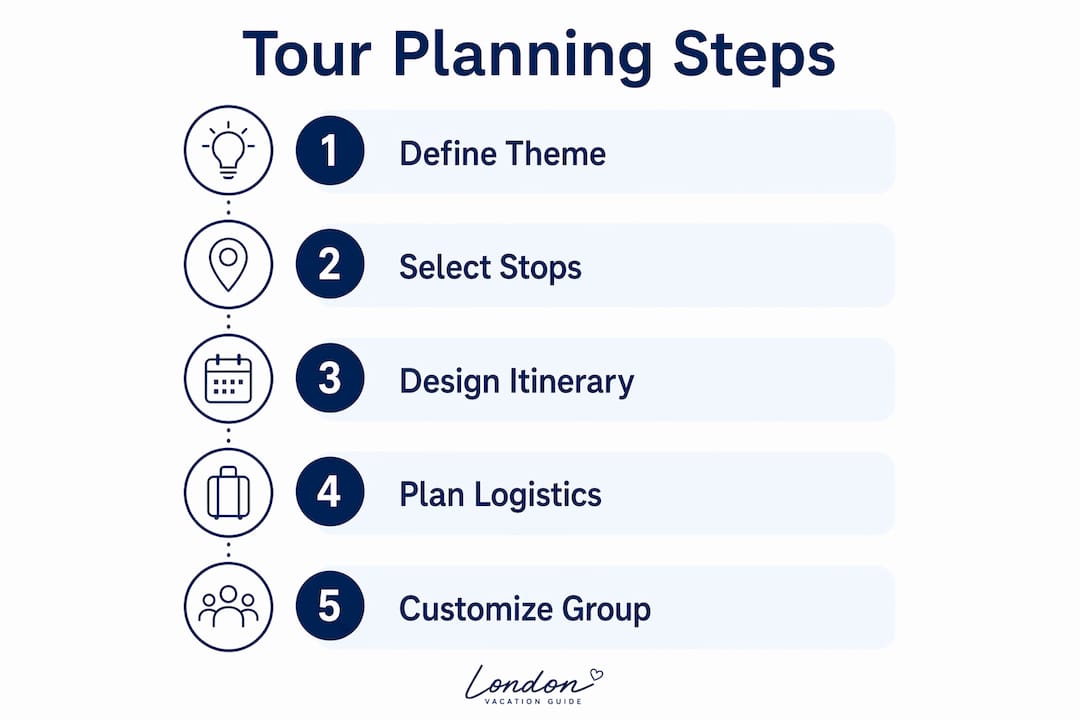
The single most important decision in planning themed tours in London is selecting a theme that is specific enough to guide every choice you make. A strong theme should be expressible in one sentence that answers the question: “Why are we exploring this today?” That constraint is a feature, not a limitation.
What makes a theme strong?
A strong theme does three things at once. It filters your stops, it shapes your stories, and it creates an emotional throughline that guests feel from the first location to the last. Weak themes fail because they try to do too much. “Victorian London” is too broad. “How Victorian poverty shaped the East End” is a theme you can build a tour around.
The theme should constrain choices, not expand them. Every stop you consider should pass a simple test: does it serve the theme directly? If the answer is uncertain, leave it out.
Here are the criteria that separate a strong London tour theme from a vague one:
- Specificity: “The women who shaped Georgian London” beats “Georgian history.”
- Emotional hook: Themes rooted in mystery, injustice, ambition, or romance hold attention better than purely factual ones.
- Narrative arc: The theme should have a beginning, a middle, and a resolution. Dickens’ rise from a blacking factory in Holborn to literary fame in Doughty Street is a story. “Places Dickens visited” is not.
- Local authenticity: The theme must be genuinely rooted in London. Avoid themes that could apply to any major city.
- Audience fit: A Sherlock Holmes detective trail works brilliantly for adults and older children. A royal pageantry tour suits families and first-time visitors. Match the theme to who is walking with you.
Pro Tip: Write your theme as a single sentence before you plan a single stop. If you cannot summarise it in one sentence, the theme is not ready yet.
London offers exceptional raw material for themed tours. Popular categories include literary walks, detective and mystery trails, street art tours, food and drink experiences, and royal tradition explorations. The city’s density of history and culture means almost any specific angle has enough material for a two to three hour walk.
How do you build a themed tour itinerary in London?
Once your theme is locked, itinerary building follows a clear structure. The goal is not to visit as many places as possible. The goal is to create an experience with emotional rhythm, sensory richness, and enough breathing room to let the story land.

The three-layer itinerary framework
Effective themed tour itineraries work on three layers simultaneously. The emotional layer sets the tone and mood at each stop. The operational layer covers timing, transport, and safety. The sensory layer anchors the experience in specific details: the smell of a Victorian market, the sound of a church bell, the taste of a pie from a Bermondsey bakery. All three must align for the tour to feel immersive rather than instructional.
Here is a practical framework for structuring your themed tour itinerary in London:
- Open with impact. Your first stop sets the emotional contract with your guests. Choose a location that immediately signals the theme. A Sherlock Holmes tour might open at 221B Baker Street. A Dickens tour might begin outside the site of the Marshalsea Prison in Southwark.
- Build to a climax. Place your most dramatic or visually striking stop roughly two thirds of the way through. This is the emotional peak guests will photograph and remember.
- Include a mellow middle section. After the opening energy, slow the pace with a quieter stop or a short walk through a characterful street. This prevents fatigue and lets earlier information settle.
- Add a sensory anchor. Build in at least one moment that engages a sense beyond sight. A food stop, a piece of live music, or a tactile object creates a memory hook that outlasts facts.
- Close with meaning. Your final stop should feel like a resolution, not just a last location. Bookend stops greatly influence guests’ lasting impression of the whole experience. Choose a closing location that echoes your opening theme and gives guests a sense of completion.
Pro Tip: Design your first and last stops before you plan anything in between. These two moments define the emotional shape of the entire tour.
Pacing, duration, and logistics
Limiting your itinerary to 2–3 major experiences per day prevents the rushed, scattered feeling that kills guest engagement. For a standard themed walking tour in London, 2–3 hours is the standard duration, with pricing around £25 per person for group walks. Private or specialist tours, such as a Sherlock Holmes group walk, typically cost more but offer exclusive guide attention and tailored storytelling.
Build flexible time slots into every itinerary to accommodate weather changes, group pace variation, and unexpected discoveries. London’s weather is famously unpredictable, and a rigid schedule will frustrate both you and your guests.
| Element | Recommendation | Why it matters |
|---|---|---|
| Duration | 2–3 hours | Maintains energy without exhausting guests |
| Major stops | 4–6 locations | Enough depth without rushing |
| Flexible buffer | 15–20 minutes | Absorbs delays and spontaneous moments |
| Transport mode | Aligned with theme | A black cab suits a 1920s mystery; walking suits a literary trail |
| Start and end points | Near transport links | Reduces logistical stress for guests |
Transport choice is an underrated part of themed tour planning. A tour themed around royal London fits naturally with a walk through St James’s Park and past Buckingham Palace. A noir mystery tour of the City of London might use the Underground between stops to heighten atmosphere. A food tour of Borough Market and Bermondsey works entirely on foot. Let the theme guide the mode of travel.
What are the best themed tour ideas in London?
London’s neighbourhoods are the building blocks of great themed tours. Each area carries its own character, history, and cast of characters. The best themed tour ideas in London use a specific neighbourhood as a lens rather than trying to cover the whole city.
Here is a comparison of popular themed tour categories, with suggested routes and audiences:
| Theme | Suggested route | Key highlights | Best for |
|---|---|---|---|
| Literary London | Bloomsbury to Clerkenwell | British Museum, Dickens Museum, Doughty Street | Book lovers, adults |
| Sherlock Holmes detective trail | Marylebone to the City | Baker Street, Criterion Bar, Barts Hospital | Mystery fans, families |
| Harry Potter filming locations | King’s Cross to Leadenhall Market | Platform 9¾, Diagon Alley, Gringotts Bank | Families, film fans |
| East London street art | Shoreditch to Brick Lane | Banksy works, Brick Lane murals, Spitalfields | Art lovers, young adults |
| Royal pageantry | Westminster to St James’s | Buckingham Palace, Horse Guards, Westminster Abbey | First-time visitors, families |
| Food and drink | Borough Market to Bermondsey | Market tastings, Maltby Street, local breweries | Foodies, groups |
Customising your themed tour for different groups
Families with children need shorter walking distances, more interactive stops, and at least one food moment. A Harry Potter tour works well because the filming locations are visually dramatic and widely spaced across central London, making each stop feel like a new discovery. For solo travellers or enthusiasts, a literary London walk through Bloomsbury rewards depth: the British Library, the Dickens Museum on Doughty Street, and the Bloomsbury Group’s Gordon Square all sit within a short walk of each other.
Food tours are among the most flexible themed tour ideas in London because they work for almost any group type. Borough Market is the obvious anchor, but pairing it with a stop at local dining experiences in Bermondsey or Maltby Street Market adds a less touristy dimension that guests genuinely appreciate.
- For enthusiasts: Go deep on one subject. A Dickens tour that visits the Marshalsea site, Doughty Street, and the Old Curiosity Shop on Portsmouth Street rewards genuine fans.
- For first-time visitors: Combine a light thematic frame with iconic locations. A royal London walk that passes Buckingham Palace, St James’s Park, and the Changing of the Guard gives context without overwhelming.
- For groups: Build in a shared meal or tasting. Food creates conversation and slows the pace naturally.
- For families: Keep walking distances under two miles and include at least one hands-on or interactive element.
Pro Tip: Use neighbourhood guides for Bloomsbury, Victoria, and London Bridge to identify thematic stops that locals actually use, not just the ones that appear on tourist maps.
What are the most common mistakes when organising themed tours?
The biggest mistake in organising themed tours is treating the itinerary as a list of locations rather than an emotionally coherent experience. Guests do not remember facts. They remember how a place made them feel. If your tour is a sequence of “and then we go here” moments, it will not stick.
Here are the most common pitfalls and how to avoid them:
- Overloading the itinerary. Ten stops in three hours means no stop gets the attention it deserves. Cut ruthlessly and go deeper on fewer locations.
- A theme that is too broad. “London history” is not a theme. “The women who ran London’s underground resistance during the Blitz” is a theme. Specificity creates engagement.
- Ignoring guest energy levels. Plan for the group to be tired by the two hour mark. Build your most important stop before that point, not after.
- No contingency for weather. London rain is not a surprise. Have an indoor alternative for at least two stops on every itinerary.
- Neglecting the narrative. Each stop should connect to the next with a sentence or two of storytelling. Without that thread, the tour feels like a walk between unrelated places.
- Skipping guest feedback. After each tour, ask two questions: what was the highlight, and what felt slow? Iterate based on real responses, not assumptions.
Pro Tip: Keep one surprise element off the published itinerary. A spontaneous stop at a hidden courtyard, a local artisan’s workshop, or an unexpected unannounced moment creates the kind of memory guests talk about for years.
Venue availability is a practical issue that catches many first-time tour organisers off guard. The Dickens Museum on Doughty Street requires booking in advance. The Sherlock Holmes Museum on Baker Street has queues that can disrupt timing. Always confirm opening hours and access conditions before finalising any stop.
Key takeaways
The most effective themed tours in London are built on a single, specific narrative that filters every stop, shapes every story, and creates a clear emotional arc from opening to close.
| Point | Details |
|---|---|
| Define your theme first | Write it in one sentence before planning any stops; vague themes produce scattered tours. |
| Limit major stops | Stick to 4–6 locations over 2–3 hours to maintain depth and prevent guest fatigue. |
| Design bookend stops | Your first and last locations shape the lasting impression more than anything in between. |
| Build in flexibility | Reserve 15–20 minutes of buffer time to absorb weather, pace variation, and surprises. |
| Add a sensory anchor | Include one moment that engages taste, sound, or touch to create a lasting memory hook. |
Why the best themed tours feel like stories, not schedules
I have spent years exploring London on foot, and the tours that stay with me share one quality: they made me feel something. Not the ones with the most facts, not the ones with the most stops, but the ones where every location felt chosen with intention.
The temptation when planning a themed tour is to add more. More stops, more history, more context. Resist it. A Dickens tour that lingers in the courtyard of Gray’s Inn and tells one story well is more powerful than a tour that races through twelve locations in two hours. The emotional and sensory layers of a well-designed itinerary are what separate a memorable experience from a forgettable one.
I also think the host’s personality matters more than most guides admit. You can have a perfect itinerary and still lose your audience if the delivery is flat. The best themed tours I have been on were led by people who genuinely loved their subject. That enthusiasm is contagious and it cannot be scripted.
My honest advice: pick a theme you care about. London has enough material for a lifetime of themed tours, and your genuine interest in the subject will come through in every stop you choose and every story you tell. Do not plan a food tour because food tours are popular. Plan one because you know Borough Market at 8am on a Saturday and you want to share that with someone.
— Matt
Plan your London themed tour with London Vacation Guide
London Vacation Guide has the local knowledge to make your themed tour planning faster and more rewarding. The first-time visitors guide covers curated itineraries across central London, with neighbourhood-level detail that helps you identify the right stops for your theme. For royal and ceremonial themes, the Victoria neighbourhood guide maps the key landmarks and timing tips around Westminster. For literary and cultural tours, the Bloomsbury neighbourhood guide is the most detailed resource available for that part of the city. Browse the full London itineraries section to find themed routes you can adapt or use as inspiration for your own.
FAQ
What is a themed tour in London?
A themed tour is a curated sightseeing experience built around one clear narrative or subject, such as literary history, detective fiction, or royal tradition. Every stop and story connects to that central theme rather than covering general sightseeing.
How long should a themed walking tour in London be?
Most guided themed tours in London last 2–3 hours and cover 4–6 major stops. This duration maintains guest energy and allows enough depth at each location without rushing.
How much does a themed tour in London cost?
Group walking tours typically cost around £25 per person. Private or specialist tours, such as a Sherlock Holmes themed walk with exclusive guide access, cost more but offer a personalised experience.
How do I choose a theme for a London tour?
Choose a theme you can express in one sentence that answers why guests are exploring this subject today. Specific themes, such as “the East End’s immigrant food culture” or “Dickens’ London from poverty to fame,” produce stronger tours than broad ones like “London history.”
Can I plan a themed tour in London without a professional guide?
Yes. Using neighbourhood guides, local knowledge resources, and a clear itinerary framework, you can plan your own route around any theme. Focus on limiting stops, building in flexibility, and designing strong opening and closing locations.
Recommended
- London for First-Time Visitors: The Essential Guide | London Vacation Guide
- London Itineraries: Plan Your Perfect Trip | London Vacation Guide
- Plan your perfect London vacation: tips for US visitors - The London Journal | London Vacation Guide
- Your essential London travel guide: tips and local experiences - The London Journal | London Vacation Guide