What is Buckingham Palace: a complete visitor’s guide
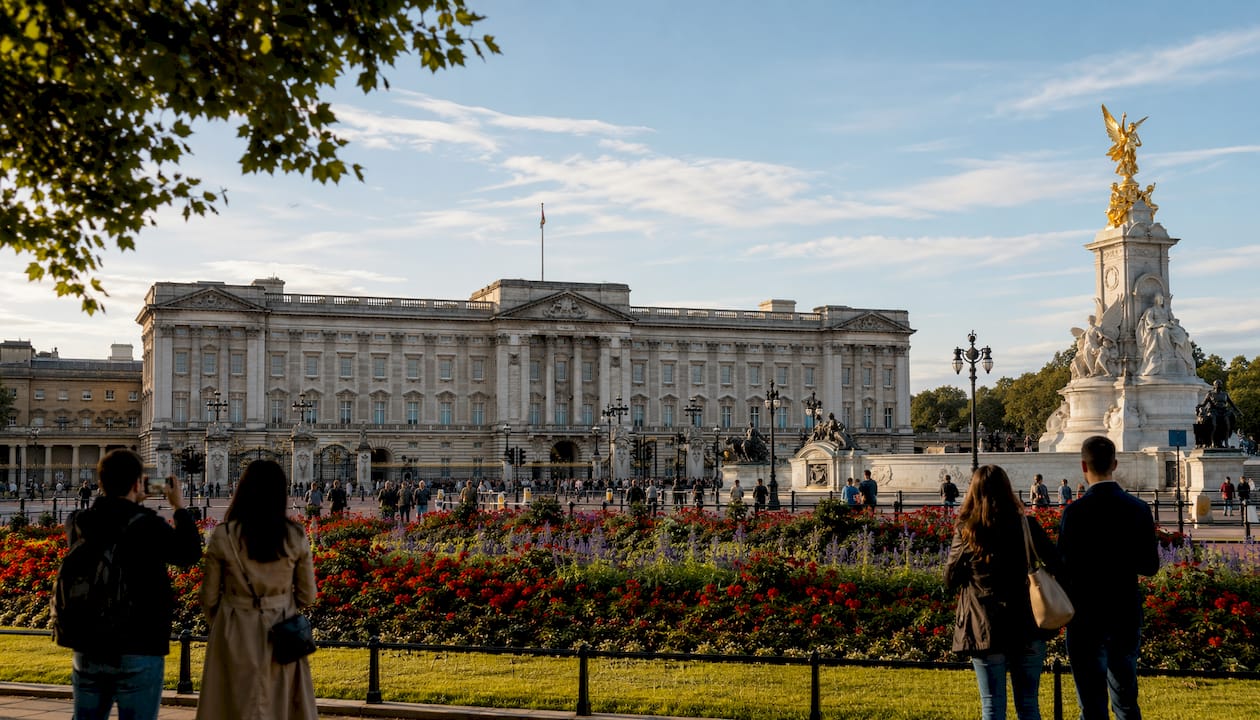
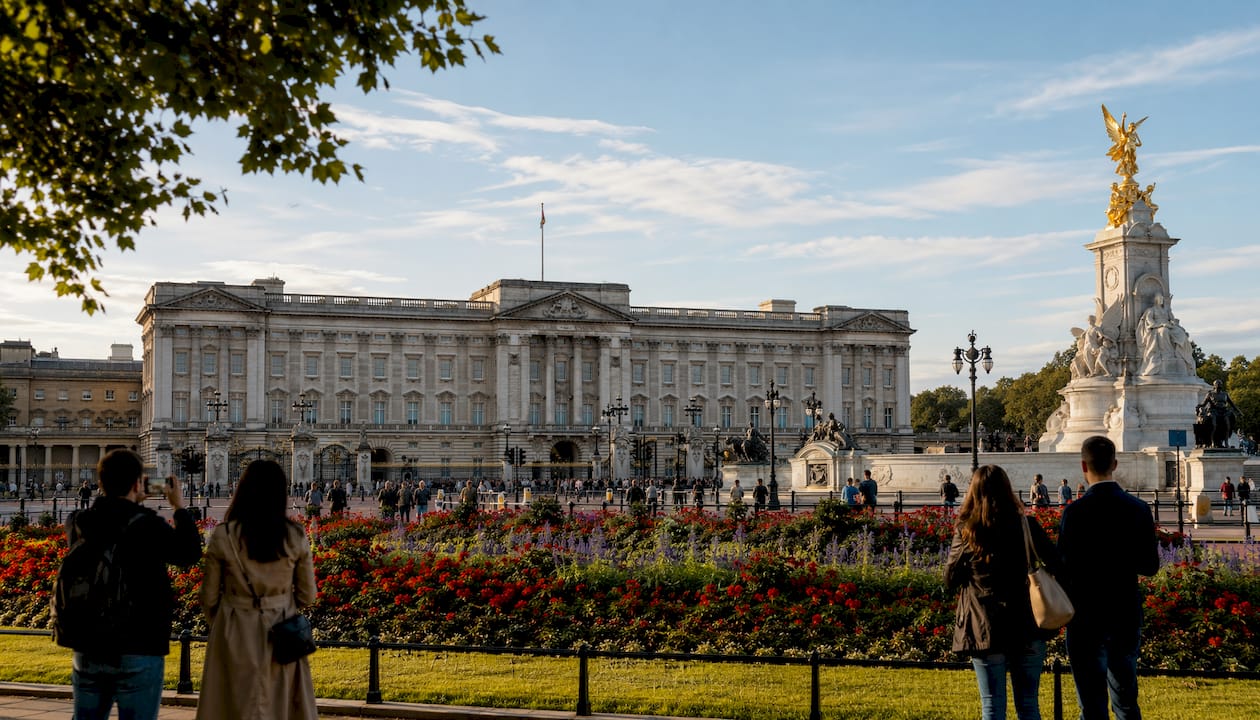
Buckingham Palace is the official London residence and administrative headquarters of the UK’s sovereign, making it both a working royal home and the nerve centre of the British monarchy. It contains 775 rooms, including 19 State Rooms used for ceremonies and official entertaining, and has held that official status since Queen Victoria moved in during 1837. King Charles III uses it today for state audiences, investitures, and formal duties. As for getting inside: yes, you can visit the State Rooms, though access is seasonal. The Royal Collection Trust opens them to the public each summer, typically from late July through September, with limited additional dates at Easter and winter.
Table of Contents
- Key Buckingham Palace facts at a glance
- How did Buckingham Palace get its name and shape?
- What’s inside? The State Rooms and principal interiors
- What does Buckingham Palace actually do today?
- What is the Changing of the Guard and when does it happen?
- Can you go inside Buckingham Palace?
- Where is Buckingham Palace and how do you get there?
- Why does Buckingham Palace matter beyond the tourist trail?
- Key takeaways
- A local perspective on visiting Buckingham Palace
- Plan your Buckingham Palace visit with London Vacation Guide
- Useful sources and further reading
- FAQ
Key Buckingham Palace facts at a glance
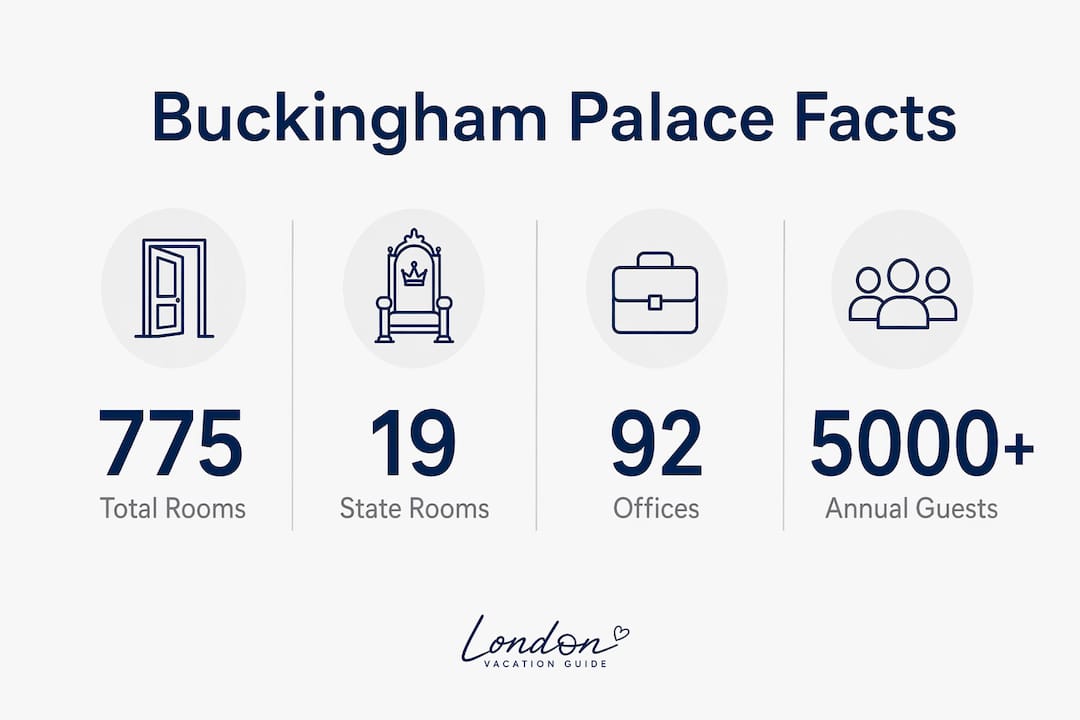
A few numbers tell the story faster than paragraphs can.
- Official residence since: 1837 (Queen Victoria was the first monarch to use it as such)
- Original name: Buckingham House, built in 1703
- Total rooms: 775
- State Rooms open to visitors: 19
- Annual invited guests: approximately 50,000, attending garden parties, receptions, banquets and audiences
- Gardens: 39 acres, one of London’s largest private gardens
| Category | Figure |
|---|---|
| Total rooms | 775 |
| State Rooms | 19 |
| Offices | 92 |
| Annual invited guests | ~50,000 |
| Garden size | 39 acres |
The scale is genuinely surprising. Most visitors picture a grand façade and a few ceremonial halls. The reality is closer to a small town: the palace runs its own post office, doctor’s surgery, cinema, and swimming pool entirely within its walls.
How did Buckingham Palace get its name and shape?
The building’s history spans more than three centuries, and understanding it explains why the palace looks the way it does today: grand from the front, oddly domestic in places, and layered with the decisions of several monarchs and architects.
1703: Buckingham House
The original structure was built in 1703 for the Duke of Buckingham as a large private townhouse. It was never intended as a royal residence. George III purchased it in 1761 as a private retreat for Queen Charlotte, and it became known informally as the Queen’s House. At this stage it was still a relatively modest building by royal standards.
The 1820s: John Nash transforms everything
The decisive change came under George IV, who commissioned John Nash in the 1820s to convert the house into a proper palace. Nash’s remodelling was ambitious: he created the U-shaped plan, added the Marble Arch as a ceremonial entrance, and gave the building the scale and grandeur befitting a royal seat. His scheme was later altered significantly. Edward Blore took over after Nash was dismissed, closing the open courtyard with a new east wing and adding the central balcony that millions now associate with royal appearances.
1837: Queen Victoria makes it official
Queen Victoria was the first sovereign to use Buckingham Palace as the official London residence on her accession in 1837. She oversaw further expansions, including the removal of the Marble Arch to its current position at the north-east corner of Hyde Park, to make room for additional wings.
The 20th century and beyond
During the Second World War, the palace was hit by German bombs on multiple occasions, including a direct strike on the chapel. The damage was eventually repaired, but the events cemented the palace’s symbolic role: King George VI and Queen Elizabeth’s decision to remain in London during the Blitz made the building a focus of national resilience. In the late 20th and early 21st centuries, the palace became a gathering point for public mourning and celebration alike, from the death of Diana, Princess of Wales in 1997 to the late Queen Elizabeth II’s Platinum Jubilee in 2022.
What’s inside? The State Rooms and principal interiors
The 19 State Rooms are the heart of any visit. They are not simply decorative: these rooms are used for state banquets, investitures, and official receptions throughout the year, which means the furniture, paintings, and objects you see are working parts of the British state.
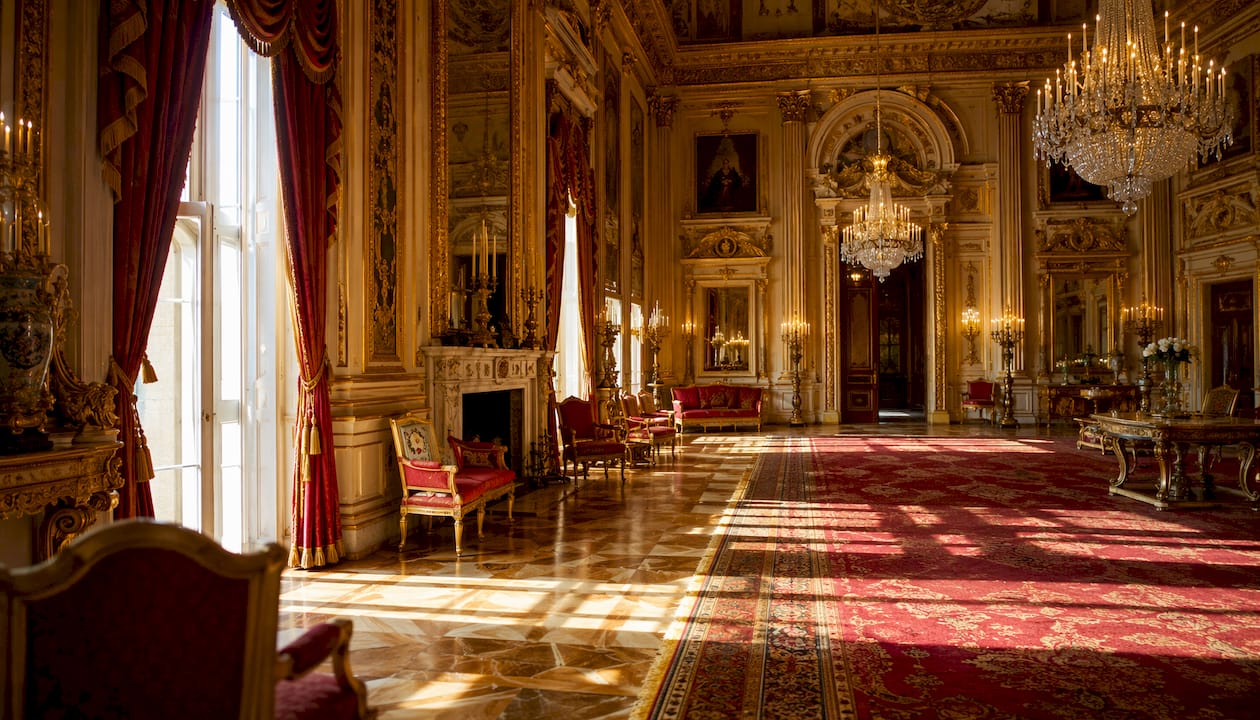
The Throne Room
The Throne Room is where the official portraits of the sovereign are taken and where certain formal ceremonies begin. The two thrones used by the late Queen Elizabeth II and Prince Philip remain on display, set beneath a crimson canopy. The room’s gilded plasterwork and painted ceiling date from the Nash era.
The Ballroom
At roughly 37 metres long, the Ballroom is the largest room in the palace. It was added by Queen Victoria in 1856 and is used today for state banquets and investitures. When King Charles III hosts a visiting head of state, this is where the formal dinner takes place.
The Picture Gallery
Running the full length of the central block, the Picture Gallery holds one of the finest collections of Old Master paintings in the world. Works by Rembrandt, Rubens, and Vermeer hang here as part of the Royal Collection, which is held in trust for the nation by the Royal Collection Trust. Visitors can see these paintings up close during the summer opening.
The Grand Staircase
The Grand Staircase, designed by Nash, sets the tone for the State Rooms. Its gilded balustrade and painted ceiling signal immediately that you have moved from the entrance into the ceremonial heart of the building.
The Music Room
The Music Room, with its domed ceiling and Regency-era decoration, has been the setting for royal christenings for generations, including those of King Charles III and Prince William.
The Palace Garden
The 39-acre garden behind the palace is one of the largest private gardens in London. It contains a lake, a tennis court, and a helicopter landing pad. During the summer opening, visitors walk through part of the garden as part of the tour route, which gives a rare view of the palace’s rear façade.
Notable highlights visitors ask about most:
- The two thrones in the Throne Room (used for official portraits)
- Rembrandt’s The Shipbuilder and His Wife in the Picture Gallery
- The Grand Staircase’s gilded Nash balustrade
- The Bow Room, which opens directly onto the garden
- The official balcony on the east façade (viewed from outside only)
- The Marble Arch, originally the palace’s ceremonial gate, now at Hyde Park
- The ornamental lake in the palace garden
- The Blue Drawing Room’s Regency-era columns
Pro Tip: The Royal Collection Trust’s website offers detailed room descriptions and high-resolution images of the State Rooms at rct.uk — worth browsing before your visit so you know what to look for in each space.
What does Buckingham Palace actually do today?
The Royal Household describes the palace as a functional working building, and that description is not diplomatic understatement. On any given working day, the palace hosts official audiences, processes correspondence, and coordinates the administrative machinery of the monarchy.
King Charles III uses the palace for:
- State Banquets: formal dinners for visiting heads of state, held in the Ballroom
- Audiences with the Prime Minister: regular private meetings between the sovereign and the Prime Minister
- Investitures: ceremonies at which honours such as MBEs and CBEs are formally conferred
- Garden parties: the palace hosts several each summer, with around 8,000 guests per party
- Receptions and diplomatic entertaining: for foreign dignitaries, charities, and public figures
The ~50,000 invited guests who pass through the palace each year are a useful measure of its operational scale. Behind the scenes, hundreds of staff work in the palace’s 92 offices, supported by facilities that include a doctor’s surgery, a cinema, a jeweller’s workshop, and a post office.
One detail that surprises most visitors: the Royal Standard flying above the palace tells you whether the sovereign is actually in residence. When the flag is up, the King is home. When the Union Flag flies instead, the palace is being used administratively but the King is elsewhere. It is a simple, centuries-old signal that still works.
What is the Changing of the Guard and when does it happen?
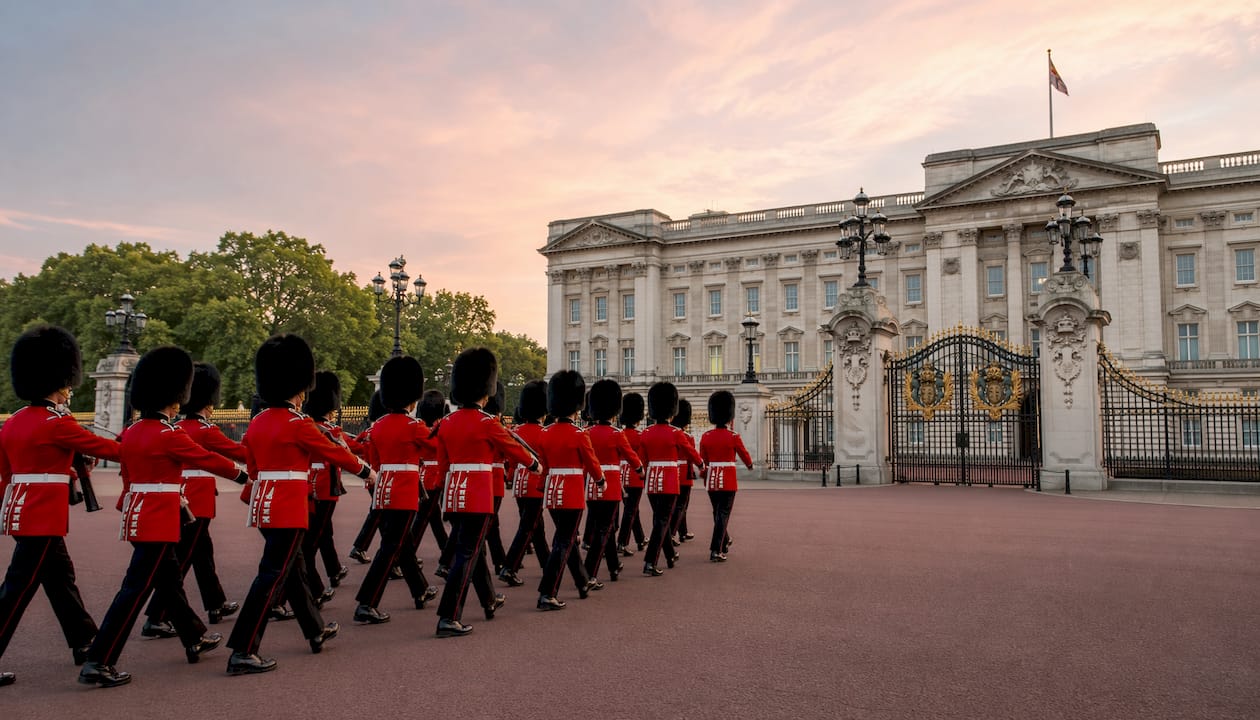
The Changing of the Guard is a formal military ceremony, not a tourist performance. It marks the handover of responsibility for guarding Buckingham Palace from one unit of the Household Division to another, following protocols that have been in place for centuries.
The typical schedule runs as follows:
- April/May through July: daily, usually starting around 11:00 AM
- Rest of the year: every other day, subject to change
- Duration: approximately 45 minutes
Schedules change without much notice due to state events, bad weather, or operational requirements. Always check the official Royal Household website before you go.
How to watch it well:
- Arrive at least 45 minutes early. The forecourt fills up fast, and latecomers end up watching from behind several rows of heads.
- The best free vantage points are along the palace railings on the forecourt side and on the steps of the Victoria Memorial directly opposite the main gates.
- Photography is fine from public areas, but stay behind barriers and do not attempt to interact with the guards.
- The procession also passes along The Mall from St James’s Palace, so you can catch part of the ceremony there with a shorter walk from Green Park Tube.
- Check the official schedule at royal.uk before your visit — it is updated regularly and lists any cancellations.
Pro Tip: The view from the Victoria Memorial gives you an elevated angle over the forecourt that the railings simply cannot match. Get there early, stand on the steps, and you will see the full ceremony without craning over anyone.
Can you go inside Buckingham Palace?
Yes, though access is limited. The State Rooms open to the public each summer, typically from late July through late September, and for shorter periods at Easter and occasionally in winter. Outside these windows, the interior is not open to general visitors.
Booking tickets
Buy directly through the Royal Collection Trust at rct.uk. Third-party sellers do resell official tickets, but booking through the RCT directly avoids any markup and guarantees you are buying a genuine ticket. Timed entry slots sell out weeks in advance during peak summer, so book early.
What to expect on a visit
- Duration: allow around two hours for the State Rooms tour; longer if you add the garden
- Photography: not permitted inside the State Rooms
- Cloakroom: bags must be left in the cloakroom before entering
- Audio guide: included in the ticket price; available in multiple languages
- Children: under-fives enter free; family tickets are available
Accessibility
The palace offers level access to most State Rooms, hearing loops, and large-print guides. Wheelchair users and visitors with mobility needs should check the RCT’s accessibility page when booking, as some areas involve steps.
Security
Expect airport-style security screening at the entrance. Prohibited items include large bags, food and drink, and selfie sticks. Allow extra time at the gate.
The Queen’s Gallery and Royal Mews
Two associated attractions sit within the palace estate and are open year-round:
- The Queen’s Gallery (entrance on Buckingham Palace Road): rotating exhibitions drawn from the Royal Collection, with works that rarely appear elsewhere. Open most of the year except during State Rooms opening periods.
- The Royal Mews (also on Buckingham Palace Road): the working stables and carriage house, home to the Gold State Coach used at coronations. One of the most underrated visits in central London.
Pro Tip: If the State Rooms are sold out or outside the summer window, the Royal Mews is open for much of the year and gives you a genuine behind-the-scenes look at the palace’s operational side. The Gold State Coach alone is worth the trip.
Where is Buckingham Palace and how do you get there?
The palace sits at the western end of St James’s Park in the City of Westminster, roughly equidistant between Victoria and Green Park Tube stations. It is about a ten-minute walk from either.
Getting there:
- Tube: Victoria line or Circle/District line to Victoria (5–7 min walk); Jubilee/Victoria/Piccadilly lines to Green Park (8–10 min walk)
- Bus: routes 11, 211, and C1 stop near the palace; route 38 stops at Hyde Park Corner
- Cycling: Santander Cycles docking stations are available on Buckingham Palace Road and near St James’s Park
- Walking: a 15-minute walk from Westminster Bridge; 20 minutes from Trafalgar Square along The Mall
A half-day itinerary around the palace
The palace sits at the centre of one of London’s most walkable clusters of landmarks. A half-day works well if you are not going inside.
- 9:30 AM: Arrive at Green Park Tube; walk through Green Park to the palace
- 10:00 AM: Watch the Changing of the Guard from the Victoria Memorial (check schedule first)
- 11:00 AM: Walk through St James’s Park along the lake towards Westminster
- 12:00 PM: Visit Westminster Abbey or the Houses of Parliament
- 1:00 PM: Lunch near Victoria or along Victoria Street
If you are visiting the State Rooms, block out the full morning and add the Royal Mews or Queen’s Gallery in the afternoon.
Where to stay nearby
The Victoria neighbourhood is the most convenient base, with direct Tube access and a wide range of hotels at every price point. Belgravia, immediately to the south-west, is quieter and more residential. Westminster itself has several well-placed hotels within walking distance of the palace. For a broader look at accommodation options across the city, the London accommodations guide covers every budget and neighbourhood in detail.
Why does Buckingham Palace matter beyond the tourist trail?
Buckingham Palace is both the working centre of the British state and the country’s most recognisable symbol of national continuity. That dual identity is what makes it unusual among royal residences worldwide.
Constitutionally, the palace is where the formal machinery of the monarchy operates. Audiences with the Prime Minister, the swearing-in of new governments, and the formal reception of foreign heads of state all take place here. The building is not a museum of past power; it is where current power is exercised in its ceremonial form.
Culturally, the palace functions as a focal point for national feeling in a way that few buildings anywhere manage. The crowd that gathered outside after the death of Diana, Princess of Wales in 1997, the jubilee celebrations that filled The Mall in 2002, 2012, and 2022, and the public vigil following the death of Queen Elizabeth II in September 2022 all centred on this building. People come here when something matters.
The architectural history reinforces that point. John Nash’s transformation of a private townhouse into a ceremonial palace was a deliberate act of nation-building under George IV. The layered look that architectural historians note — domestic scale in places, grand in others — reflects three centuries of monarchs adapting the building to their needs. It was never built as a monument. It became one.
The Royal Household consistently emphasises this working character, and it is the right frame. Visitors who approach the palace as a living institution rather than a historic relic tend to get far more from the experience.
Key takeaways
Buckingham Palace is the official London residence and administrative headquarters of the British sovereign, open to visitors during the summer State Rooms season and associated with major national ceremonies throughout the year.
| Point | Details |
|---|---|
| Official residence since 1837 | Queen Victoria was the first monarch to use the palace as the official London residence. |
| 775 rooms, 19 open to visitors | The palace contains 775 rooms in total; the 19 State Rooms are accessible during the summer opening. |
| Changing of the Guard | The ceremony runs daily from April/May through July and every other day for the rest of the year; check the official schedule before visiting. |
| ~50,000 guests per year | The palace hosts around 50,000 invited guests annually at banquets, garden parties, investitures, and receptions. |
| London Vacation Guide | For practical planning advice, itineraries, and neighbourhood guides near the palace, London Vacation Guide covers the full Westminster area. |
A local perspective on visiting Buckingham Palace
Most people see the palace from the forecourt and leave. That is fine, but it misses the best view in the area. St James’s Park, directly behind the Victoria Memorial, offers a perspective that the forecourt simply cannot give you: a long diagonal sightline across the lake with the palace in the background, particularly good in the early morning when the light hits the east façade cleanly and the crowds have not yet arrived.
The summer State Rooms opening is genuinely worth doing if you are in London between late July and late September. The Picture Gallery alone justifies the ticket price. But if your dates do not align, the Royal Mews is open for much of the year and is consistently underrated. Most visitors walk straight past it on Buckingham Palace Road without realising what is inside.
Pro Tip: For the quietest photos of the palace exterior, arrive before 8:30 AM on a weekday. The forecourt is almost empty, the light is good, and you can take your time. By 10:00 AM it is a different story entirely.
For a broader look at the Westminster area and what to pair with a palace visit, the London Vacation Guide’s neighbourhood coverage has everything you need.
Plan your Buckingham Palace visit with London Vacation Guide
London Vacation Guide is the practical planning resource for first-time visitors and returning travellers who want to get the most out of the area around Buckingham Palace. The Victoria neighbourhood guide covers where to stay, where to eat, and how to move around the area efficiently, with recommendations at every price point. For a full itinerary that takes in the palace, St James’s Park, Westminster Abbey, and the surrounding streets, the first-time visitor guide maps out a logical, well-timed route that works whether you have a single day or a full week. Browse the guides, pick your neighbourhood, and arrive knowing exactly what you are doing.
Useful sources and further reading
- Royal Residences: Buckingham Palace | The Royal Family: The official Royal Household page covering the palace’s function, history, and role as the monarch’s administrative headquarters. Best starting point for authoritative facts.
- Visit Buckingham Palace | Royal Collection Trust: Official ticketing and visitor information for the State Rooms, including opening dates, prices, accessibility, and booking. Use this for live schedule and ticket availability.
- Who built Buckingham Palace? | Royal Collection Trust: Detailed architectural history covering John Nash, Edward Blore, and the building’s transformation from Buckingham House to its present form.
- Buckingham Palace | Britannica: Reliable encyclopaedic overview covering history, architecture, and the Changing of the Guard schedule. Good for cross-referencing dates and facts.
- Buckingham Palace: historical facts | HistoryExtra: Accessible historical summary from the BBC History Magazine team, covering Queen Victoria’s accession and key 19th-century changes.
- Buckingham Palace | Wikipedia: Comprehensive reference with room counts, staff figures, and operational details. Useful for background research; cross-check key figures against the Royal Household’s official pages.
FAQ
What is Buckingham Palace used for today?
Buckingham Palace is the official London residence and administrative headquarters of King Charles III, used for state banquets, investitures, audiences with the Prime Minister, garden parties, and the formal reception of visiting heads of state.
Can you go inside Buckingham Palace?
Yes. The 19 State Rooms open to the public each summer, typically from late July through late September, with limited additional openings at Easter and in winter. Tickets are sold through the Royal Collection Trust at rct.uk.
Who has lived in Buckingham Palace?
Every British sovereign since Queen Victoria, who moved in during 1837, has used the palace as their official London residence. King Charles III is the current resident.
What are some key facts about Buckingham Palace?
The palace contains 775 rooms including 19 State Rooms, has been the official royal residence since 1837, hosts around 50,000 invited guests each year, and sits within a 39-acre garden in the City of Westminster.
Does the King live in Buckingham Palace?
King Charles III uses Buckingham Palace as his official London residence and working headquarters. When the Royal Standard is flying above the palace, the King is in residence.
Recommended
- Buckingham Palace - Attractions in Westminster | London Vacation Guide
- Royal Parks London: your complete visitor guide - The London Journal | London Vacation Guide
- London for First-Time Visitors: The Essential Guide | London Vacation Guide
- Why visit Greenwich: the complete London guide - The London Journal | London Vacation Guide