Royal Parks London: your complete visitor guide
The Royal Parks in London are eight historic parks owned by the Crown and managed by The Royal Parks charity, covering approximately 5,000 acres across the capital. They are free to enter, open year-round, and collectively form one of the largest networks of urban green space in any major European city. From the ceremonial grandeur of St James’s Park to the wild deer-filled woodlands of Richmond Park, these spaces serve tourists, locals, and wildlife in equal measure. Understanding what the Royal Parks are, and what each one offers, is the single most useful piece of planning knowledge before any London visit.
What are the Royal Parks in London?
The Royal Parks is the official name for a collection of eight Crown-owned parks managed by a dedicated charity of the same name. The eight parks are Hyde Park, Kensington Gardens, St James’s Park, Green Park, Regent’s Park and Primrose Hill, Greenwich Park, Richmond Park, and Bushy Park. Each park sits on land that historically belonged to the monarchy, and that Crown ownership is what distinguishes them from the hundreds of other green spaces maintained by London’s boroughs.
The Royal Parks charity took over management from central government in 2017, operating as a not-for-profit body. Its remit covers conservation, public access, events management, and long-term sustainability. The parks are free to enter, which makes them among the most visited attractions in the country without ever appearing on a ticketed attraction list.
What sets this network apart from other city park systems is the sheer variety it contains. You can walk from the formal rose gardens of Regent’s Park to the ancient woodland of Bushy Park and experience two entirely different Londons within the same afternoon. That range is the defining characteristic of the Royal Parks as a whole.
Which parks are included and what makes each one different?
The eight parks divide broadly into two categories: the central urban parks clustered around Westminster and Kensington, and the larger outer parks that prioritise wildlife and open landscape over ceremony.
| Park | Location | Size | Defining feature |
|---|---|---|---|
| Hyde Park | Central London, W2 | 350 acres | Serpentine Lake, Speaker’s Corner, open-air concerts |
| Kensington Gardens | Adjacent to Hyde Park | 265 acres | Kensington Palace, Diana Memorial Fountain |
| St James’s Park | Westminster | 57 acres | Pelicans, views of Buckingham Palace and Horse Guards |
| Green Park | Between St James’s and Hyde Park | 47 acres | Undeveloped meadow, mature trees, no café or lake |
| Regent’s Park and Primrose Hill | North London, NW1 | 487 acres | Open Air Theatre, London Zoo border, panoramic hill views |
| Greenwich Park | South-east London, SE10 | 183 acres | Royal Observatory, meridian line, river views |
| Richmond Park | South-west London, TW10 | 2,500 acres | Free-roaming red and fallow deer, ancient woodland |
| Bushy Park | Adjacent to Richmond Park | 1,099 acres | Chestnut Avenue, herds of deer, wilder landscape |
The central parks serve a different purpose to the outer ones. Management styles differ park by park, with Hyde Park and St James’s Park handling intensive footfall and ceremonial events, while Richmond and Bushy Park are managed primarily for wildlife and natural habitats. Richmond Park alone covers 2,500 acres, making it larger than the entire borough of Richmond town centre. That scale means you can walk for two hours without retracing a single step.
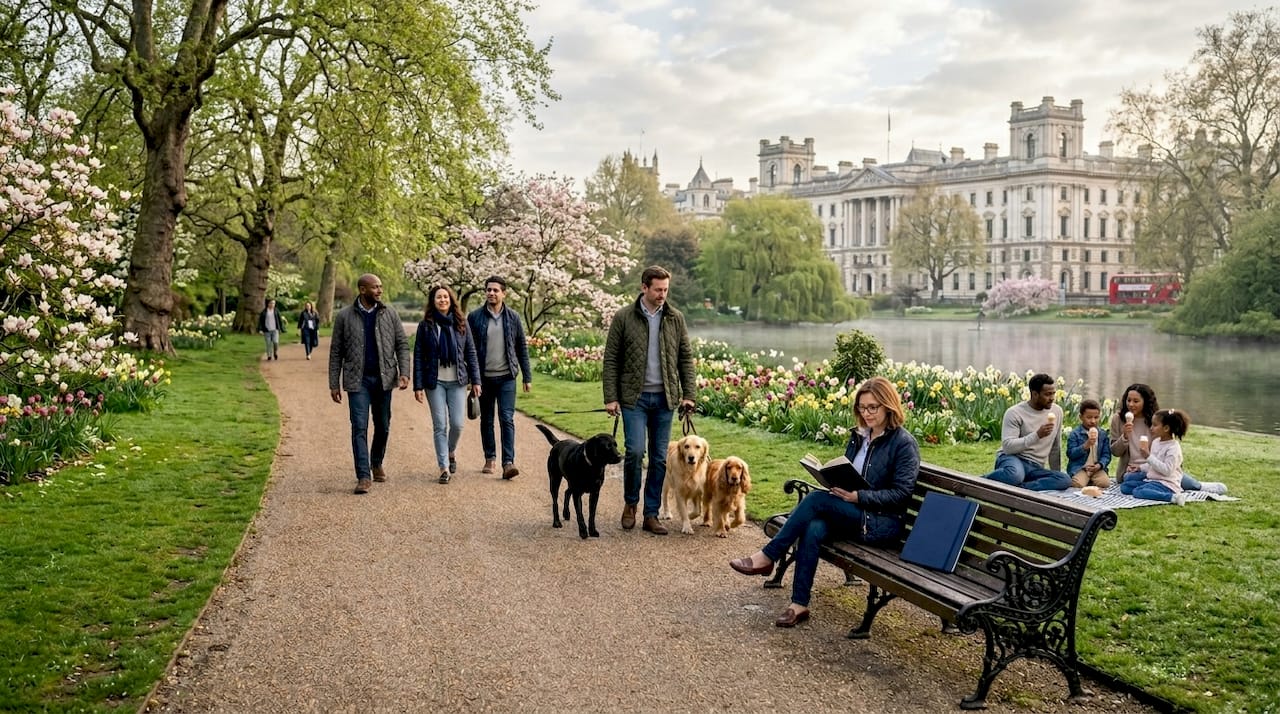
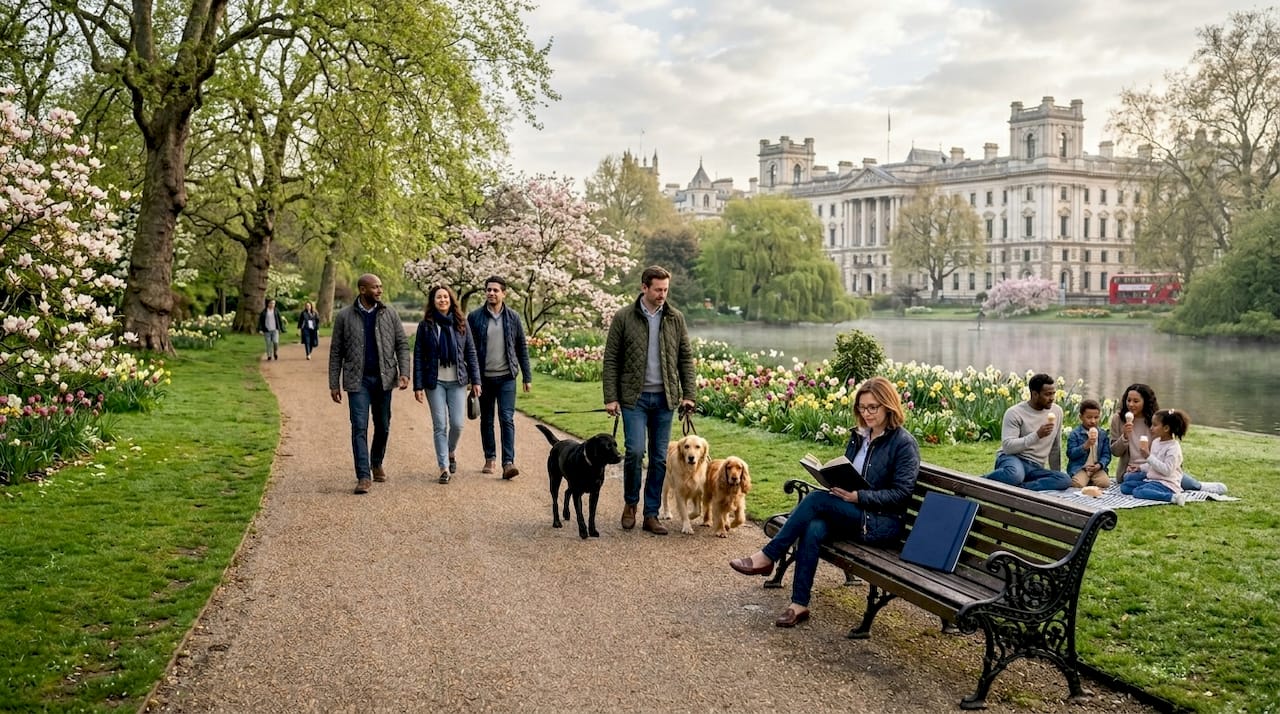
St James’s Park deserves particular mention for its ceremonial significance. Bordered by royal palaces, it offers direct sightlines to Buckingham Palace, The Mall, and Horse Guards Parade. Its pelicans have been resident since 1664, making them one of the longest-running wildlife features of any urban park in the world. Green Park, by contrast, is the only Royal Park with no formal garden, no café, and no water feature. That deliberate restraint makes it a favourite among Londoners who want quiet rather than spectacle.
What activities and facilities do the Royal Parks offer?
The parks collectively support an enormous range of activities, from structured sporting events to quiet afternoon picnics. The variety means there is a genuinely different experience available depending on your interests, fitness level, and the time of year.
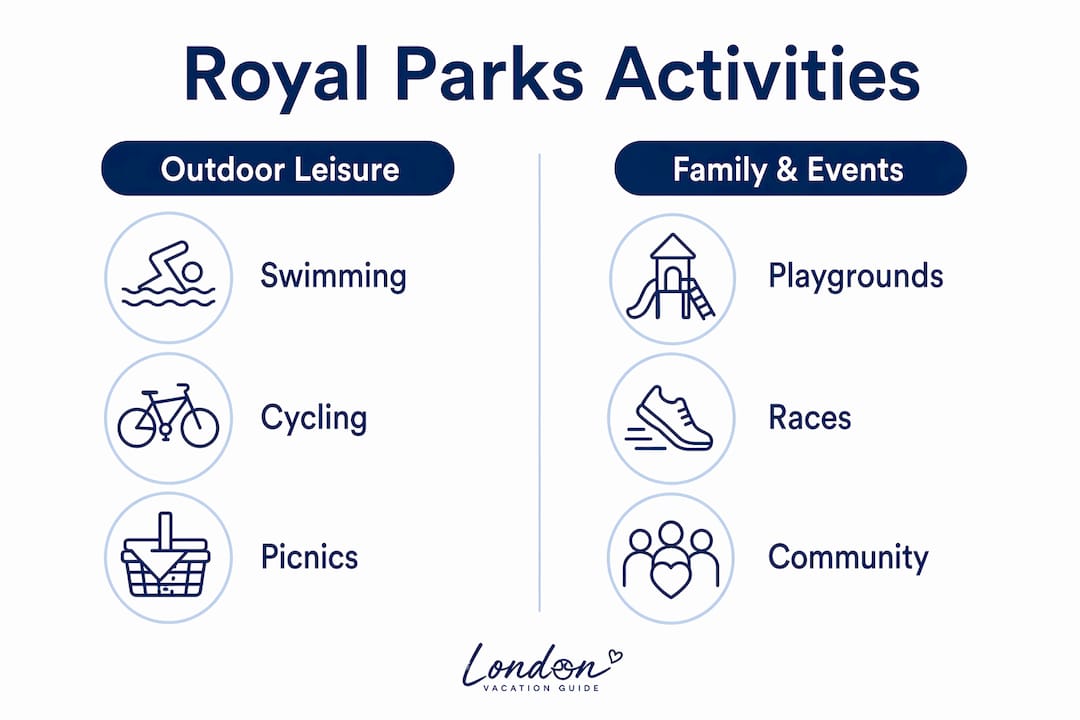
Outdoor leisure and sport
Hyde Park contains the Serpentine Lido, one of London’s few open-water swimming venues, open from June to September. Cycling is permitted on designated routes across most parks, with hire stations available near Hyde Park and Regent’s Park. Both parks also have tennis courts bookable through the All England Lawn Tennis Club’s public booking system. Walking routes are well-signed and range from a 20-minute circuit of Green Park to a full-day exploration of Richmond’s woodland trails.
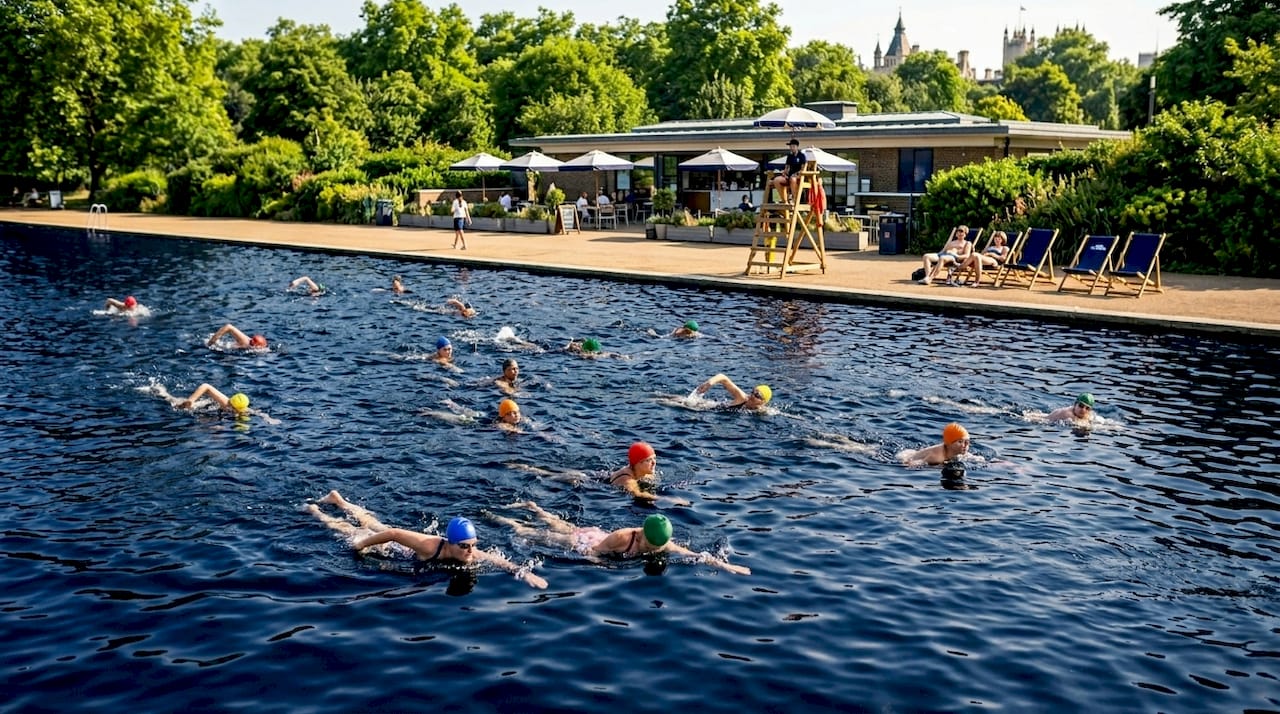
Wildlife spotting
Richmond Park is the standout destination for wildlife. The park’s free-roaming deer herds include both red and fallow deer, and the best sightings occur at dawn and dusk near Pembroke Lodge or the Isabella Plantation. St James’s Park offers a different kind of wildlife encounter. The pelican feeding takes place daily at around 2:30pm near Duck Island, and the lake also hosts over 15 species of wildfowl year-round.
Family facilities and play
The Royal Parks charity operates 14 playgrounds across the network, with recent investment focused on accessibility and natural materials. The ‘Play in the Park’ programme runs structured sessions in Kensington Gardens, Regent’s Park, and Greenwich Park, combining outdoor play with nature education. These are not generic sessions. Activities include community play sessions and outdoor educational events designed to build children’s connection with the natural environment. For families visiting London, anchoring your park visit around one of these playground hubs is far more practical than attempting to cover multiple parks in a single day.
Events and community
The Royal Parks Half Marathon attracts over 16,000 runners annually and raises millions for charity, demonstrating that these parks function as active community hubs rather than passive green spaces. Regent’s Park Open Air Theatre runs a full summer season from May to September, staging West End-quality productions in a 1,240-seat outdoor venue. Greenwich Park hosts the annual RHS Chelsea Flower Show satellite events and serves as a key venue during major sporting occasions.
Pro Tip: If you are visiting with children under ten, the Diana Memorial Playground in Kensington Gardens is one of the best free play spaces in London. It features a large wooden pirate ship, sand areas, and teepee structures, and is specifically designed for under-12s.
How do the Royal Parks balance history with modern public use?
The origins of the Royal Parks lie in medieval royal hunting grounds. King Charles II opened Hyde Park to the public in 1673, a decision that set the precedent for gradual public access across the other parks over the following two centuries. What began as private royal estates became, over time, the green lungs of a rapidly expanding city. That transition from exclusivity to public ownership is one of the more remarkable stories in London’s urban history.
Today, the parks carry both ceremonial and ecological responsibilities simultaneously. The ceremonial role is most visible in St James’s Park, where The Mall serves as the processional route for state occasions including coronations, state funerals, and Trooping the Colour. Horse Guards Parade, which borders the park, hosts the annual Beating Retreat ceremony each June. These are not tourist reconstructions. They are active constitutional events that happen to take place in a public park.
The conservation work is equally serious. Biodiversity efforts include grassland diversification, habitat restoration, and volunteer engagement programmes running across all eight parks. The Royal Parks charity has committed to a Net Zero pathway, which includes reducing energy use across park buildings, transitioning vehicle fleets, and expanding wildflower meadow coverage. These are measurable targets, not aspirational statements.
Safety management has become increasingly complex. Wildfire risks have increased due to recent heatwaves, and the parks now enforce strict bans on barbecues and open flames during dry periods. Visitors are advised to follow these rules precisely:
- No disposable barbecues at any time of year in any Royal Park.
- No cigarette disposal in dry grass or vegetation.
- Report any smoke or signs of fire immediately to park staff or via 999.
- Keep dogs under close control near deer, particularly during the rutting season in autumn.
“The Royal Parks are not just green spaces. They are living heritage sites that require active stewardship from every visitor who uses them.” — The Royal Parks charity
That framing matters. The parks absorb tens of millions of visits each year, and the cumulative impact of visitor behaviour on fragile habitats is significant. Respecting the rules is not bureaucratic compliance. It is the practical condition that keeps these spaces accessible and ecologically viable for future generations.
How to plan your visit to the Royal Parks
Timing and preparation make a substantial difference to the quality of a Royal Parks visit. The parks are open year-round, but each season offers a distinct experience.
Best times to visit
Spring (March to May) is the most photogenic season across all eight parks. The Isabella Plantation in Richmond Park peaks with azalea and rhododendron colour in late April and early May, and the cherry blossoms along Kensington Gardens’ paths are at their best in late March. Summer brings the highest footfall, particularly in Hyde Park and St James’s Park on weekends. Arriving before 9am on a summer morning gives you the parks largely to yourself. Autumn is the best season for wildlife watching, particularly deer rutting in Richmond and Bushy Park from September to November.
Accessibility
All eight parks have accessible entrances and paved paths suitable for wheelchairs and pushchairs. Hyde Park and Regent’s Park have the most developed accessible infrastructure, including accessible toilets, café facilities, and hire options. Greenwich Park has some steep gradients near the Observatory, so visitors with mobility considerations should enter from the Blackheath Gate rather than the main Cutty Sark entrance.
Transport and combining visits
- Hyde Park and Kensington Gardens: served by Hyde Park Corner (Victoria line), Marble Arch (Central line), and Queensway (Central line).
- St James’s Park and Green Park: St James’s Park station (District and Circle lines) and Green Park station (Jubilee, Victoria, and Piccadilly lines).
- Regent’s Park: Regent’s Park station (Bakerloo line) or Baker Street (multiple lines).
- Greenwich Park: Cutty Sark DLR station or Greenwich National Rail.
- Richmond Park and Bushy Park: Richmond station (District line and National Rail) with bus connections to park gates.
Combining a visit to St James’s Park with the Victoria neighbourhood gives you access to Westminster Abbey, the Tate Britain, and some of London’s best café streets within a 15-minute walk. Richmond Park pairs naturally with the Richmond area, which has an excellent high street, riverside pubs, and independent restaurants worth building a half-day around.
Pro Tip: The Lido Café in Hyde Park, situated on the south bank of the Serpentine, serves some of the best flat whites in central London and has outdoor seating with direct lake views. It is far less crowded than the main Serpentine Bar and Kitchen on the north bank.
Key takeaways
The Royal Parks are eight Crown-owned green spaces managed by a dedicated charity, offering free public access to historic, ecologically rich, and ceremonially significant land across London.
| Point | Details |
|---|---|
| Eight distinct parks | Hyde Park, Kensington Gardens, St James’s Park, Green Park, Regent’s Park, Greenwich Park, Richmond Park, and Bushy Park each offer a different experience. |
| Free and open year-round | All eight parks are free to enter, making them among the most accessible major attractions in London. |
| History meets conservation | Originally royal hunting grounds, the parks now balance ceremonial use, biodiversity programmes, and public recreation simultaneously. |
| Family facilities are strong | Fourteen playgrounds and the ‘Play in the Park’ programme make the parks a practical destination for families with children of all ages. |
| Plan by season and interest | Spring suits photography, autumn suits wildlife, and early mornings in summer give you the parks without the crowds. |
Why the Royal Parks deserve more than a passing visit
I have spent years exploring London’s green spaces, and the Royal Parks still surprise me. Most visitors treat Hyde Park as a thoroughfare between Kensington and Marble Arch, or glance at St James’s Park pelicans for five minutes before heading to Buckingham Palace. That approach misses almost everything worth seeing.
The parks that receive the least attention often reward the most. Green Park has no formal attractions, which is precisely why it works. On a Tuesday morning in October, you can sit under a 200-year-old plane tree with a coffee and watch the city move around you without a single tourist in sight. Bushy Park, which sits adjacent to Richmond Park but receives a fraction of the visitors, has a heron colony, a walled garden, and a chestnut avenue that looks extraordinary in autumn. Most people have never heard of it.
The conservation work also deserves recognition beyond the charity’s annual reports. The wildflower meadow expansion in Hyde Park has visibly changed the character of the park’s southern sections over the past three years. The grassland diversification in Greenwich Park has brought back species of butterfly that were absent from central London for decades. These are not cosmetic changes. They represent a genuine shift in how urban green space is managed, and the ecological value of that work extends well beyond the park boundaries.
My practical advice is to pick one park per visit and go deep rather than covering several superficially. If you are travelling with children, anchor around the Play in the Park sites and build the rest of the day around that. If wildlife is your priority, Richmond Park at dawn in October is one of the finest free experiences London offers. And if you want to understand the city’s relationship with its own history, stand on the bridge in St James’s Park at dusk and look west. That view, with the pelicans on the lake and the palace behind the trees, is the one that stays with you.
— Matt
Plan your Royal Parks visit with Londonvacationguide
Londonvacationguide has detailed resources to help you get the most from every park visit. The first-time visitor guide covers how to structure your time across London’s major sights, including the best Royal Parks to prioritise on a short trip. For those exploring the outer parks, the parks traveller’s guide offers practical itineraries combining green space with local neighbourhood experiences. If you are bringing children, the London with kids guide covers the best playground locations and family-friendly routes across the network. All of these resources are free and updated regularly to reflect current opening times, events, and seasonal highlights.
FAQ
What are the Royal Parks in London?
The Royal Parks are eight historic parks owned by the Crown and managed by The Royal Parks charity, covering around 5,000 acres across London. They include Hyde Park, Kensington Gardens, St James’s Park, Green Park, Regent’s Park, Greenwich Park, Richmond Park, and Bushy Park.
Are the Royal Parks free to visit?
All eight Royal Parks are free to enter and open year-round. Some specific facilities within the parks, such as the Serpentine Lido or tennis courts, carry separate charges.
Which Royal Park is best for families?
Kensington Gardens, Regent’s Park, and Greenwich Park are the strongest choices for families, as they host the ‘Play in the Park’ programme and some of the network’s 14 playgrounds. The Diana Memorial Playground in Kensington Gardens is particularly well-regarded for children under 12.
Can you see deer in the Royal Parks?
Richmond Park and Bushy Park both have free-roaming herds of red and fallow deer. The best sightings occur at dawn and dusk, and the autumn rutting season from September to November offers the most dramatic wildlife viewing.
What is the largest Royal Park in London?
Richmond Park is the largest of the eight Royal Parks, covering 2,500 acres in south-west London. It is also a National Nature Reserve and one of the few places in Greater London where you can experience genuinely wild open space.
Recommended
- Why visit London parks: a traveller’s guide - The London Journal | London Vacation Guide
- London for First-Time Visitors: The Essential Guide | London Vacation Guide
- Best Free Things to Do in London (2025 Guide) - The London Journal | London Vacation Guide
- London historical sites: The essential guide for visitors - The London Journal | London Vacation Guide