The role of West End theatre in London’s culture
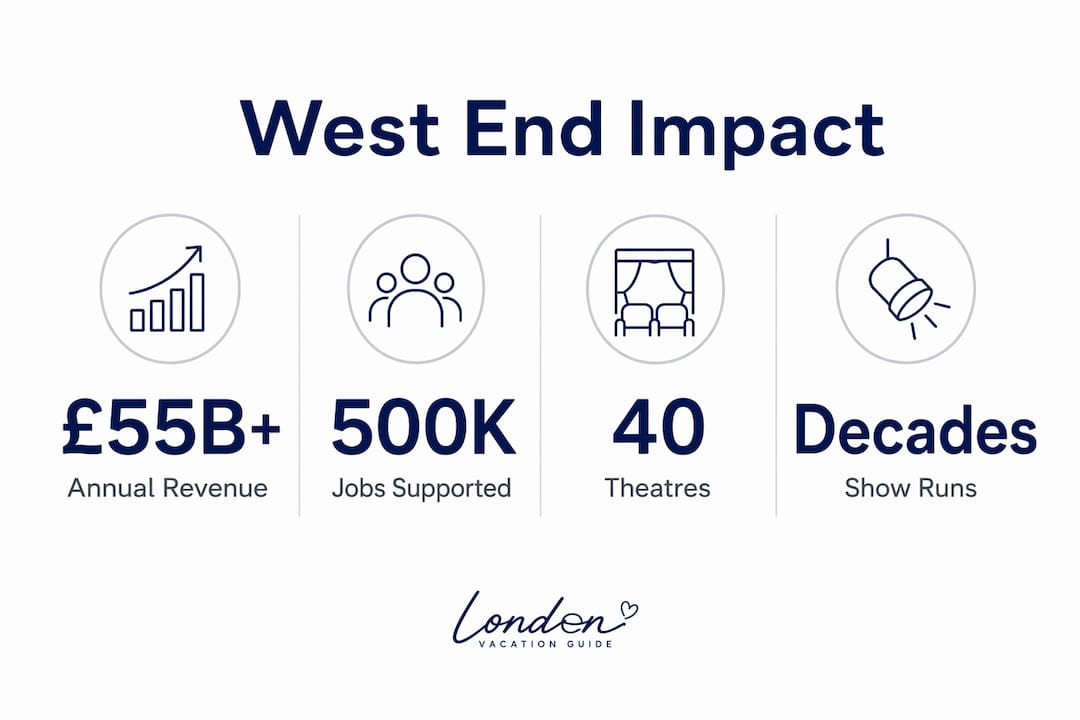
London’s West End is the highest level of commercial theatre in the English-speaking world, sitting alongside New York’s Broadway as the global benchmark for live performance. It is not simply a collection of stages. The district generates over £55 billion for the wider economy annually and supports approximately 500,000 jobs, making it one of the most productive cultural and commercial zones on the planet.
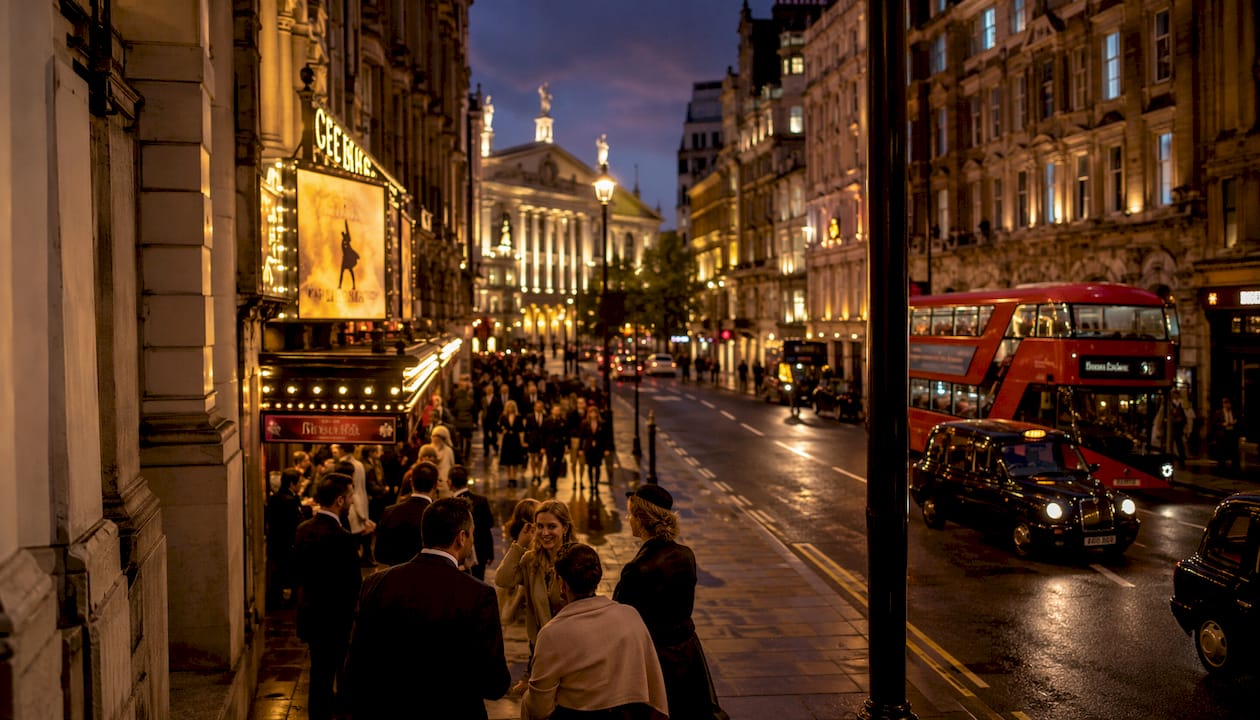
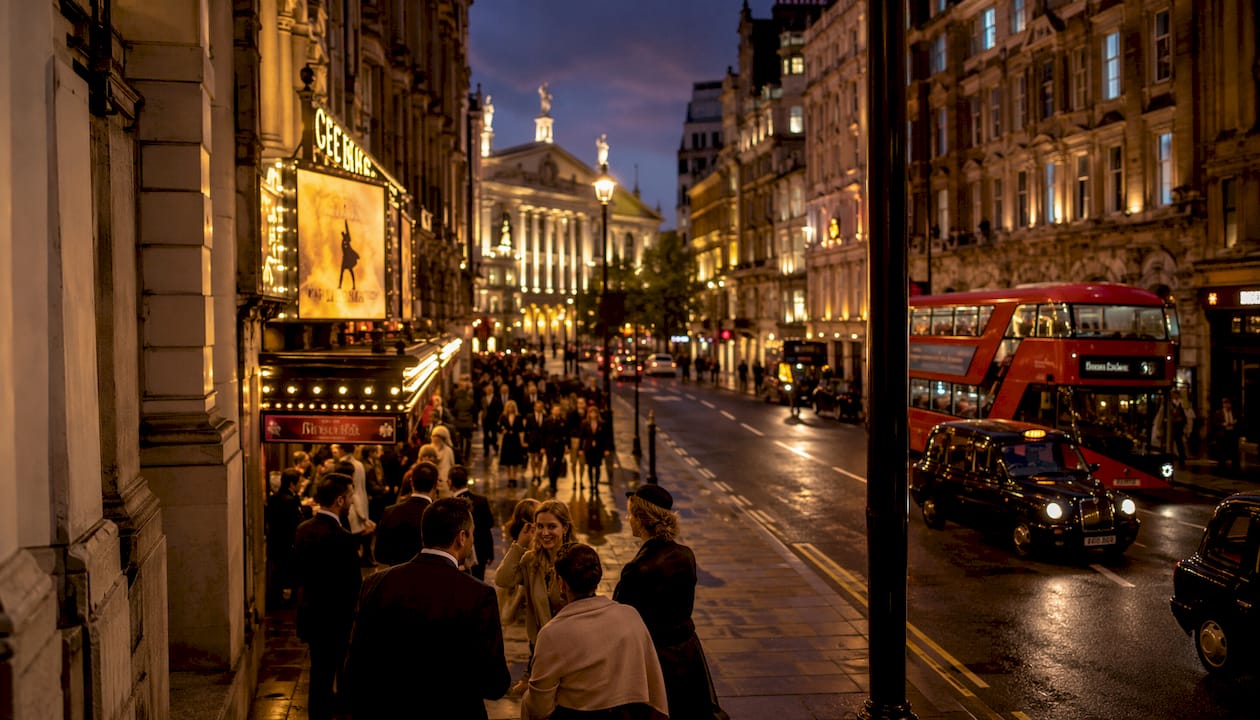
Geographically, Theatreland sits within a rough rectangle bounded by the Strand to the south, Oxford Street to the north, Regent Street to the west, and Kingsway to the east. Its roughly 40 core venues include the London Palladium, the Royal Opera House, the Lyceum, and the Empire. Key streets, particularly Shaftesbury Avenue, Drury Lane, and the Strand, form the arteries of this district. Covent Garden and Soho frame it on either side, giving the area a density of culture, dining, and nightlife that few city districts anywhere can match.
The West End’s main functions at a glance:
- Entertainment hub: musicals, classic plays, comedy, opera, and ballet under one concentrated district
- Tourist magnet: seeing a West End show is one of London’s most common visitor activities
- Economic engine: retail, hospitality, transport, and nightlife all depend on theatre foot traffic
- Creative launchpad: productions premiere here before transferring internationally
- Cultural institution: the district shapes British identity and exports it globally
How the West End theatre district developed over the centuries
The term “West End” only became commonplace in the early 19th century, though the area’s cultural character was being shaped well before that. Henry Jermyn), known as the Father of the West End, drove the development of St James’s and Mayfair in the late 17th century, giving western London a fashionable new identity distinct from the financial City to the east.
By the Victorian era, that identity had crystallised around entertainment. The grand theatres built during this period, many of which still stand today, were designed to project ambition. Names like Palladium, Lyceum, Hippodrome, and Empire were chosen deliberately to suggest scale and spectacle. Their neo-classical and Romanesque façades were statements of civic confidence.
Key milestones in the West End’s development:
- Late 17th century: Henry Jermyn develops St James’s and Mayfair, establishing the area’s fashionable character
- Early 19th century: the term “West End” enters common usage; Westminster consolidates its identity as London’s leisure and entertainment centre
- Mid-19th century: Covent Garden and surrounding areas cleared and redeveloped; Theatreland begins to take shape
- Late Victorian era: major theatre construction along Shaftesbury Avenue and Drury Lane; grand architectural styles define the district
- Edwardian period: further theatre building; commercial productions flourish alongside music halls
- Post-war decades: West End theatre rebounds; long-running musicals become a commercial staple
- 1990s onwards: non-commercial venues like the National Theatre develop a symbiotic relationship with commercial Theatreland, with successful productions transferring to West End houses for extended runs
- 2020–2022: pandemic forces closure; theatres lead the post-pandemic recovery
“The City of London became a centre for the banking, financial, legal and professional sectors, while Westminster became associated with the leisure, shopping, commerce, and entertainment sectors.” — Wikipedia, West End of London
One detail that often surprises visitors: the West End largely escaped the worst of the Victorian railway demolitions that reshaped much of central London. The major termini, Charing Cross, Marylebone, Paddington, and Victoria, were placed on the district’s periphery, preserving Theatreland’s street fabric and allowing its Victorian theatres to survive largely intact.
Key theatres and venues you need to know
Theatreland’s roughly 40 venues range from grand Victorian houses to intimate modern spaces, and each has a distinct personality. Understanding which theatre suits which experience saves you both time and disappointment.
| Theatre / Venue | Location | Capacity (approx.) | Known for |
|---|---|---|---|
| London Palladium | — | — | Musicals, Royal Variety Performance |
| Royal Opera House | Covent Garden, WC2 | — | Opera and ballet |
| Theatre Royal Drury Lane | Catherine Street, WC2 | — | Large-scale musicals |
| Lyceum Theatre | Wellington Street, WC2 | — | Major musicals (The Lion King) |
| Shaftesbury Theatre | Shaftesbury Avenue, WC2 | — | Musicals and plays |
| Donmar Warehouse | Covent Garden, WC2 | 251 | Intimate drama and new writing |
| Apollo Victoria | — | — | Spectacle musicals (Wicked) |
The London Palladium is arguably the district’s most iconic address. Built in 1910, it has hosted everything from variety shows to Andrew Lloyd Webber productions, and its stage is the traditional home of the Royal Variety Performance. The Royal Opera House in Covent Garden operates on a different register entirely: it is the home of the Royal Ballet and the Royal Opera, and its productions draw audiences from across Europe.
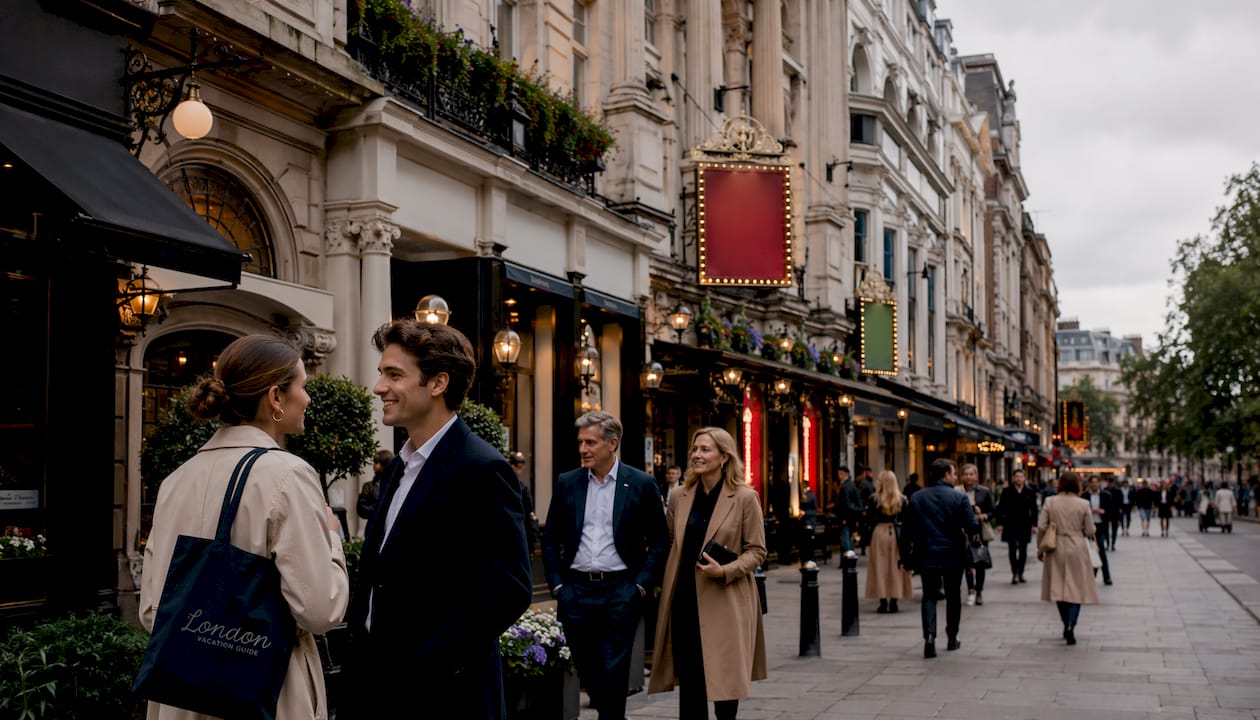
Shaftesbury Avenue is the street most visitors picture when they think of Theatreland, lined with theatres on both sides for several hundred metres. Drury Lane, officially Theatre Royal Drury Lane, is the oldest theatre site in continuous use in London, with origins dating to 1663. For visitors who want something more intimate, the Donmar Warehouse in Covent Garden seats just 251 people and regularly produces work that transfers to Broadway.
Pro Tip: Book Donmar Warehouse tickets at least six weeks in advance. Productions sell out fast and day seats are limited. The sightlines from every seat are excellent, which is rare for a venue of its age.
Non-commercial venues add another layer. The National Theatre on the South Bank, the Old Vic in Waterloo, and Shakespeare’s Globe near Bankside sit outside Theatreland’s traditional boundaries but feed directly into it. Productions developed at these venues frequently transfer to commercial West End houses, giving audiences a chance to see work that began life as subsidised, risk-taking theatre at a larger scale.
Famous and long-running West End shows
The West End’s global reputation rests partly on its ability to sustain productions for years, sometimes decades. A handful of shows have become cultural landmarks in their own right, including Andrew Lloyd Webber’s musical The Phantom of the Opera, Les Misérables, Agatha Christie’s The Mousetrap, Mamma Mia!, Hamilton, and The Lion King. The Royal Variety Performance is held annually at a major West End venue and has been a fixture of British cultural life for many years.
The diversity of programming is worth noting. On any given evening in the West End, you can choose between a large-scale musical, a Shakespeare revival, a new play by a living British playwright, a stand-up comedy show, or an opera. That breadth is what keeps the district relevant to audiences of every age and background, and it is what sustains the tourist draw that fills hotels across Soho and Covent Garden on weeknights.
Why the West End matters economically and culturally today
The West End functions as a single interconnected economic ecosystem where culture, retail, transport, hospitality, and nightlife depend closely on one another. A sold-out show at the Palladium fills the restaurants on nearby Great Marlborough Street. A new production at the Lyceum drives hotel bookings in Covent Garden. The relationship runs in both directions: when theatres closed during the pandemic, the surrounding retail and hospitality sectors felt the impact almost immediately.
The post-pandemic recovery in the West End was driven more by the reopening of theatres and live entertainment venues than by retail alone. That sequence confirmed what the Heart of London Business Alliance and other industry groups had long argued: arts and live performance are the district’s engine, not its decoration.
“The West End works as one economy — policy should catch up.” — City A.M., 2024
The £55 billion annual contribution and the approximately 500,000 jobs the district supports make the case for treating it as a national economic asset rather than a local amenity. Yet governance has historically been fragmented across different councils, business improvement districts, and government departments. This has prompted calls for a unified management structure under the proposed West End International Centre for Culture and Commerce (WEIC), which would give the district a single voice on planning, transport, and cultural policy.
For visitors, the practical implication is that the West End offers far more than theatre tickets. The district’s role in London’s arts identity extends into galleries, street performance, live music, and world-class dining, all within walking distance of each other. Exploring it as an integrated cultural quarter, rather than a list of individual shows, is the approach that rewards the most.
Awards and recognitions that define West End excellence
The West End’s prestige is reinforced by a set of awards that carry genuine weight in the global theatre industry.
- Laurence Olivier Awards: the UK’s most prestigious theatre awards, equivalent to Broadway’s Tony Awards; categories cover acting, directing, design, and new writing across West End and London productions
- Evening Standard Theatre Awards: annual awards presented by the Evening Standard newspaper, with a strong focus on new writing and emerging talent
- Royal Variety Performance: held annually and broadcast on ITV, this event at the London Palladium or another major venue celebrates the best of British and international entertainment; its prestige and popular recognition make it one of the most-watched arts broadcasts of the year
- WhatsOnStage Awards: voted for entirely by the public, these awards reflect audience opinion rather than critical consensus and often highlight shows with strong popular followings
- Critics’ Circle Theatre Awards: presented by professional critics, with particular weight given to drama and classical performance
Winning an Olivier Award transforms a production’s commercial prospects. Shows that collect nominations see measurable increases in ticket sales, and performers who win often find their careers shift permanently. For aspiring actors, the Olivier is the benchmark: it signals that a performance has been recognised at the highest level of the English-speaking theatre world.
The Royal Variety Performance deserves particular mention for its cultural reach. Broadcast to millions each year, it introduces West End talent to audiences who may never set foot in a theatre, and it has done so consistently since 1912.
How to plan your West End visit and get the most from it
Timing matters more than most visitors realise. The West End runs shows Tuesday through Saturday, with matinées on Wednesdays and Saturdays. Sunday performances exist but are less common. If you want the widest choice, aim for a Wednesday or Thursday evening: demand is lower than weekends, prices are often better, and the atmosphere in the surrounding restaurants is more relaxed.
Visitor tips and best practices:
- Book directly through the official box office or the venue’s own website to avoid inflated fees from secondary ticket platforms
- Day seats and standing tickets are available at many venues from the morning of the performance; the queue at the Donmar Warehouse and the National Theatre can be worth it for significant savings
- Dress code is relaxed at most West End venues; smart casual is fine everywhere, and nobody will turn you away for wearing jeans
- Arrive 20 minutes early to collect tickets, find your seat, and buy a programme without rushing
- West End Kids runs family-friendly shows and workshops across the district, making it a practical option for visitors travelling with children
- Combine theatre with dining in Covent Garden or Soho; both neighbourhoods have restaurants at every price point within a five-minute walk of most major venues
For accommodation, Covent Garden puts you at the centre of Theatreland. The Savoy on the Strand is the classic choice for a special occasion. Soho is the better option if you want to be close to late-night bars and restaurants after the show. Soho’s neighbourhood has changed considerably in the past decade and now offers a wide range of hotels alongside its well-known nightlife.
Pro Tip: The TKTS booth on Leicester Square sells same-day and advance tickets at reduced prices for selected shows. It is run by the Society of London Theatre and is entirely legitimate. Avoid the unofficial ticket touts who operate nearby.
Beyond the main shows, the West End rewards exploration. Street performers in Covent Garden’s piazza operate at a genuinely high level. The area around Seven Dials, just north of Covent Garden, has independent shops, cafés, and occasional pop-up events that feel nothing like the tourist-facing main drag. If you want to see London’s broader cultural experiences, the West End is the natural starting point.
How West End theatre shapes global culture and performance
The West End’s influence on global theatre is structural, not just inspirational. Productions that premiere in Theatreland routinely transfer to Broadway, to major European capitals, and to touring productions that reach audiences in Australia, Asia, and North America. The direction of travel is usually London first, then the world.
This matters because it means the West End sets the production standard. When a musical opens at the Palladium or the Lyceum, its design, casting, and staging become the template that other productions around the world attempt to replicate or respond to. Shows like Les Misérables, The Phantom of the Opera, and Hamilton all carry their West End DNA into every international production.
The influence extends into film and television. West End productions have generated some of the most commercially successful film adaptations in British cinema history, and the pipeline runs in both directions: screen actors regularly return to the stage in the West End, bringing their audiences with them. Actors including Benedict Cumberbatch, Judi Dench, and Ian McKellen have all used West End productions to demonstrate range that screen work alone cannot provide.
Popular culture absorbs the West End more quietly but just as thoroughly. The vocabulary of musical theatre, the conventions of the West End review, and the idea of “going to see a show” as a social ritual are all exports from this district that have shaped how audiences everywhere experience live performance.
Key figures who built the West End theatre tradition
The West End’s history is inseparable from the individuals who shaped it. A few names stand out as genuinely formative.
Henry Jermyn (1605–1684) laid the physical groundwork. His development of St James’s and Mayfair created the fashionable western district that would eventually become the West End’s cultural home. Without his urban planning, the geography that makes Theatreland possible would not exist.
David Garrick (1717–1779) transformed acting at Theatre Royal Drury Lane from a declamatory art into something recognisably modern. His influence on naturalistic performance echoes through every West End production today.
Andrew Lloyd Webber is the figure most associated with the modern commercial West End. His productions, from Jesus Christ Superstar in 1972 through to The Phantom of the Opera and beyond, defined the large-scale musical as the district’s dominant commercial form and made the West End a global brand.
Cameron Mackintosh produced Les Misérables, Cats, Miss Saigon, and Hamilton in London, among others. His model of producing shows that could be replicated globally turned West End productions into intellectual property with international commercial value.
Judi Dench and Ian McKellen represent the tradition of serious actors who move between stage and screen, lending the West End credibility that pure commercial theatre might otherwise lack. Their presence in West End productions signals to audiences that the work is worth taking seriously.
The non-commercial sector has its own formative figures. Peter Brook, who directed at the Royal Shakespeare Company and later in Paris, developed staging techniques that influenced directors across the West End and beyond. Nicholas Hytner, during his tenure at the National Theatre, oversaw a period of transfers to commercial Theatreland that raised the artistic standard of the whole district.
Challenges facing West End theatre and what comes next
The West End has faced two structural challenges in the past decade that have not fully resolved. The first is digital disruption. Streaming platforms now compete directly for the leisure time that theatre once monopolised, and younger audiences in particular are harder to convert into regular theatregoers. The industry’s response has been to invest in filmed productions, broadcast partnerships like National Theatre Live, and social media campaigns that bring backstage content to audiences who have not yet bought a ticket.
The second challenge is cost. Producing a large-scale West End musical now requires investment at a level that concentrates risk among a small number of producers. Ticket prices have risen accordingly, and there is a genuine concern that the West End is pricing out the audiences it needs to sustain itself over the long term. The TKTS scheme and day-seat policies at individual venues are partial responses, but they do not address the underlying economics.
The pandemic exposed a third vulnerability: the West End has no meaningful financial reserve. When theatres closed in 2020, the sector required emergency government support to survive. The post-pandemic recovery was faster than many predicted, driven by pent-up demand for live experience, but the structural fragility remains.
Looking ahead, the proposed WEIC governance model offers the most coherent path forward. Unified management of the district’s culture, transport, and commercial policy would allow the West End to make the case for bespoke support rather than competing with other sectors for generic funding. The district’s role in London’s festivals and cultural life is already well understood by policymakers; the question is whether governance can catch up with economic reality.
Planning your first visit to London? The essential visitor guide from London Vacation Guide covers everything from neighbourhoods to transport, with specific recommendations for making the most of the West End.
Key takeaways
The West End is the world’s leading commercial theatre district, generating over £55 billion annually and sustaining approximately 500,000 jobs across culture, retail, hospitality, and transport.
| Point | Details |
|---|---|
| Economic scale | The West End generates over £55 billion annually and supports approximately 500,000 jobs. |
| Theatreland’s scope | Roughly 40 core venues sit within the traditional boundaries of Strand, Oxford Street, Regent Street, and Kingsway. |
| Global benchmark | West End theatre is the highest level of commercial theatre in the English-speaking world, alongside Broadway. |
| Post-pandemic recovery | Theatre and live entertainment led the district’s recovery, confirming arts as the economic engine, not retail. |
| Governance gap | Fragmented policy management limits the West End’s potential; the proposed WEIC model aims to unify it. |
FAQ
What exactly is the West End?
The West End is London’s primary theatre and entertainment district, containing roughly 40 venues within Theatreland and representing the highest level of commercial theatre in the English-speaking world alongside Broadway.
Why is the West End important to London and the UK?
The West End generates over £55 billion annually and supports approximately 500,000 jobs, making it a national economic asset as well as the country’s most significant cultural district.
Why is it called the West End?
The name refers to the western end of the historic City of London. The term became common in the early 19th century as Westminster developed into London’s leisure and entertainment centre, distinct from the financial City to the east.
How much does a West End performer earn?
The estimated annual salary for a West End performer is around £44,586, reflecting the professional status of these roles within the commercial theatre industry.
How does the West End compare to Broadway?
Both are considered the highest level of commercial theatre in the English-speaking world. The West End tends to have a higher proportion of straight drama and classic plays alongside musicals, while Broadway skews more heavily towards large-scale musicals. Productions regularly transfer between the two.
Recommended
- The role of markets in London culture: a local guide - The London Journal | London Vacation Guide
- The role of art in London’s identity: a 2026 guide - The London Journal | London Vacation Guide
- Top London cultural experiences for tourists and enthusiasts - The London Journal | London Vacation Guide
- Tea culture in London: history, customs, and where to go - The London Journal | London Vacation Guide