How London festivals shape culture, community and tourism
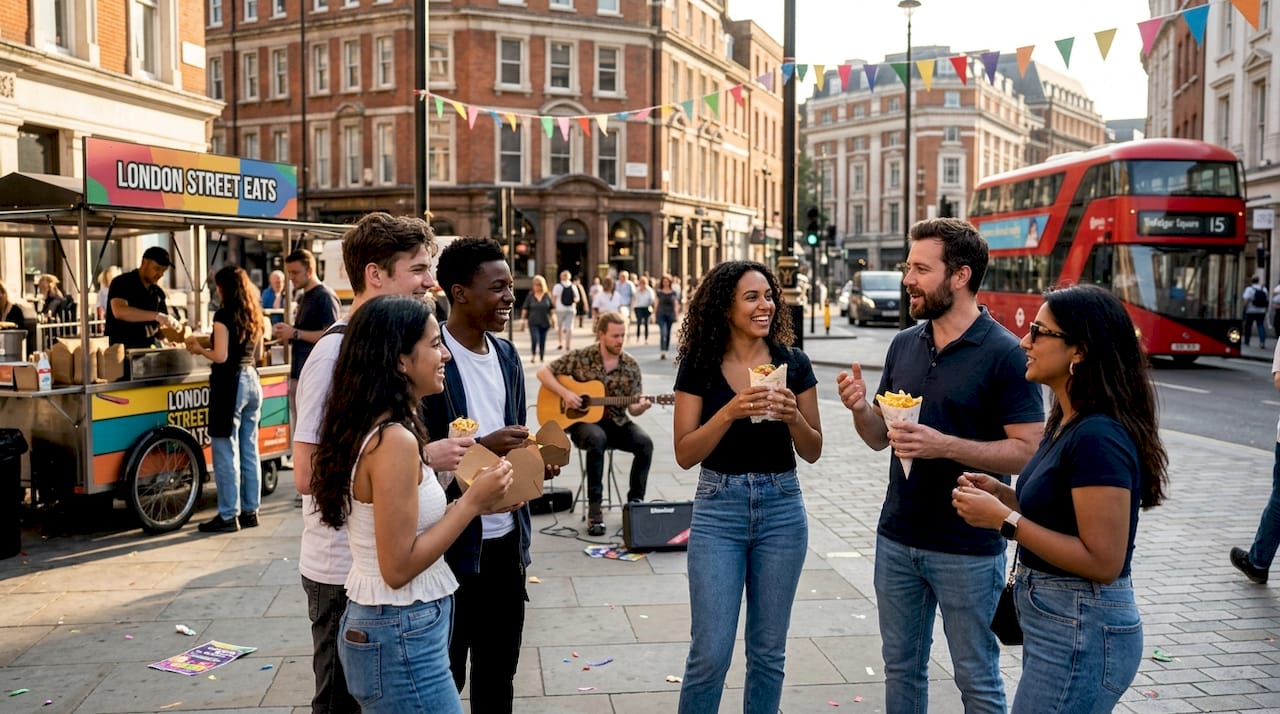
London hosts over 200 major festivals across its boroughs every year, and the numbers alone should make you pause. These are not simply fun weekends or tourist photo opportunities. They are economic engines, community anchors, and cultural statements that reshape neighbourhoods, create thousands of jobs, and attract millions of visitors. Whether you are planning your first visit or you have lived here for decades, understanding what London’s festival scene actually does for the city changes the way you experience it entirely.
Table of Contents
- London festivals: A cultural powerhouse across the city
- Economic impact: Tourism, jobs and local business growth
- Community and accessibility: Bringing Londoners together
- Challenges, debates and future directions for London festivals
- A fresh perspective: London festivals as engines of renewal and belonging
- Discover London festivals and city life with expert guides
- Frequently asked questions
Key Takeaways
| Point | Details |
|---|---|
| Cultural impact | London festivals showcase world-class arts and offer immersive experiences across all boroughs. |
| Economic driver | Festivals contribute billions to the UK economy and support thousands of jobs every year. |
| Community benefits | Free and diverse festivals help unite residents, highlight inclusion and foster local pride. |
| Accessibility focus | Half of London’s events budget goes to accessible, free public festivals open to all. |
| Ongoing challenges | Safety, public space usage and crowd control require smart solutions for festival success. |
London festivals: A cultural powerhouse across the city
London’s festival calendar is genuinely staggering in its variety. You have world-class music events like the BBC Proms, which draws over 300,000 attendees across its summer season at the Royal Albert Hall. You have the Notting Hill Carnival, the largest street festival in Europe. You have Diwali celebrations on Trafalgar Square, Pride in London, the BFI London Film Festival, and dozens of neighbourhood food markets that quietly become annual fixtures.
What makes London’s festival landscape unusual is its geographical spread. Events do not cluster in the West End and then fade out. They reach every borough, from Hackney’s Lovebox to Greenwich’s outdoor concerts, from Southwark’s food festivals to Barking and Dagenham’s community celebrations. If you want to explore where each festival sits within the city’s fabric, our neighbourhood guides give you a borough-by-borough breakdown of what to expect throughout the year.
Here is a quick overview of the main festival categories you will encounter:
- Music festivals: BBC Proms, All Points East, Field Day, Wireless
- Cultural and heritage: BFI London Film Festival, London Design Festival, Frieze Art Fair
- Community and identity: Pride in London, Diwali on the Square, St Patrick’s Day Parade
- Food and drink: Taste of London, Borough Market events, Maltby Street festivals
- Carnival and street: Notting Hill Carnival, Thames Festival, Pearly Kings and Queens Harvest Festival
| Festival type | Key example | Typical attendance |
|---|---|---|
| Music | BBC Proms | 300,000+ |
| Carnival | Notting Hill Carnival | 2 million+ |
| Arts and film | BFI London Film Festival | 150,000+ |
| Community | Diwali on the Square | 35,000+ |
| Food | Taste of London | 50,000+ |
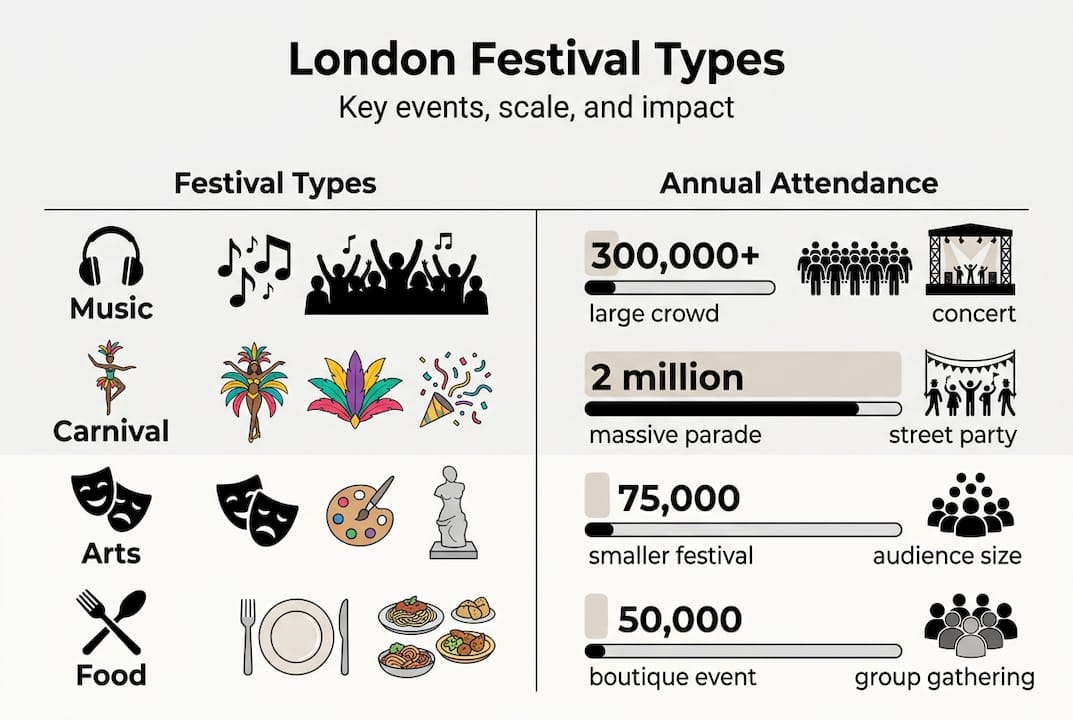
One of the most important things to understand is that access is deliberately built in. The Greater London Authority allocates 50% of its events budget to free public events, meaning that a huge proportion of what London offers culturally costs nothing to attend. For visitors who want to stretch their budget without missing out, there are genuinely remarkable secret spots in London tied to festival seasons that most tourists walk straight past.
Economic impact: Tourism, jobs and local business growth
The economic argument for London’s festivals is not subtle. London’s event industry, including festivals, generates £42.3 billion annually to the UK economy and supports over 500,000 jobs. That figure includes everything from the sound engineers and security staff to the hotel receptionists and taxi drivers who benefit indirectly from the surge in visitors.
Notting Hill Carnival alone illustrates the scale possible from a single event. It boosts London’s economy by nearly £400 million and attracts 2 million visitors across its August bank holiday weekend. To put that in context, that is more visitors than many European cities receive in an entire month.
Here is how different festival types compare in their economic outcomes:
| Festival type | Primary economic driver | Secondary benefit |
|---|---|---|
| Large music festivals | Ticket sales, hospitality | Transport, retail |
| Cultural festivals | Tourism spend, media coverage | Brand visibility for London |
| Community festivals | Local business footfall | Neighbourhood investment |
| Food festivals | Direct vendor revenue | Restaurant and supplier chains |
The job creation effect works in layers:
- Direct employment: Event staff, performers, security, logistics
- Hospitality surge: Hotels, restaurants and bars see significant revenue spikes
- Supply chain work: Catering suppliers, equipment hire, printing and marketing
- Long-term talent retention: London’s festival scene attracts creative professionals who stay year-round
For local businesses, festival periods are among the most valuable trading windows of the year. Restaurants near Notting Hill Carnival, for instance, often see their busiest days of the entire year during that single weekend. If you are looking for the best places to eat near festival zones, our guide to where to eat covers every neighbourhood in detail.
Pro Tip: If you run a local business, festivals are the single best time to increase your visibility. Getting listed in the London business directory ahead of major festival seasons puts you in front of visitors actively searching for nearby services. You can also explore listing your business to reach a wider festival audience throughout the year.
Community and accessibility: Bringing Londoners together
The economic figures are impressive, but they do not capture what festivals actually feel like from the inside. Walk through Trafalgar Square during Diwali, or stand in the crowd at Pride in London, and you understand something that spreadsheets cannot measure: festivals create belonging.
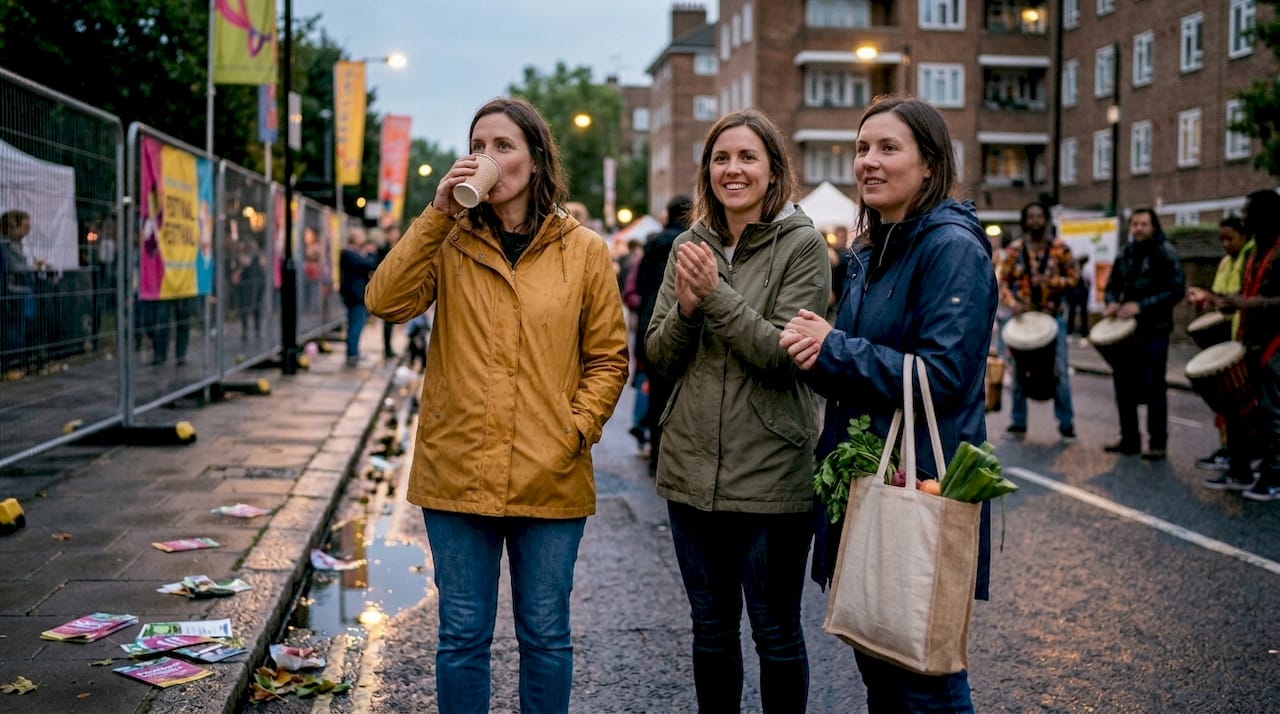
For many Londoners, particularly those from communities whose cultures are not always visible in mainstream city life, festivals are moments of genuine recognition. Events like the Notting Hill Carnival, the Chinese New Year celebrations in Chinatown, and the South Asian Mela in various boroughs do not just entertain. They assert presence and identity in the public space of one of the world’s most watched cities.
The accessibility dimension matters enormously here. With 50% of the GLA events budget going to free public events, the city is making a deliberate statement: cultural participation should not be determined by income. This is not a minor policy footnote. It shapes the character of London’s festival scene in ways that distinguish it from many other global cities.
Festivals also support 20,000 seasonal jobs annually, many of which go to young Londoners entering the creative and events industries for the first time. That first seasonal role at a festival can be the beginning of a career.
Here are some of the most community-focused festival experiences to look for:
- Diwali on the Square: Free, family-friendly, central London
- Pride in London: Inclusive, high-energy, borough-wide events
- Notting Hill Carnival: Caribbean heritage, open streets, free entry
- Eid in the Square: Growing annual celebration in Trafalgar Square
- Hackney Carnival: Neighbourhood-scale, deeply local feel
“Festivals are where London stops being a collection of postcodes and becomes a single, breathing city.” This is the feeling that draws both first-time visitors and long-term residents back year after year.
Pro Tip: Locals who want to engage more deeply with their community should look beyond the headline events. Smaller neighbourhood festivals, often listed through borough councils, offer far more personal connections and far less crowding. Check our guide to free things to do for a curated list of accessible events across the city.
Areas like the South Bank and Covent Garden host regular free cultural programming that sits just outside the formal festival calendar but delivers the same sense of shared experience.
Challenges, debates and future directions for London festivals
Not everyone celebrates festival season with equal enthusiasm. For residents living directly adjacent to major events, the reality can be genuinely difficult. Noise, litter, road closures, and the sheer volume of people can strain patience and infrastructure alike.
Notting Hill Carnival is the most discussed example. It is beloved and economically vital, but it also faces overcrowding and safety risks that require ongoing management. Crowd control, stewarding ratios, and emergency access routes are subjects of serious annual planning. The debate about whether the Carnival should remain in its current location or move to a larger venue has been running for years without resolution.
The city’s response has been substantive. The Mayor has committed £5m in funding specifically for Carnival safety improvements and supports 15 major festivals through the Growth Plan for London. That financial commitment signals that the city views festivals not as optional extras but as core infrastructure.
Broader challenges facing London’s festival scene include:
- Sustainability: Reducing waste, carbon footprint and single-use plastics at large outdoor events
- Funding uncertainty: Reliance on sponsorship and public grants creates vulnerability
- Gentrification pressure: As neighbourhoods change, the communities that gave festivals their character can be displaced
- Resident relations: Balancing the needs of festival-goers with those of people who simply live nearby
“The question is not whether London should have festivals. It is whether the benefits are shared equitably and the costs are not borne disproportionately by those with the least power to object.”
The experience economy is also reshaping what festivals look like. Immersive events, digital integrations, and hybrid formats are becoming more common. Areas like Shoreditch have become testing grounds for experimental cultural events that blur the line between festival, installation, and community gathering.
A fresh perspective: London festivals as engines of renewal and belonging
Here is what most festival coverage misses: the real power of London’s festival scene is not in the headline acts or the economic multipliers. It is in the fact that festivals force the city to reimagine itself, repeatedly, in public.
Every year, a street in Notting Hill becomes the Caribbean. Every summer, the Royal Albert Hall becomes a democratic concert hall where the cheapest tickets are the most coveted. Every autumn, Trafalgar Square becomes a stage for cultures that built London but rarely own its landmarks. That is not entertainment. That is urban renewal happening in real time.
For tourists, this means that attending a festival is not just a leisure activity. It is a way of seeing the city that no museum or bus tour can replicate. For locals, it is a reminder that London belongs to everyone who lives in it, not just those who can afford its property prices.
The festivals that endure are the ones that serve both functions simultaneously. They give visitors something extraordinary to witness, and they give communities something worth protecting. Exploring hidden spots during festivals often reveals this dual character most clearly, in the side streets and local pubs where the real festival community gathers.
Discover London festivals and city life with expert guides
Planning around London’s festival calendar can transform a good trip into an unforgettable one. Whether you are a visitor wanting to time your stay around the Carnival or a local looking to discover events in a borough you have never explored, having the right resources makes all the difference.
London Vacation Guide brings together everything you need to navigate the city’s cultural calendar with confidence. Browse our neighbourhood guides to discover which areas come alive during which seasons. Find trusted local services through the London business directory, and if you want to experience the city on foot during festival season, London Walks offers guided routes that put you right at the heart of the action. Let us help you make the most of every festival moment.
Frequently asked questions
How do London festivals influence local neighbourhoods?
Festivals foster community identity, increase footfall and support local businesses. Events like Notting Hill Carnival drive high local and tourist engagement that benefits entire surrounding areas long after the event ends.
Are most London festivals accessible to tourists and locals?
Yes. With 50% of the GLA budget dedicated to free public events, a large proportion of London’s festival programme is open to everyone regardless of budget.
Which festival attracts the largest crowds in London?
Notting Hill Carnival is London’s biggest festival, drawing 2 million visitors annually and generating nearly £400m for the local economy across its August bank holiday weekend.
How do festivals impact jobs in London?
Festivals support 20,000 seasonal jobs each year and contribute to broader employment across hospitality, logistics, creative industries, and the wider events sector.
What is being done to address safety at large festivals?
The Mayor has committed £5m in funding for Carnival safety improvements, alongside increased stewarding, improved crowd management systems, and strategic planning for all 15 major supported festivals.
Recommended
- London Vacation Guide - Your Expert Guide to London
- Best Free Things to Do in London (2025 Guide) - The London Journal | London Vacation Guide
- Hidden London: Secret Spots Most Tourists Miss - The London Journal | London Vacation Guide
- The Perfect 3-Day London Itinerary - The London Journal | London Vacation Guide