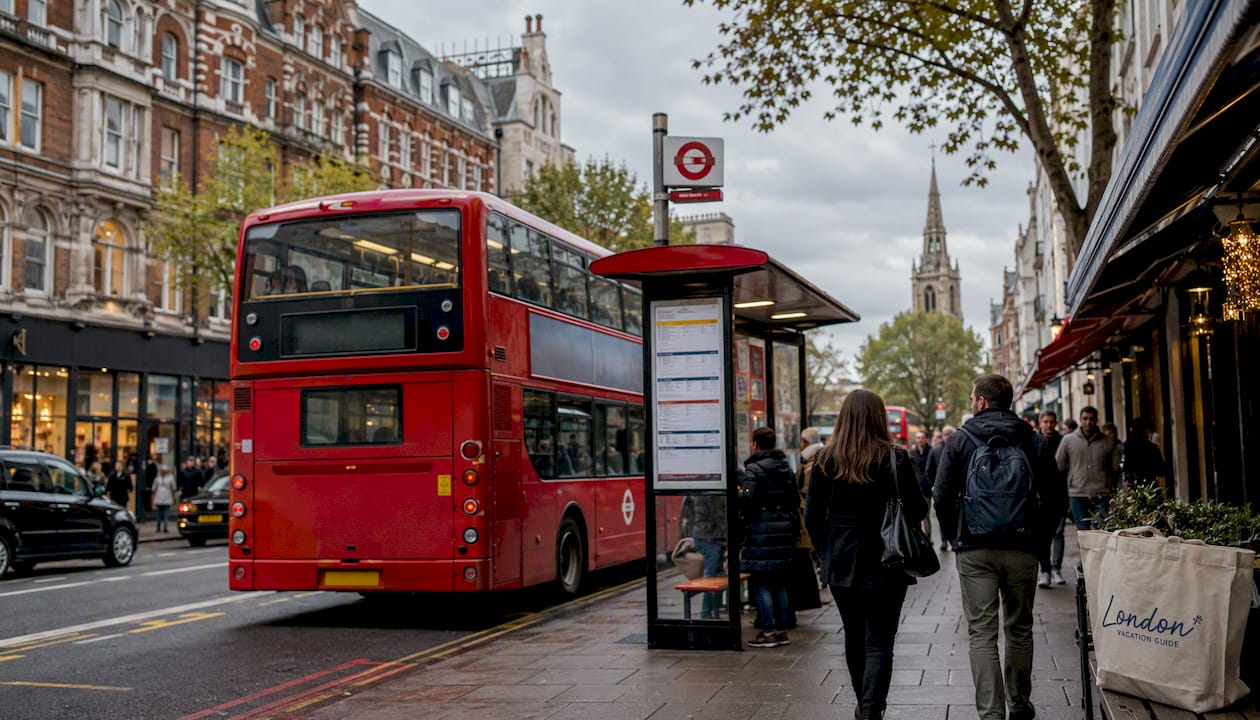
London bus fares: a step-by-step guide for visitors
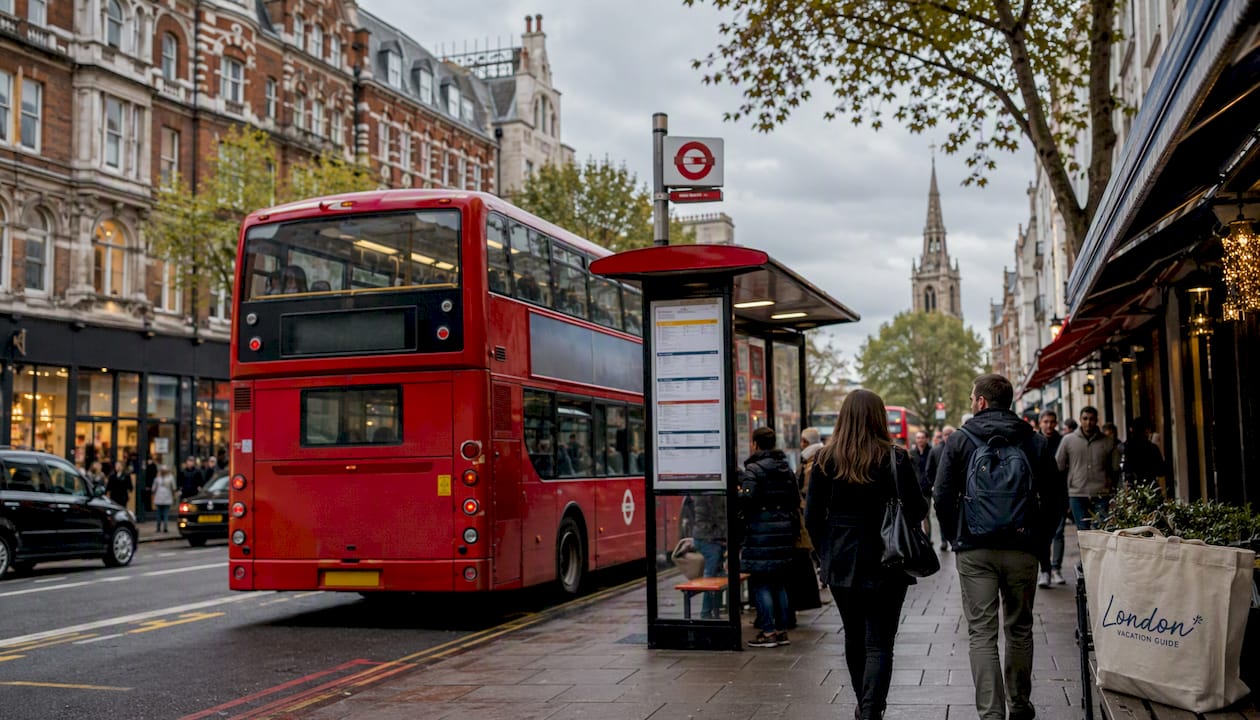
Every London bus charges a flat single fare of £1.75 for pay-as-you-go travel, regardless of how far you ride. The Hopper fare means any additional bus or tram journey taken within one hour of your first tap is free. Most visitors need nothing more than a contactless debit card or mobile wallet to board and pay correctly.
Here is what matters before you step on:
- Single fare: £1.75 per journey (adult, pay-as-you-go)
- Daily cap: £5.25 for buses and trams — after that, further bus journeys that day cost nothing extra
- Hopper rule: unlimited bus and tram journeys within one hour of your first tap, all counted as one fare
- Tap once on boarding — there is no tap-out on London buses
- Use the same card or device for every tap if you want Hopper and daily capping to apply automatically
Cash is not accepted on any London bus. Contactless card, mobile wallet (Apple Pay or Google Pay), or an Oyster card are your only options.
Table of Contents
- How do you board and pay on a London bus?
- Which payment method should you use on London buses?
- What are the headline bus fares and daily caps?
- How does the Hopper one-hour rule work?
- Who pays less? Child fares, concessions and discounts
- How do you get an Oyster card and top it up?
- How do you plan routes and check live bus times?
- Contactless or Oyster: which is right for you?
- Night buses, sightseeing routes and tourist bus services
- Accessibility on London buses
- Key takeaways
- A local perspective on getting around by bus
- Plan your London days with ready-made itineraries
- Official sources and where to check live information
- FAQ
How do you board and pay on a London bus?
The sequence is short, but getting it wrong costs money or leaves you stranded at the stop.
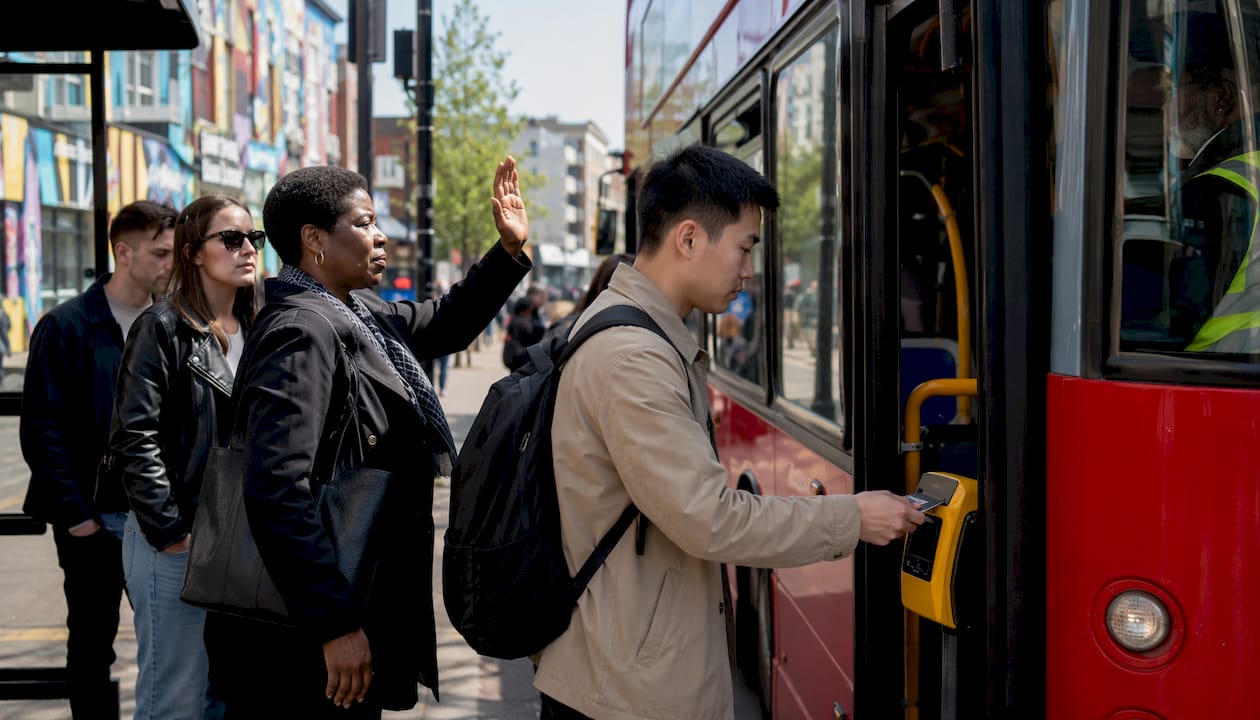
Step 1: Find the right stop. Bus stops display a letter code (for example, “Stop A”) and a yellow pole with the route numbers that serve it. The electronic display shows the next two or three arrivals with countdowns in minutes. Check the route number and the final destination shown on the board — two buses sharing a number can split at different termini.
Step 2: Signal the driver. Stick your arm out clearly as the bus approaches. Drivers are not obliged to stop if no one signals.
Step 3: Board at the front. All passengers board through the front doors. Some routes with articulated (bendy) buses have multiple entry points, but on standard double-deckers the front door is the only one.
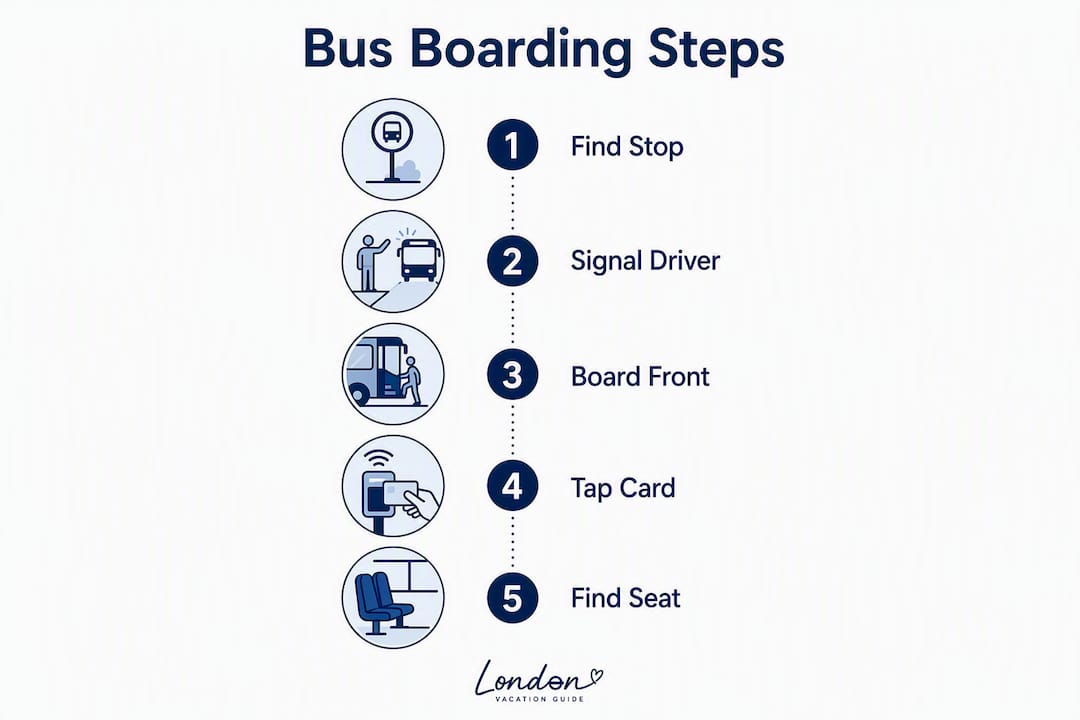
Step 4: Tap the yellow reader once. Hold your contactless card, phone, or watch against the yellow circular reader beside the driver. Wait for the green light and the beep. That is it. Do not tap out when you leave — tapping twice is a common newcomer mistake that charges you twice.
Step 5: Find a seat and ride. Press the red “Stop” button before your destination to signal the driver. Exit through the middle or rear doors.
Pro Tip: Have your payment method ready before the doors open. Fumbling with a wallet holds up other passengers and, on busy routes, the driver may close the doors. If you are using a mobile wallet, wake the screen before you queue. Keep only one contactless card near the reader to avoid card clash, where the reader picks up the wrong card and charges the wrong account.
Which payment method should you use on London buses?
The right choice depends on how long you are staying and whether you need any concessions.
Contactless card or mobile wallet
This is the simplest option for most visitors. Tap your Visa, Mastercard, or American Express contactless card, or use Apple Pay or Google Pay, and daily and weekly caps apply automatically — exactly as they would with an Oyster card. No top-up, no deposit, no queuing at a machine. For a short stay of a few days, this is almost always the better choice. Our full guide to contactless payment in London covers setup and common pitfalls in detail.
Oyster card
Oyster is a reloadable smart card that works on buses, the Tube, the DLR, London Overground, and the Elizabeth line. It makes sense if you are staying longer than a week, need a specific concession (such as a 7-Day Bus & Tram Pass loaded onto the card), or simply prefer a dedicated travel card. There is a £7 deposit on a standard Oyster, refundable when you return it. Visitor Oyster cards (pre-loaded, available before you travel) carry no deposit but are not refundable.
Day passes and Travelcards
| Option | Adult price | Best for |
|---|---|---|
| Pay-as-you-go (contactless/Oyster) | £1.75 per journey, capped at £5.25/day | Flexible travel, short stays |
| One Day Bus & Tram Pass | £6.00 | Unlimited bus/tram travel in one day |
| 7 Day Bus & Tram Pass | — | Regular bus/tram use over a week |
| Travelcard (1 Day, Zones 1–2) | Varies by zone | Combined bus + rail travel |
The One Day Bus & Tram Pass at £6.00 costs more than the £5.25 daily cap you hit automatically with pay-as-you-go. Unless you need a physical pass for a specific reason, pay-as-you-go will almost always be cheaper or identical.
What are the headline bus fares and daily caps?
| Fare type | Adult price |
|---|---|
| Single bus fare (pay-as-you-go) | £1.75 |
| Daily bus & tram cap | £5.25 |
| One Day Bus & Tram Pass | £6.00 |
Three bus journeys in a day cost £5.25 and hit the daily cap. Every bus or tram journey after that is free for the rest of the day, provided you use the same card or device throughout. The daily cap of £5.25 means even a full day of bus-hopping across London costs less than a single Zone 1–2 Tube return at peak time.
Worth checking: TfL has run promotional Weekend Hopper fares in previous summers, temporarily extending the Hopper window. Always verify current fares on TfL before travel, as promotional rules can change.
How does the Hopper one-hour rule work?
The Hopper fare lets you take unlimited bus and tram journeys within one hour of your first tap, all charged as a single £1.75 fare. The clock starts the moment you tap in on your first bus.
Practical examples:
- You tap onto the 38 bus at 10:00. You tap onto the 73 bus at 10:45. The second journey is free — you are within the hour.
- You tap onto the 38 bus at 10:00. You tap onto the 73 bus at 11:05. That is a new fare: £1.75 charged again.
- You tap onto three buses between 10:00 and 10:55. All three count as one £1.75 fare.
Common pitfalls to avoid:
- Switching between cards or devices mid-journey breaks the Hopper grouping. If you tap in with your Visa card, tap in with your Visa card for every subsequent bus within the hour.
- Switching from your phone to your watch, or from one card to another in the same wallet, counts as a different payment method and triggers a new fare.
- The Hopper applies only to buses and trams. If you hop onto the Tube or a rail service mid-journey, that is a separate fare entirely, and tapping out matters on those services.
- A negative Oyster balance blocks the Hopper. If your card lacks credit, the system may allow one more journey, but you will need to top up before the Hopper benefit applies again.
Pro Tip: TfL occasionally runs temporary promotional Hopper extensions, particularly at weekends during summer. Check the TfL bus fares page before a big day out — you may get a longer free-transfer window than the standard hour.
Who pays less? Child fares, concessions and discounts
London’s concession system is generous but requires some planning for visitors.
Children’s fares:
- Under 11: travel free on buses and trams at all times, with no card or registration needed.
- 11–15: free bus and tram travel with an Oyster photocard (requires registration with TfL and a passport-style photo — not practical for short visits).
- 16–17: free bus and tram travel with a 16+ Oyster photocard (same registration requirement).
For visiting families, children under 11 simply board for free. Older children without a photocard pay the adult fare of £1.75.
Other concessions:
- 60+ London Oyster photocard: free bus travel for London residents aged 60 and over.
- Disabled persons’ Freedom Pass: free travel on buses, trams, and most rail services.
- Jobcentre Plus Travel Discount Card: half-price pay-as-you-go fares for eligible jobseekers.
- Student and apprentice discounts: available via specific Oyster photocards for those studying or working in London.
Pro Tip: Visitor photocards are not available for short stays. If you are travelling with an 11–15 year old who does not have an Oyster photocard, budget for the adult fare of £1.75 per journey. The daily cap of £5.25 still applies, so a day of bus travel will not exceed that amount per person.
How do you get an Oyster card and top it up?
If you decide an Oyster is right for your trip, here is how to get one and keep it funded.
- Buy at a Tube station ticket machine or TfL Visitor Centre. Every staffed Underground station sells Oyster cards. The TfL Visitor Centres at Heathrow Terminals 2 & 3, King’s Cross St. Pancras, Liverpool Street, Piccadilly Circus, Victoria, and Euston are the best starting points for new arrivals.
- Pay the £7 deposit. This is refunded when you return the card at a station. Visitor Oyster cards (pre-ordered online before travel) have no deposit but are not refundable.
- Add credit at a ticket machine. Station machines accept cash and card. The minimum top-up is £5; the maximum balance is £90.
- Top up via the TfL Go app or Oyster online account. Add credit remotely and it loads onto the card the next time you touch in at a yellow reader.
- Use PayPoint shops. Many convenience stores and newsagents display the PayPoint logo and can top up Oyster cards with cash.
- Handle a negative balance promptly. If your Oyster runs out of credit mid-trip, TfL permits one more bus journey before the card is blocked. Top up at the next station or PayPoint shop before boarding again.
Refunds on remaining Oyster credit are available at any Tube station ticket machine (for balances up to £10) or by post for larger amounts via the TfL website.
How do you plan routes and check live bus times?
The TfL Go app is the most reliable tool for live bus times, interactive maps, and disruption alerts. Download it before you travel — it works offline for maps and shows real-time arrivals when you have a signal.
Practical tools and habits:
- TfL Journey Planner (tfl.gov.uk/plan-a-journey) gives step-by-step directions, step-free route options, and estimated journey times for any combination of bus, Tube, and rail.
- Bus stop countdown displays show the next two or three arrivals in minutes. If the display is blank, check TfL Go for the same data.
- Stop letter codes appear on every bus stop pole. Save your regular stops in TfL Go as favourites for one-tap access to live arrivals.
- Check for disruptions before heading out on busy event days. Notting Hill Carnival, the London Marathon, and major football matches regularly divert or suspend bus routes across central London.
- Allow extra time at peak hours. Bus travel between 08:00–09:30 and 17:00–19:00 on weekdays is significantly slower through central London. If you are heading somewhere time-sensitive, add 15–20 minutes to the app’s estimate.
Contactless or Oyster: which is right for you?
For the vast majority of visitors, contactless payment is the better choice — it removes the need to top up, avoids the £7 deposit, and applies the same fare caps automatically.
Choose contactless or a mobile wallet if:
- Your stay is a week or less
- You have a Visa, Mastercard, or Amex contactless card, or a phone with Apple Pay or Google Pay set up
- You want automatic daily capping with no queuing at machines
- You are not eligible for any TfL concession that requires an Oyster photocard
Choose Oyster if:
- You are staying longer than a week and want a dedicated travel card
- You need a specific concession (Disabled persons’ Freedom Pass, 60+ card, or a loaded Travelcard)
- You prefer not to use your bank card on public transport
Quick checklist:
- Trip under 7 days? → Contactless
- Need a concession photocard? → Oyster
- Multiple daily bus journeys? → Either (caps apply to both)
- Arriving without a contactless card? → Oyster from the airport station
Pro Tip: If you are using a mobile wallet, make sure your phone has enough battery to last the full day. A dead phone mid-journey means you cannot pay, and a revenue inspector can issue a penalty fare if you cannot show proof of payment. Carry a portable charger or have a backup contactless card.
Night buses, sightseeing routes and tourist bus services
London’s bus network runs 24 hours a day, seven days a week. The night bus routes — prefixed with “N” (N38, N73, N29, for example) — cover most of the city after the Underground closes, typically from around midnight to 05:00. The same flat fare of £1.75 applies, and the Hopper rule works identically on night buses.
TfL bus routes worth riding for the views:
- Route 11: from Fulham to Bank, passing the King’s Road, Sloane Square, Victoria, Westminster, and St Paul’s Cathedral. One of the best above-ground sightseeing routes in central London, and completely free once you have hit the daily cap.
- Route 15H: a heritage Routemaster service running between Trafalgar Square and Tower Hill on selected days. Check TfL for current operating days.
- Route 188: connects Euston with Greenwich, passing through Waterloo and Bermondsey — useful for reaching the Cutty Sark and the Old Royal Naval College without paying Tube fares.
TfL buses versus hop-on hop-off tourist services:
Regular TfL buses and commercial hop-on hop-off tourist buses are entirely separate. Tourist services charge their own ticket prices (typically £30–£40 per adult for a day pass), include audio commentary, and stop at a curated set of landmarks. TfL buses cost £1.75 and go everywhere, but have no commentary. For pure sightseeing value on a budget, Route 11 on a TfL bus beats most commercial alternatives.
Accessibility on London buses
Most of London’s bus fleet is low-floor, meaning the bus kneels at the stop to reduce the step height. Wheelchair spaces are located near the centre doors on double-deckers and at the front of single-deckers.
Boarding and alighting:
- Signal the driver with a raised arm as usual. If you need the bus to kneel or the ramp to deploy, catch the driver’s attention before the doors close.
- The wheelchair space is a priority area. Other passengers are expected to vacate it when needed, though drivers can request this rather than enforce it.
- Press the “Stop” button early if you need extra time to move to the doors — drivers will wait when they know someone needs assistance.
Priority seating and assistance dogs:
- Blue priority seats near the front of every bus are reserved for older passengers, disabled passengers, and those who are pregnant.
- Assistance dogs travel free and may accompany their owner anywhere on the bus. No prior notice is required.
Planning step-free journeys:
- TfL Journey Planner has a step-free filter that shows only routes with level or ramped access at every interchange.
- The TfL Go app displays accessibility information for each stop, including whether a bus stop has a raised kerb for easier boarding.
- For complex journeys or if you need advance assistance, TfL’s free and discounted travel page lists the relevant contact points and eligibility details.
Key takeaways
London buses use a flat £1.75 pay-as-you-go fare with automatic daily capping at £5.25, and the Hopper rule makes transfers within one hour free when you use the same card or device throughout.
| Point | Details |
|---|---|
| Flat fare, automatic caps | Every bus journey costs £1.75; the daily cap of £5.25 applies automatically with contactless or Oyster. |
| Hopper one-hour rule | Tap the same card or device for all buses within one hour and only the first £1.75 is charged. |
| Contactless beats Oyster for most visitors | No deposit, no top-up, same capping — contactless or mobile wallet is simpler for stays under a week. |
| Negative Oyster balance | TfL allows one more bus journey if your Oyster runs out, but top up before boarding again. |
| London Vacation Guide itineraries | Use London Vacation Guide’s ready-made day plans to pair bus routes with the best attractions and neighbourhoods. |
A local perspective on getting around by bus
The conventional wisdom among visitors is that the Underground is the “proper” way to get around London. It is fast, yes, but it also puts you underground for most of the journey, which means you miss the city entirely. Buses are slower, but they are also how you actually see London.
Route 11 from Fulham Broadway to Bank is a case in point. Ride it on a clear morning and you pass the King’s Road, Sloane Square, the front of Buckingham Palace Road, Westminster Bridge, and St Paul’s, all for £1.75 or nothing if you have already hit the cap. A Tube journey covering the same ground would cost more, take less time, and show you nothing but tunnel walls.
The smarter approach for visitors is to combine short Tube hops for speed with bus legs for sightseeing. Take the Tube to a neighbourhood like Chelsea or Soho, then use buses to connect between nearby areas. A walk from Soho to Covent Garden takes ten minutes. A bus from Covent Garden to Waterloo takes five. Neither costs more than £1.75, and both show you more of the city than any Tube ride.
The one thing most guides understate is how good the night bus network is. After midnight, when the Tube closes, buses are not a fallback — they are the only affordable option. The N38 and N73 cover the same corridors as their daytime equivalents and run frequently enough that you rarely wait more than ten minutes. Budget a night out properly and the bus home costs £1.75, not £30 for a cab.
Plan your London days with ready-made itineraries
Knowing how to pay for a bus is one thing. Knowing which bus to take, where to get off, and what to do next is where most visitors lose time. London Vacation Guide’s ready-made itineraries are built around exactly this: day plans that pair easy bus routes with the best neighbourhoods, restaurants, and attractions, so you spend your time exploring rather than planning. The first-time visitor guide is the best starting point — it maps out a full day using buses and walking, with specific stops and timing built in. If you are still sorting accommodation, HeyVacay is worth checking for competitive hotel rates close to the routes you plan to use.
Official sources and where to check live information
Always verify fares and service changes directly with TfL before travel. Fares are reviewed annually and promotional rules can change without much notice.
Bookmark these:
- TfL bus and tram fares: the authoritative source for all headline fares, caps, and pass prices.
- TfL pay-as-you-go information: explains how contactless and Oyster capping works and which cards are accepted.
- TfL Journey Planner: real-time journey planning with step-free options and live disruption data.
- TfL Go app: download from the App Store or Google Play for live bus countdowns, interactive maps, and disruption alerts — the most practical tool for day-to-day use.
- TfL free and discounted travel: full details on concessions, photocards, and eligibility for reduced fares.
- TfL Visitor Centres: for in-person help with Oyster cards, maps, and journey planning on arrival.
A note on fare accuracy: this guide reflects TfL fares as published in 2026. Fares are typically reviewed each March. Always check the TfL website for the current figures before budgeting your trip — the figures above are correct at time of writing but may change.
FAQ
How do you pay bus fares in London?
Tap a contactless debit or credit card, a mobile wallet (Apple Pay or Google Pay), or an Oyster card against the yellow reader when you board. Cash is not accepted on any London bus.
Do you tap twice on London buses?
No. You tap once on boarding and do not tap out when you leave. Tapping twice charges you for two separate journeys.
What is the one-hour bus rule in London?
The Hopper fare allows unlimited bus and tram journeys within one hour of your first tap, all charged as a single £1.75 fare. You must use the same card or device for every tap within that hour.
Is it cheaper to use an Oyster card or a contactless debit card?
The fares and daily caps are identical for both. Contactless is generally simpler for visitors because it requires no deposit and no top-up, while Oyster is worth considering for longer stays or specific concessions.
What happens if my Oyster card runs out of credit on a bus?
TfL permits one more bus journey if your Oyster has insufficient credit, putting the card into a negative balance. Top up at a station ticket machine, TfL Visitor Centre, or PayPoint shop before boarding again.
Recommended
- Contactless payment in London: your 2026 visitor guide - The London Journal | London Vacation Guide
- London for First-Time Visitors: The Essential Guide | London Vacation Guide
- The role of hop-on hop-off buses for city sightseeing - The London Journal | London Vacation Guide
- How to save money in London: a practical guide - The London Journal | London Vacation Guide