Your essential London travel guide: tips and local experiences
TL;DR:
- London offers rich experiences beyond its famous landmarks, with neighborhoods each boasting distinct character.
- Effective transportation planning, including contactless payments and familiarizing with the Tube, maximizes exploration.
- Slowing down to truly engage with local neighborhoods and culture creates memorable visits rather than rushed sightseeing.
London rewards the curious visitor in ways that no postcard or travel brochure can fully capture. Yes, Buckingham Palace exists, and Big Ben is every bit as impressive as you imagine, but treating these landmarks as the entire point of your trip means missing the city’s real personality. London is a patchwork of villages stitched together over centuries, each neighbourhood buzzing with its own accent, food culture, and sense of identity. This guide exists to hand you the practical tools and local knowledge to plan a trip that is genuinely memorable rather than merely ticked off a checklist.
Table of Contents
- Understanding London’s layout and must-see neighbourhoods
- Navigating the city: transport tips for exploring London
- Top London attractions and unique experiences
- Where to eat and drink in London
- Planning your London trip: timing, budgeting, and essential practicalities
- How to experience the real London beyond the obvious
- Plan your London adventure with us
- Frequently asked questions
Key Takeaways
| Point | Details |
|---|---|
| Choose the right neighbourhood | Staying central lets you balance famous sights with local discovery, saving time and energy. |
| Master city transport | Using the Tube and buses with contactless cards makes travel simple and affordable. |
| Mix tourist and local experiences | Combine must-see attractions with hidden spots to create a richer London itinerary. |
| Sample diverse food scenes | Plan at least one traditional meal, one market visit, and one unique restaurant each day. |
| Plan for seasons and budgets | Adjust your packing, spending, and bookings to London’s weather and event calendar. |
Understanding London’s layout and must-see neighbourhoods
London can feel genuinely overwhelming when you first spread out a map. It is enormous. Roughly 1,572 square kilometres of streets, parks, rivers, and hidden courtyards, spread across 33 boroughs. Rather than treating it as one sprawling blob, the smartest approach is to think of it as a collection of distinct villages, each worth exploring on their own terms. As the London neighbourhood guides note, London is made of distinct neighbourhoods, each with its own landmarks and vibe.
For first-time visitors, a handful of areas offer the best blend of convenience and character.
Popular areas compared
| Neighbourhood | Best for | Vibe | Tube access |
|---|---|---|---|
| Bloomsbury | Culture lovers, families | Calm, literary, central | Excellent |
| Shoreditch | Art, nightlife, street food | Edgy, creative | Good |
| Kensington | Museums, upscale shopping | Refined, green | Excellent |
| South Bank | River views, theatres | Buzzy, walkable | Good |
| Notting Hill | Markets, photography | Colourful, relaxed | Good |
| London Bridge | History, food markets | Lively, gritty | Excellent |
Where you choose to stay shapes your entire experience. Staying in Bloomsbury puts you minutes from the British Museum and within easy reach of the West End. Kensington is ideal if natural history and art are your priorities, with the Victoria and Albert Museum and the Natural History Museum practically on your doorstep. London Bridge sits near Borough Market, Tate Modern, and the Thames Path, making it excellent for visitors who want to walk rather than rely entirely on the Tube.
- Bloomsbury: Quiet Georgian squares, independent bookshops, and proximity to Russell Square
- Shoreditch: Street art, vintage shops, and some of London’s most inventive restaurants
- Kensington and Chelsea: World-class museums, Hyde Park, and Sloane Square boutiques
- South Bank: The Southbank Centre, the Globe Theatre, and brilliant riverside walking
- Notting Hill: Portobello Road Market on Saturdays, colourful terraces, and excellent cafés
For visitors who want to go beyond the standard tourist trail, unique local neighbourhood experiences await in areas like Peckham, Dalston, and Bermondsey, each offering something very different from central London. These are the places where Londoners actually spend their weekends.
Pro Tip: London’s Tube zones mean staying in Zone 1 or Zone 2 reduces your daily travel time significantly. If your hotel is in Zone 3 or beyond, factor in an extra 30 to 40 minutes of commuting per journey. Proximity to a Tube station matters more than proximity to a specific neighbourhood.
Checking the top 10 things to do in London before you finalise your base neighbourhood is a good idea. If half your list is in East London, staying in Bloomsbury will cost you time every single day.
Navigating the city: transport tips for exploring London
Once your base is sorted, mastering London’s transport network turns a frustrating city into an exhilarating one. London is easily navigable thanks to extensive Tube, bus, and train networks, and getting around efficiently is simply a matter of knowing the right tools.
The single most important thing you can do before your first journey is set up contactless payment on your bank card or smartphone. Tap in, tap out, and the system automatically calculates the cheapest fare for your day’s travel, applying daily and weekly caps so you never overpay. An Oyster card works identically and is useful if your bank card charges foreign transaction fees.
Key transport options at a glance:
- The Tube: Fast, frequent, and covers most of Central and Greater London. Eleven lines colour-coded for ease of use
- London buses: Slower but brilliant for sightseeing. Bus 15 along the Strand past St Paul’s Cathedral is essentially a free sightseeing tour
- Thames Clippers: River bus services running between Putney and Woolwich, offering stunning views of the city skyline
- Santander Cycles (Boris Bikes): Hire points across the city for short rides between dockless stations
- Walking: Genuinely the best option for anything under 2 kilometres. Many central attractions are closer on foot than the Tube suggests
Here is a simple sequence for getting the most from your transport options:
- Download the Citymapper app before you land. It combines Tube, bus, river, and walking routes into one intuitive interface
- Set your contactless card as your default payment and turn off any foreign fee settings
- Always exit the Tube by tapping out. Failing to do so charges you the maximum possible fare
- Use buses in the evenings when the Tube is busier or when you want to see more of the city at street level
- Check the TfL (Transport for London) website for planned engineering works before weekend travel
“Standing on the left side of any escalator on the London Underground is an offence that will earn you genuine disapproval from commuters. Stand on the right, walk on the left. No exceptions.”
For visitors trying to keep costs under control, budget travel tips include clustering your sightseeing by neighbourhood so that a single Tube journey covers multiple attractions in one day. Visiting top London attractions like the Tate Modern, the Globe Theatre, and Borough Market all in one South Bank sweep means paying for just one return journey.
Pro Tip: The contactless daily cap in Zone 1 and 2 is currently around £8.10 per day. If you are making three or more journeys in the central zones, you will almost certainly hit this cap by early afternoon, meaning further travel is free for the rest of the day.
Top London attractions and unique experiences
With transport sorted, the real question is what to actually do. First-time visitors often choose a blend of historic sites and modern attractions, and that instinct is right. London layers Roman history, medieval architecture, Georgian grandeur, and cutting-edge contemporary culture on top of each other in a way no other city quite manages.
Mainstream versus unique experiences compared
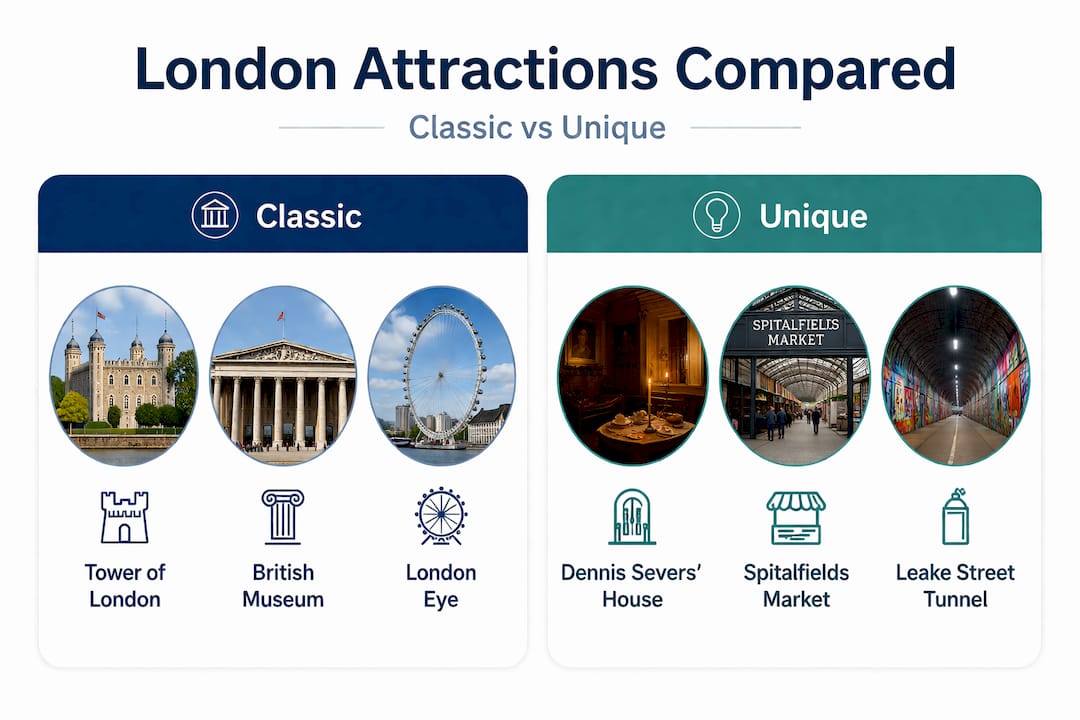
| Classic attraction | Unique alternative | Why it matters |
|---|---|---|
| Tower of London | Dennis Severs’ House, Spitalfields | Intimate, candlelit Georgian experience |
| Changing of the Guard | Household Cavalry Museum | See the horses up close, no crowds |
| Borough Market | Maltby Street Market | Smaller, less touristy, equally excellent food |
| National Gallery | Dulwich Picture Gallery | World-class art in a peaceful south London setting |
| Oxford Street shopping | Lamb’s Conduit Street | Independent boutiques, no chain stores at all |
The essential sights are essential for good reason. The British Museum houses one of the world’s greatest collections of human history, entirely free to enter, including the Rosetta Stone, the Elgin Marbles, and Egyptian mummies. The National Gallery on Trafalgar Square covers six centuries of European painting from Van Eyck to Van Gogh. The Tower of London tells the story of English monarchy with genuine drama. These are worth your time without apology.
However, London’s neighbourhoods offer hidden gems beyond the main tourist trail that reveal what the city actually feels like to live in. Some of the local gems to discover include:
- Leadenhall Market: A Victorian covered market in the City of London with extraordinary iron and glass architecture. Recognisable to Harry Potter fans as Diagon Alley
- Kyoto Garden, Holland Park: A Japanese garden tucked inside a west London park, complete with peacocks and a waterfall
- Postman’s Park, City of London: A small garden containing the Watts Memorial, a Victorian wall of ceramic tablets commemorating ordinary citizens who died saving others
- Columbia Road Flower Market: Open Sunday mornings only, this East End street transforms into a riot of colour and scent
- Leake Street Arches, Waterloo: A legal graffiti tunnel where street artists create enormous murals that change constantly
The tourist trap problem is real in London. The area immediately around Covent Garden, for instance, contains several restaurants that survive entirely on footfall rather than quality. The rule of thumb is simple: if the menu is laminated and features photographs of the food, keep walking. Equally, any café within 200 metres of a major museum entrance will charge a premium. Walk one street further and prices drop noticeably.
For must-see London sights that genuinely justify the hype, the view from the Tate Modern’s Switch House terrace at sunset is free and arguably better than the paid observation decks. Similarly, climbing to the top of Greenwich Park for a panoramic view of Canary Wharf and the Thames costs nothing and takes twenty minutes from Greenwich station.
Where to eat and drink in London
London’s food scene has undergone a transformation in the past two decades that makes it almost unrecognisable from its stodgy reputation. Each London neighbourhood has its own renowned food and drink venues, and navigating them well is one of the great pleasures of visiting the city.
Where to eat by budget and style:
- Budget (under £15 per person): Street food at Kerb markets, Bao’s bao buns in Soho, Roti King in Euston, Bleecker Burger in multiple locations
- Midrange (£20 to £45 per person): Dishoom Covent Garden for Bombay-style café food, Padella in Borough Market for fresh pasta, Manteca in Shoreditch for Italian-inspired modern cooking
- Splurge (£60 and above): Kiln on Brewer Street for northern Thai food, Brat in Shoreditch for Basque-influenced cooking, any of the river-facing restaurants along the South Bank
For a drink with genuine character, Gordon’s Wine Bar near Embankment is London’s oldest wine bar, dating to 1890, with low-ceilinged vaulted rooms that feel unchanged by the past century. It is a genuinely special experience and easy to overlook in favour of more polished options.
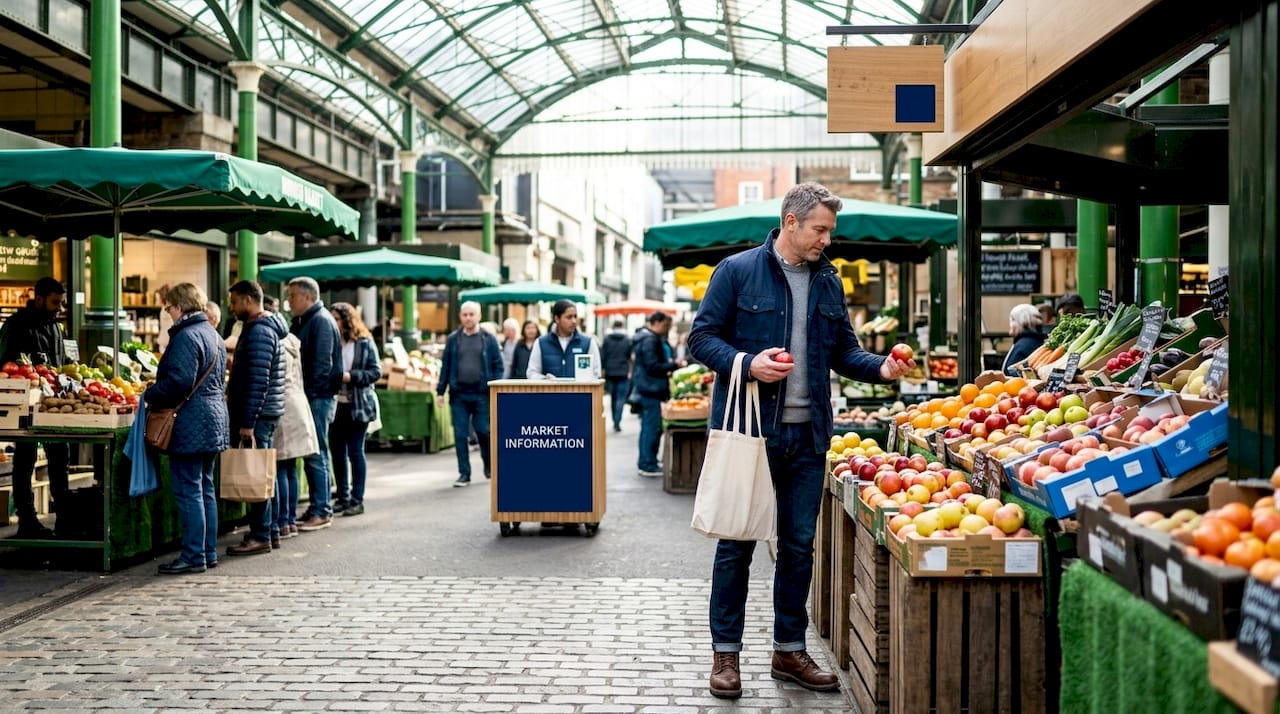
London’s markets deserve special attention. Borough Market near London Bridge operates Thursday to Saturday and is extraordinary for grazing. Maltby Street Market, a ten-minute walk away, is smaller and less known but equally high quality. Brixton Market covers everything from Jamaican patties to excellent Vietnamese sandwiches, all within a Victorian arcade.
For London’s best restaurants across all price points, the variety spans every global cuisine imaginable. Brick Lane remains famous for Bangladeshi curry houses, though the quality varies enormously between restaurants. Chinatown in Soho has been partly supplanted by better Chinese restaurants in Bayswater and around Golders Green. Asking a Londoner where they actually eat is always more valuable than reading tourist-oriented top ten lists.
Pro Tip: Restaurants in London do not expect you to tip beyond 12.5%, and that service charge is usually added automatically to your bill. You are legally entitled to remove it if service was poor. Tipping on top of the service charge is not expected and not necessary.
Booking is essential for popular restaurants at weekends. Many places open reservations exactly 28 days in advance at midnight, and tables at somewhere like Brat or Kiln vanish within minutes. If you cannot get a reservation, most restaurants hold back a portion of tables for walk-ins. Arriving at 5.30pm, before the main evening service, often secures you a spot without a booking.
Planning your London trip: timing, budgeting, and essential practicalities
The best time to visit London is a genuinely nuanced question, and the honest answer is that every season has real merits.
- May and June: Long days, relatively warm weather, Chelsea Flower Show, and the city at its most vibrant. Crowds are manageable
- July and August: Peak summer, school holidays, and the highest hotel prices of the year. Still enjoyable but considerably busier
- September and October: Often London’s most underrated months. Warm enough, far fewer tourists, and a rich programme of arts and culture
- November and December: Cold and grey, but Christmas markets, theatrical productions, and winter sales make it genuinely atmospheric
- January and February: The quietest and cheapest months. Museums are empty, hotels are affordable, and the occasional crisp, sunny winter day is spectacular
For budgeting, budgeting properly enhances the London experience, letting you enjoy more by making deliberate choices rather than being caught out by unexpected costs.
Essential packing list for London:
- A lightweight, packable waterproof jacket. London’s weather changes hourly
- Comfortable walking shoes. You will cover 15,000 to 20,000 steps daily without noticing
- A reusable water bottle. Tap water in London is perfectly safe and free to refill
- A small day bag. You will accumulate leaflets, market finds, and picnic supplies
Accommodation represents the largest single cost. Central hotels can easily cost £200 per night and above. Well-reviewed serviced apartments offer better value for stays of three nights or more. For London budget travel 2026, staying in a Zone 2 neighbourhood like Bethnal Green, Brixton, or Clapham cuts accommodation costs by 30 to 40% compared with Zone 1, with excellent Tube connections still providing fast access to central sights.
Pre-booking attractions saves both money and time. The Tower of London, Warner Bros. Studio Tour, and Kew Gardens all offer cheaper tickets when purchased in advance online. Several major museums and galleries including the British Museum, the National Gallery, the Victoria and Albert Museum, and the Tate Modern are entirely free to enter, meaning a culturally rich day out can cost almost nothing beyond food and transport.
Pro Tip: Avoid booking accommodation near a mainline terminus like King’s Cross, Paddington, or Victoria purely for the transport connections. These areas are busy, noisy, and rarely charming. A 10-minute Tube ride from a quieter neighbourhood is almost always the better choice.
How to experience the real London beyond the obvious
Here is something worth saying plainly: the visitors who leave London with the most vivid memories are rarely the ones who crammed in the most landmarks. They are the ones who let a neighbourhood pull them somewhere unexpected.
We have seen this pattern time and again. Someone arrives with a meticulously structured itinerary, every hour accounted for, and returns home having technically seen everything but experienced relatively little. Another visitor builds in long, lazy mornings with no particular plan, ends up following their nose down a cobbled Bermondsey side street at 7am, discovers a fantastic independent coffee roaster, gets talking to the owner, and learns about a local food market happening that afternoon. That is the version of London you will still be talking about in five years.
The truth is that London does not reveal itself to efficiency. It rewards curiosity. The city is full of experiences that exist entirely outside the tourist economy, that are not on any app or review site, that you only find by being present and unhurried in a single neighbourhood for a few hours. Exploring like a local means accepting that getting slightly lost in Hackney or Peckham is not wasted time. It is the whole point.
“Give yourself one completely unplanned afternoon. No map app. No agenda. Pick a neighbourhood you know nothing about and simply walk.”
The conventional advice says to see as much as possible. Our view is the opposite. Depth over breadth, every time. Pick five or six neighbourhoods that genuinely interest you, spend real time in each, and leave the rest for your next visit. Because there will be a next visit. London has a way of making that feel inevitable.
The other thing nobody says loudly enough: slow down in the museums. The British Museum is not something you experience in two hours. Pick three rooms, spend forty minutes in each, and actually look at what is in front of you. The Rosetta Stone surrounded by people taking photographs for thirty seconds each is one experience. Sitting quietly with the Lewis Chessmen for twenty minutes and reading about who might have carved them is another experience entirely.
Plan your London adventure with us
Ready to move from inspiration to an actual itinerary? The London Vacation Guide is built precisely for this moment. Whether you are visiting for the first time or returning to go deeper, our London for first-time visitors itineraries take the planning pressure off entirely, combining iconic highlights with the kind of local knowledge that only comes from genuinely loving this city. Browse our complete neighbourhood guides to find the areas that match your interests, whether that is art, food, history, nightlife, or green spaces. Every guide is practical, opinionated, and honest about what is actually worth your time.
Frequently asked questions
What is the best way to get around London as a tourist?
Using the Tube with a contactless bank card is the fastest and most cost-effective option, as the system applies daily fare caps automatically so you never overpay for travel.
Which London neighbourhoods should I stay in?
Central areas like Bloomsbury, Kensington, and London Bridge offer the best balance of convenience and local character, as each neighbourhood has distinct landmarks, atmosphere, and accessibility.
How much should I budget daily for sightseeing, food, and transport?
Most visitors spend between £80 and £150 per day covering attractions, meals, and travel, though budgeting strategically by using free museums and daily transport caps keeps costs significantly lower.
Is it necessary to pre-book tickets for major attractions?
Pre-booking is strongly recommended for paid attractions like the Tower of London and Kew Gardens, as it saves money and avoids queues, though London’s many free museums need no booking at all.
When is the best time of year to visit London?
May to September offers the warmest weather and a full calendar of outdoor events and festivals, while September and October combine decent weather with noticeably thinner crowds and lower hotel prices.
Recommended
- How to experience London like a local: your essential guide - The London Journal | London Vacation Guide
- London for First-Time Visitors: The Essential Guide | London Vacation Guide
- Discover local London: Why exploring beyond tourist spots matters - The London Journal | London Vacation Guide
- Streamline your London sightseeing: efficient workflow guide - The London Journal | London Vacation Guide
- Plan a perfect Scottish day trip from Edinburgh - Skye Highlands Tours