Streamline your London sightseeing: efficient workflow guide

TL;DR:
- Effective London sightseeing relies on structured planning and flexible workflows.
- Using a comprehensive itinerary template and transport tools ensures efficiency and reduces stress.
- Anticipating disruptions and building in buffers improve travel experience and enjoyment.
London is one of the most visited cities on earth, and yet a surprising number of visitors leave feeling they barely scratched the surface. The problem is rarely a lack of things to do. It is almost always a lack of structure. Without a clear sightseeing workflow, even the most enthusiastic traveller can find themselves standing at the wrong Tube exit, queuing for a sold-out attraction, or simply collapsing on a park bench by 2pm, exhausted and behind schedule. This guide walks you through exactly how to build an efficient London sightseeing workflow, from the tools you need before you arrive, to the troubleshooting techniques that save a day when things go sideways.
Table of Contents
- Preparing for success: What you need to design an efficient London sightseeing workflow
- Step-by-step workflow: Building your London sightseeing itinerary
- Adapting workflows for real-world constraints: Accessibility, stamina, and timing in London
- Troubleshooting and refining: Common workflow mistakes and how to fix them
- A local’s perspective: Why efficient workflows matter more than ever in London
- Continue your London sightseeing journey with expert guides
- Frequently asked questions
Key Takeaways
| Point | Details |
|---|---|
| Use structured templates | Centralising itinerary details minimises missed bookings and duplicate work for London sightseeing. |
| Optimise for real-world needs | Smart workflows balance timing, stamina, and accessibility for a smoother sightseeing experience. |
| Be flexible and adapt | Resilience in planning lets you turn unforeseen problems into memorable travel moments. |
| Refine with reflection | Post-trip review strengthens your process for future London adventures. |
Preparing for success: What you need to design an efficient London sightseeing workflow
After understanding common sightseeing frustrations, the next step is ensuring you are equipped for efficient planning. Preparation is not about spending hours at a desk before your holiday. It is about gathering the right ingredients so that when you sit down to plan, the process is fast, clear, and genuinely useful.
The single biggest mistake most visitors make is starting from scratch. They open a browser, search “things to do in London,” and immediately drown in thousands of options with no framework for choosing between them. AFFiNE describes a step-by-step process for travel workflow design, noting that an advanced approach for tourists who want less planning friction is to start with a structured itinerary template and then fill in personalised constraints. In other words, the template comes first. Your preferences slot in afterwards.
What you actually need before you start planning:
- A reliable itinerary template (digital or paper) that covers dates, transport legs, attraction timeslots, meal stops, and booking references
- Access to the TfL JourneyPlanner tool for real transport times between locations
- A shortlist of must-see attractions and a secondary list of flexible options
- Booking apps or websites for pre-purchasing tickets to high-demand venues
- An honest assessment of your group’s stamina, mobility needs, and budget
Personal constraints matter far more than most planning guides admit. A family with a pushchair needs step-free Tube access at every stop, which immediately rules out several central stations. A couple celebrating an anniversary might prioritise atmosphere over efficiency. A solo traveller on a tight budget will find enormous value in curating a day around London free experiences, which are genuinely world-class and often overlooked.
Comparing common planning tools:
| Planning method | Best for | Key advantage | Key limitation |
|---|---|---|---|
| Spreadsheet template | Detail-oriented planners | Fully customisable | Time-consuming to set up |
| App-based planner | Mobile-first travellers | Real-time updates | Requires internet access |
| Paper itinerary | Offline reliability | No battery dependency | Hard to edit on the go |
| Online itinerary template | First-time visitors | Pre-structured format | Less flexible for niche needs |
| Local expert advice | Complex or long stays | Insider knowledge | May not suit all budgets |
If you are visiting for the first time and want a proven structure to build from, a three-day London itinerary gives you a solid backbone to adapt rather than starting with a blank page. From there, you can swap out individual attractions based on your group’s interests, layering in the things to do for first-timers that genuinely deserve their reputation.
Pro Tip: Use a centralised itinerary document shared across your travel group. When everyone can see the same plan, you avoid double bookings, conflicting expectations, and the classic “I thought you booked the Tower of London” conversation at 9am.
Step-by-step workflow: Building your London sightseeing itinerary
Once you have the right tools and resources, it is time to put workflow theory into practice. Building a London sightseeing itinerary is not about listing every attraction you want to visit. It is about sequencing them intelligently so that you spend your energy on experiences, not logistics.
Structured, reusable templates centralise dates, accommodation, activities, transport, costs, and reservation links in one place. This single habit removes the most common source of on-the-ground confusion: not knowing where your booking confirmation is, or forgetting that the museum closes at 5pm on Tuesdays. When everything lives in one document, decisions become faster and stress drops noticeably.
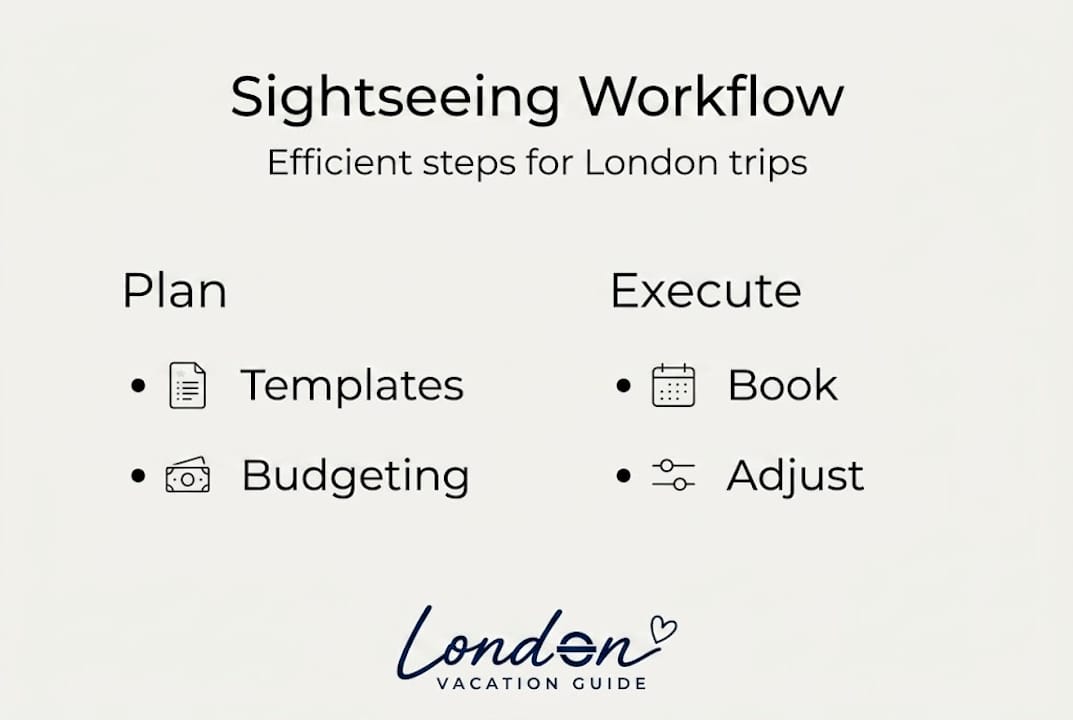
It is also worth noting that travel-planning quality depends on satisfying hard constraints while optimising for personal preferences. In practical terms, this means your non-negotiables (a specific show, a family member’s dietary requirement, a must-see exhibition) get locked in first. Everything else arranges itself around them.
Step-by-step workflow for building your itinerary:
- Define your goals. Are you after iconic landmarks, neighbourhood culture, food experiences, or a mix? Write down three priorities per day.
- List your options. Collect every attraction, restaurant, and experience you are considering without filtering yet. Quantity first.
- Apply hard constraints. Mark anything with a fixed time (pre-booked theatre tickets, timed museum entries, restaurant reservations). These anchor your day.
- Apply soft constraints. Factor in travel time between locations using TfL JourneyPlanner, typical queue lengths, and your group’s realistic pace.
- Sequence geographically. Group nearby attractions together to minimise unnecessary Tube journeys. London’s neighbourhoods are distinct enough that a well-planned day can feel like visiting three different cities.
- Add buffer time. Build in at least 30 minutes of unscheduled time per half-day. London almost always finds a way to use it.
- Confirm and book. Lock in any required bookings, save confirmation numbers to your shared document, and set reminders.
- Share the plan. Send the final itinerary to everyone in your group before departure day.
For inspiration on what to include, the hidden spots to add to any itinerary are often the moments people remember most vividly. Pairing a famous landmark with a lesser-known nearby gem creates a richer day than back-to-back bucket-list ticking.
Comparing planning approaches:
| Approach | Speed | Personalisation | Reliability | Best suited to |
|---|---|---|---|---|
| Manual planning | Slow | High | Variable | Experienced travellers |
| App or template-guided | Fast | Medium | High | First-timers and families |
| Local expert advice | Medium | Very high | High | Complex itineraries |
For a practical example of how these steps come together, the example London itinerary on this site shows exactly how geographic grouping, anchor bookings, and buffer time work in a real three-day plan.
Pro Tip: Build a “rainy day swap list” alongside your main itinerary. London’s weather is famously unpredictable. Having three indoor alternatives ready for each outdoor activity means a sudden downpour becomes a minor inconvenience rather than a ruined afternoon.
Adapting workflows for real-world constraints: Accessibility, stamina, and timing in London
With an itinerary in hand, smart travellers fine-tune their workflow for the realities of London’s environment. A plan that looks perfect on paper can unravel quickly when it meets the actual city. The Tube station you assumed was step-free is not. The queue for the attraction you wanted is an hour longer than expected. Someone in your group needs to eat every three hours or becomes impossible to be around.

These are not edge cases. They are the normal conditions of a London day out, and your workflow needs to account for them explicitly.
Efficient sightseeing in London is not simply about minimising travel time. It includes stamina management, bathroom realities, queue psychology, and accessible routing. The TfL JourneyPlanner tool is genuinely excellent for this. You can filter routes by step-free access, which is essential for pushchair users, wheelchair users, or anyone with mobility considerations. It also gives you realistic journey times rather than optimistic estimates.
“The biggest hidden cost of poor sightseeing planning is not money. It is energy. Groups that run out of stamina by early afternoon miss the best parts of the day, which in London often means the quieter, more atmospheric evening hours.”
In-the-moment adaptations for unexpected scenarios:
- Queue longer than 45 minutes: Move to your next attraction and return at a less busy time, typically late afternoon on weekdays
- Someone needs a rest: London’s parks are genuinely beautiful and free. Hyde Park, St James’s Park, and Regent’s Park are all within easy reach of central attractions
- Weather turns bad: Switch to your indoor alternatives immediately rather than waiting for conditions to improve
- A child or elderly group member is flagging: Build in a proper sit-down meal rather than eating on the go. It resets energy levels more effectively than a quick snack
- Transport disruption: The TfL app sends live alerts. Check it before leaving each location, not after you arrive at a closed station
- Toilet stops: Plan these around major attractions and department stores. London’s public toilet provision is inconsistent, and running out of options with a young child is genuinely stressful
For groups who want to experience the city at a manageable pace without the pressure of self-navigation, guided London walks offer a structured way to see multiple highlights while someone else handles the logistics. This is particularly effective for first-time visitors who want context alongside the sights.
Pro Tip: Schedule your highest-energy activities for the morning and your most relaxed experiences for the afternoon. Most people’s energy peaks before noon and drops significantly after 3pm. Matching your itinerary to your natural rhythm rather than fighting it makes an enormous difference to how much you enjoy the day.
Troubleshooting and refining: Common workflow mistakes and how to fix them
No plan survives reality untouched. Being ready to adjust and improve is the last vital ingredient of an efficient sightseeing workflow. The good news is that most planning failures are predictable, which means they are also preventable with a little foreknowledge.
Itinerary suggestions can fail in the presence of rare or unexpected conditions. Workflow design should always account for long-tail edge cases: the exhibition that closes unexpectedly, the restaurant that loses your reservation, the Tube line that suspends service. These things happen in London with enough regularity that treating them as surprises is itself a planning failure.
“The travellers who enjoy London most are rarely those with the most detailed plans. They are the ones whose plans are flexible enough to absorb the unexpected without falling apart entirely.”
Common workflow mistakes and what they actually cost you:
- Overstuffed days: Trying to visit six or seven major attractions in a single day is a recipe for exhaustion and resentment. You end up rushing through everything and genuinely enjoying nothing. Three to four well-chosen experiences per day is almost always more satisfying.
- Ignoring transit time: Central London looks compact on a map but is not. Walking from the British Museum to Borough Market takes over 40 minutes. Failing to account for this means you are perpetually late and perpetually stressed.
- Inflexible plans: Treating your itinerary as a contract rather than a guide creates unnecessary pressure. Build in decision points where you can choose to linger or move on based on how the day is actually going.
- Missing booking confirmations: Many of London’s most popular attractions, including the Tower of London, the Tate Modern special exhibitions, and the Sky Garden, require advance booking. Assuming you can walk up on the day is an increasingly unreliable strategy.
- Overlooking alternative activities: Having no backup options means a single closure or long queue derails your entire day.
Immediate troubleshooting steps when things go wrong:
- Pause and assess calmly. Identify what has changed and what options are still available.
- Check your backup list. If you prepared one, this is the moment it earns its place.
- Use TfL JourneyPlanner to find the fastest route to your nearest alternative.
- Communicate the change to your group clearly and positively. Framing it as an adventure rather than a failure genuinely affects how people experience the pivot.
- Note what went wrong for future reference. A brief note on your phone takes 30 seconds and is invaluable when planning your next visit.
Reflection questions for improving your workflow next time:
- Which parts of the day felt rushed, and what would you remove or shorten?
- Were there moments where more buffer time would have helped?
- Did everyone in the group feel their priorities were met?
- Were there any booking or access issues that could have been avoided with earlier preparation?
- What was the single best experience of the trip, and what made it work so well?
Iterative improvement is how casual visitors become genuinely skilled London explorers. Each trip teaches you something about the city’s rhythms, and each lesson makes the next visit more rewarding.
A local’s perspective: Why efficient workflows matter more than ever in London
There is a persistent myth in travel culture that the best experiences are spontaneous. Wander without a plan, the thinking goes, and you will stumble upon something magical. In some cities, this works reasonably well. In London, it is a fast track to spending three hours in the wrong neighbourhood, missing the last entry to a major attraction, and paying twice as much for a mediocre meal because you were too hungry to walk another five minutes.
This is not to say spontaneity has no place. It absolutely does. But there is a crucial difference between structured flexibility and no structure at all. The best London days we have seen are built on a solid workflow that handles the logistics invisibly, leaving genuine mental space for the unexpected detour, the conversation with a local, the gallery you wandered into on a whim. The workflow does not remove spontaneity. It creates the conditions for it.
The other myth worth challenging is the idea that seeing more is always better. London’s depth rewards slower, more deliberate attention. A single afternoon spent properly in one neighbourhood, eating well, reading the architecture, finding the where to eat across London spots that locals actually use, is worth more than a frantic morning ticking off five landmarks in a row.
Efficient workflows matter more than ever in London because the city is busier, more booked-up, and more complex to navigate than it was even a decade ago. The visitors who leave satisfied are almost always the ones who planned thoughtfully, built in flexibility, and treated their itinerary as a living document rather than a rigid schedule.
Pro Tip: After every London trip, spend ten minutes writing down what you would do differently. This single habit, done consistently, turns a good visitor into someone who genuinely knows the city.
Continue your London sightseeing journey with expert guides
Planning a London trip well takes time, local knowledge, and access to the right resources. At London Vacation Guide, we have built exactly that: a comprehensive, expertly curated resource covering everything from neighbourhood deep-dives to specific attraction guides. Whether you are trying to decide between areas to stay, looking for the best family-friendly days out, or wanting to know which iconic experiences are genuinely worth the queue, our guides give you the honest, practical information you need. Explore our London neighbourhood guides to understand the city area by area, or dive straight into specific experiences like the London Eye attraction to see what to expect before you arrive. Every guide is written to save you time, reduce friction, and help you experience more of what makes London genuinely extraordinary.
Frequently asked questions
What’s the single most important tool for efficient London sightseeing?
A structured itinerary template that centralises bookings, transport details, and constraints in one place is the most effective tool for frictionless London sightseeing. It removes the need to make repeated decisions under pressure and keeps your whole group aligned.
How do I make my London itinerary accessible for all in my group?
Use the TfL JourneyPlanner to plan step-free routes and identify stations with lift access, then build in regular rest stops to accommodate different energy levels across your group. Flagging accessibility needs before you finalise your route saves significant stress on the day.
How can I adjust my plans if something goes wrong on the trip?
Revisit your workflow, consult your backup list of alternative activities, and remember that itinerary suggestions can fail in unexpected conditions, so building flexibility into your plan from the start is the most reliable safeguard. A calm reassessment and a quick TfL check usually resolve most disruptions within minutes.
What are typical mistakes people make when planning London sightseeing?
People most commonly overfill their days with too many attractions, underestimate transit times between locations, and fail to pre-book tickets for high-demand venues like the Tower of London or popular museum exhibitions. Leaving no buffer time and having no backup plan for closures or bad weather are equally common and equally avoidable errors.
Recommended
- The Perfect 3-Day London Itinerary - The London Journal | London Vacation Guide
- Best Free Things to Do in London (2025 Guide) - The London Journal | London Vacation Guide
- Top 10 Things to Do in London for First-Time Visitors - The London Journal | London Vacation Guide
- Hidden London: Secret Spots Most Tourists Miss - The London Journal | London Vacation Guide