London made a decision decades ago that national museums should be free to enter. The result is one of the most extraordinary things about visiting the city: you can spend an entire week in world-class institutions and never pay a penny for admission. The British Museum, the Natural History Museum, the V&A, the National Gallery, Tate Modern, the Science Museum — all free. All open every day. All genuinely among the best of their kind on earth.
No other city offers this. It's one of the best arguments London has for itself, and it's still underused by visitors who spend £35 on the London Eye when a building full of dinosaurs and Tudor treasures is ten minutes away and costs nothing.
The British Museum — Where Civilisation Comes to Work
If you visit one museum in London, make it this one. The British Museum holds 8 million objects spanning two million years of human history: the Rosetta Stone, the Elgin Marbles, Egyptian mummies, the Lewis Chessmen, sutton Hoo helmet, Roman Britain's largest silver hoard. The scale is genuinely staggering — you could visit six times and still find rooms you've never been in.
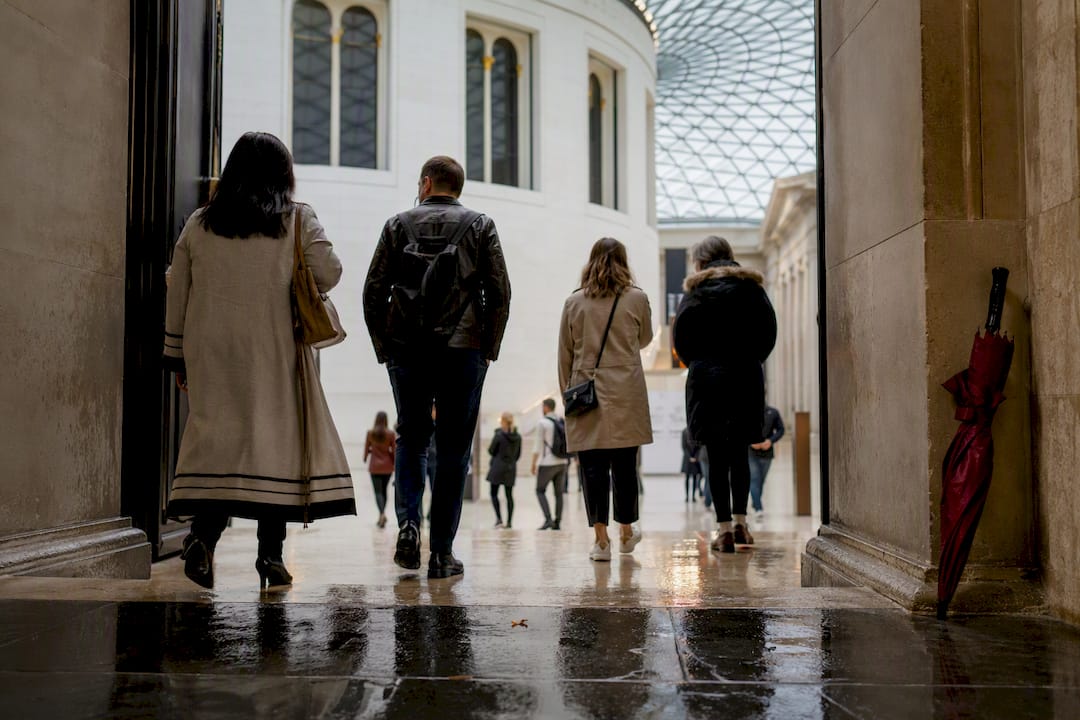
The building itself is worth the journey. The Great Court — a vast glass-roofed atrium wrapping around the circular Reading Room — is one of the finest interior spaces in London. Designed by Norman Foster and opened in 2000, it functions as a kind of covered public square in the middle of the museum complex.
Practical note: the permanent collections are free; major temporary exhibitions charge. Weekday mornings are significantly less crowded than weekends. The Bloomsbury neighbourhood surrounding the museum repays wandering — Bloomsbury has independent bookshops, Georgian squares, and a density of literary history that makes it worth an afternoon regardless.
Address: Great Russell Street, WC1B 3DG | Nearest tube: Holborn or Tottenham Court Road | Open: Daily 10am–5pm (Fri to 8:30pm)
The Natural History Museum — The Building Is the Exhibit
The Natural History Museum in South Kensington is one of the great Victorian civic achievements. Alfred Waterhouse's Romanesque terracotta building — 675 feet long, with towers and carved animals in every cornice — would be worth visiting even if it contained nothing. Inside, it contains rather a lot.
The Hintze Hall, formerly home to a diplodocus skeleton and now dominated by a full-size blue whale hanging from the ceiling, remains the best entrance of any museum in the world. Turning a corner to find a 25-metre whale suspended above your head is an experience that does not dim with repetition.
The dinosaur galleries are reliably excellent. The earthquake and volcano exhibits are interactive in ways that hold attention across age groups. The wildlife photographer of the year exhibition (permanent and ticketed) is one of the best photography shows in London, but the permanent collections are free and more than justify the visit on their own.
Address: Cromwell Road, SW7 5BD | Nearest tube: South Kensington | Open: Daily 10am–5:50pm
The V&A — Five Floors of Everything Humans Have Made
The Victoria and Albert Museum is harder to categorise than most. It describes itself as the world's largest museum of art and design, which is accurate but undersells the range: medieval Islamic tiles, Renaissance bronzes, 20th-century fashion, furniture from six continents, photography, jewellery, ceramics, stage costumes, surgical instruments, and a cast of Trajan's Column that takes up an entire two-storey gallery because there was no other way to house it.
145 galleries. A John Madejski Garden that functions as an outdoor sculpture court. A cafe in a Victorian dining room that is itself worth visiting as an interior. The John Soane staircase. The Raphael Cartoons — seven enormous 16th-century tapestry designs on long-term loan from the Royal Collection.
The V&A is also next door to the Natural History Museum and a three-minute walk from the Science Museum, which makes South Kensington the most concentrated museum district in Europe. Plan accordingly.
Address: Cromwell Road, SW7 2RL | Nearest tube: South Kensington | Open: Daily 10am–5:45pm (Fri to 10pm)
Tate Modern — Contemporary Art in an Industrial Cathedral
The Tate Modern opened in 2000 in the Bankside Power Station on the South Bank and immediately became one of the most visited art museums in the world. The Turbine Hall — a former power station hall 35 metres high and 155 metres long — anchors the building architecturally. It hosts large-scale commissioned works that no other museum in the world has the space to attempt.
The permanent collection — Picasso, Rothko, Bourgeois, Hepworth, Warhol, Hockney, Basquiat — is free and housed across two buildings connected by a bridge. The collection is organised thematically rather than chronologically, which is either refreshing or disorienting depending on your tolerance for curation theory.
The top-floor restaurant and the viewing gallery on Level 10 offer some of the best views of St Paul's Cathedral and the City skyline in London. Neither requires a ticket to access.
Address: Bankside, SE1 9TG | Nearest tube: Southwark or London Bridge | Open: Daily 10am–6pm (Fri–Sat to 10pm)
Smaller Museums Worth the Detour
The four institutions above are the obvious starting points. These are the ones worth seeking out specifically:
Sir John Soane's Museum (Lincoln's Inn Fields, WC2A 3BP): The eccentric architect's personal collection, packed into a Georgian townhouse with mirrors, skylights, and hidden panels. Free. One of the strangest and most affected spaces in London. Timed entry required — book in advance.
Wallace Collection (Manchester Square, W1U 3BN): Free. A private collection of Old Masters, French furniture, medieval armour, and Sevres porcelain in Hertford House, a mansard-roofed mansion north of Oxford Street. Routinely described as London's best-kept secret by people who haven't actually kept it much of a secret.
Horniman Museum (Forest Hill, SE23 3PQ): Free. Natural history, music instruments, aquarium, and a walrus taxidermy that has become something of an internet celebrity. Worth the trip south if you want a museum that feels genuinely local rather than international destination.
How to Beat the Crowds
The British Museum and Natural History Museum draw millions of visitors annually. Peak crowding: Saturday and Sunday 11am–3pm, school half-terms, and bank holidays. The practical moves:
Arrive at opening time on a weekday. The first hour of the day at the Natural History Museum is noticeably quieter than mid-morning. The British Museum's Great Court fills up by 10:30am on weekends — arriving at 10am makes a real difference.
Use the back entrance. The British Museum has a less-used entrance on Montague Place — queues there are typically shorter than the main Great Russell Street gate.
Free lates. The V&A runs Friday Late events on the last Friday of each month, with special programming, the building to yourself at 7pm, and a very reasonable bar in the courtyard. Tate Modern is also open late on Friday and Saturday evenings, with crowds that thin significantly after 6pm.
Planning Your Museum Day
The three museums of South Kensington — V&A, Natural History Museum, Science Museum — are all within a five-minute walk of each other, which makes them naturally grouped. Budget a minimum of two hours per museum; a full day covering all three is ambitious but achievable if you move purposefully.
The Bloomsbury cluster (British Museum, British Library, Wellcome Collection) rewards a different kind of day: slower, more literary, with better coffee options in the surrounding streets. Spend the morning at the British Museum, lunch in Bloomsbury, afternoon at the British Library's free public galleries (current exhibitions, the Magna Carta, Shakespeare's First Folio).
The South Bank cluster (Tate Modern, Design Museum near Kensington, Fashion and Textile Museum in Bermondsey) works well combined with a walk along the river from Waterloo to London Bridge — about 40 minutes at a relaxed pace, passing most of the cultural institutions without requiring you to go inside any of them.