How to navigate London music venues: plan your gig night
Tonight’s plan in three venues: start at KOKO in Camden (mid-size, electric atmosphere, Northern line), move to The Jazz Café five minutes’ walk away for late-night jazz, then finish at Moth Club in Hackney if you want something smaller and weirder. That cluster keeps you in north and east London, avoids cross-city tube chaos, and covers three completely different experiences in one evening. London’s music scene rewards geography-first planning — treat it like a neighbourhood crawl, not a venue-hopping marathon.
Tonight’s quick checklist:
- Tickets confirmed and downloaded (screenshot them — signal drops underground)
- Photo ID in your pocket (under-25s especially: Challenge 25 is real at most venues)
- Doors time noted, not show time — arrive 20–30 minutes after doors for standing rooms
- Curfew checked: many venues in residential areas stop amplified music by 11pm or midnight
- Night Tube or last bus route confirmed before you leave the house
- Cloakroom cash ready (most charge £2–£3 per item; card not always accepted)
- Meeting point agreed outside the venue, not inside
What to expect at a glance:
- Standing mid-size rooms (500–2,000 capacity): lively, loud, arrive early for a good position
- Seated theatres: more relaxed, assigned seats, photography usually restricted after the first song
- Grassroots/intimate venues (under 300): cash bar, no support act, doors often at 7:30pm
- Ticket prices vary roughly by venue size, with grassroots venues generally lower priced than mid-size or arena shows.
- Booking fees typically add 5–10% on top of the face value
Table of Contents
- Which London venues suit your night?
- Where are London’s hidden-gem music venues?
- How to plan an efficient gig night by neighbourhood
- What do you need to know about tickets and door policies?
- Accessibility and crowd etiquette at London venues
- How much does a night out at a London music venue cost?
- What are the best apps for finding gigs across London?
- Key takeaways
- What most guides get wrong about London’s music scene
- London Vacation Guide has the neighbourhood planning covered
- Useful sources
- FAQ
Which London venues suit your night?
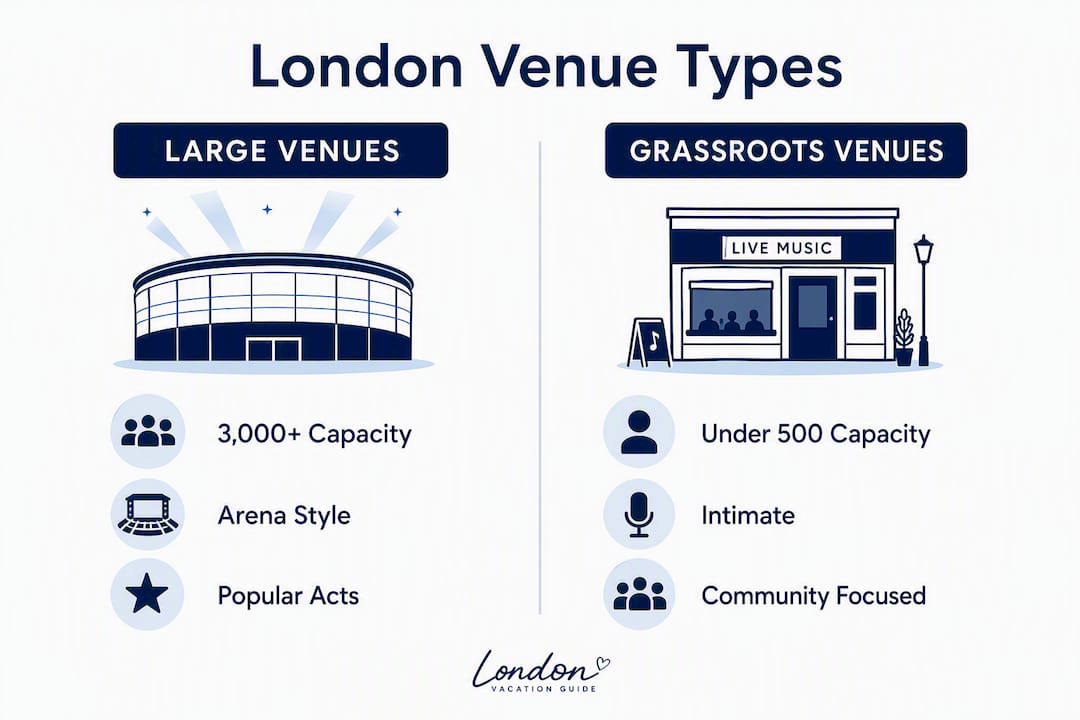
London’s live music offer ranges from large arenas with tens of thousands capacity to small basement rooms holding fewer than a hundred people, and the gap between them is not just size. The atmosphere, crowd behaviour, ticket price, and even the sound quality shift dramatically across categories. Here is how to read the map.
Arena and large venues (3,000+ capacity)
O2 Academy Brixton (Brixton, Victoria line) is the gold standard for large club-style shows, with a capacity for thousands, a raked floor, and a sound system that suits rock, hip-hop, and electronic acts equally well. It books consistently strong headliners and sells out fast. Alexandra Palace (Ally Pally, Overground from Finsbury Park) is a different beast: a Victorian exhibition hall that holds large audiences and delivers a genuinely spectacular setting, though the acoustics can be uneven depending on where you stand. Eventim Apollo in Hammersmith (District and Piccadilly lines) is a seated theatre with art deco bones and near-perfect sightlines — it suits orchestral pop, comedy, and classic-rock acts better than anything that needs a mosh pit.
Mid-size rooms (1,000–3,000 capacity)
Roundhouse in Camden (Chalk Farm, Northern line) is a converted Victorian engine shed with a circular layout that puts almost every audience member close to the stage. It programmes a diverse range of music and performance arts. Shepherd’s Bush Empire (Shepherd’s Bush, Central line) is a three-tiered Victorian theatre with a standing floor and two balconies, known for excellent sightlines. KOKO (Mornington Crescent, Northern line) reopened after a major refurbishment and now combines a spacious main room with a rooftop bar and multiple smaller stages — worth arriving early to explore the building.
“London’s music venues are not clustered in one district the way Nashville’s are on Broadway or New York’s in the East Village. The city’s best rooms are spread across a dozen neighbourhoods, each with its own character. Plan by area, not by name.” — Mood, Music Events in London guide
Intimate and grassroots venues (under 500 capacity)
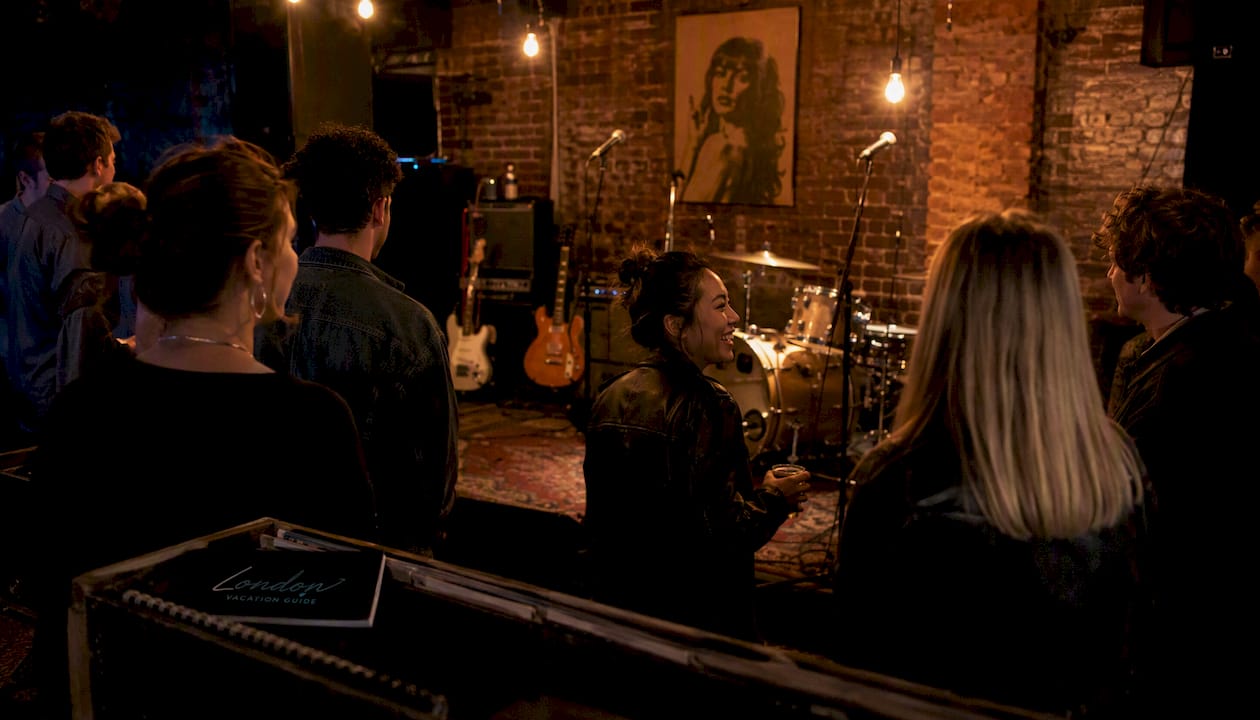
100 Club on Oxford Street (Tottenham Court Road, Central/Northern lines) has been running since 1942 and hosted the Sex Pistols, the Rolling Stones, and Oasis. The low ceiling and narrow room create an intensity that larger venues simply cannot replicate. Village Underground in Shoreditch (Shoreditch High Street, Overground) is built into converted Tube carriages on a railway arch and programmes art-forward electronic and indie shows. Moth Club in Hackney (Hackney Central, Overground) is a converted working men’s club with a sprung dancefloor and a genuine sense of community — the programming leans DIY and queer-friendly.
Jazz and classical
The Jazz Café in Camden (Camden Town, Northern line) runs nightly shows across jazz, soul, and Afrobeats with a balcony restaurant overlooking the stage — one of the few venues where dinner and a headline act genuinely work together. Union Chapel in Islington (Highbury & Islington, Victoria/Overground) is a working Gothic church that doubles as a concert venue; the acoustics are extraordinary for acoustic and orchestral acts. For dedicated jazz, Ronnie Scott’s in Soho has run nightly since 1959 and programmes 104 dates in July alone according to Mood, making it the most reliable jazz calendar in the city.
Hootananny in Brixton (Brixton, Victoria line) sits in a different register: a reggae and world-music pub venue with a free entry policy on many nights, a roof terrace, and a relaxed atmosphere that suits spontaneous evenings.
Where are London’s hidden-gem music venues?
The venues that rarely make the mainstream lists are often the ones worth seeking out. Independent venues like Village Underground and Hootananny function as community hubs as much as concert spaces, combining live shows with food stalls, club nights, and neighbourhood events. That dual identity means the crowd is different — more local, more invested, less tourist-facing.
A few rooms that consistently punch above their weight:
- The Garage — (Highbury, Highbury & Islington station): an indie and rock institution since 1993 that many bands treat as a rite of passage before stepping up to larger rooms
What makes these rooms different from the mid-size circuit is the atmosphere. Sound bounces off low ceilings, you can see the sweat on the guitarist’s face, and the bar queue is three people long. There is no production budget, which means the performance has to carry the night.
Pro Tip: Sign up to venue mailing lists directly — Moth Club and Village Underground both send weekly emails with unannounced additions and last-minute support act news that never appears on aggregators. Local Facebook groups for Hackney and Brixton gig-goers are also worth joining for pop-up show alerts.
How to plan an efficient gig night by neighbourhood
The single biggest mistake visitors make is treating London as one music district. Seasoned planners recommend building itineraries by area, not by venue name, because cross-city travel between shows can eat 45 minutes each way. London’s music circuits cluster naturally into five zones.
The five neighbourhood circuits:
- Islington/Highbury: — Union Chapel, The Garage (Angel and Highbury & Islington stations, both on the Victoria line)
Sample two-venue evening: Camden to Brixton
Doors at KOKO at 7pm, support act at 8pm, headline at 9pm, finish by 11pm. Jump on the Northern line south to Stockwell, change to the Victoria line, arrive Brixton by 11:20pm. Hootananny’s late bar runs until 2am on weekends. Total travel: 20 minutes.

Sample three-venue evening: Shoreditch cluster
Village Underground doors at 7pm, finish by 10pm. Walk 12 minutes to Moth Club for a 10:30pm club night. Overground from Hackney Central back to Liverpool Street by 1am. No zone changes, no taxis required.
Transport checklist:
- Night Tube runs on the Central, Jubilee, Northern, Piccadilly, and Victoria lines on Fridays and Saturdays
- Night buses (N-prefix routes) cover most of the city when the Tube stops around midnight on weekdays
- Overground services stop earlier than the Tube — check the last train time before you go
- Ride-hail apps (Uber, Bolt) surge-price heavily after midnight near large venues; book 10 minutes before the show ends
- Black cabs are metered and safer for late-night solo travel; find a licensed rank rather than hailing from the pavement
Pro Tip: Reorder your venues by curfew, not by preference. If one venue finishes at 10:30pm and another at midnight, visit the earlier one first — you will never regret arriving at the second venue with time to spare.
What do you need to know about tickets and door policies?
Buy direct from the venue website or an authorised platform (Dice, Ticketmaster, See Tickets, Skiddle) wherever possible. Third-party resale sites charge significantly more and occasionally sell invalid tickets. Booking fees typically run 5–10% on top of face value — that is £1.50–£3 on a £20 grassroots ticket, or £6–£12 on a £60 mid-size show.
Door policy checklist:
- Photo ID (passport or driving licence) required at most venues for Challenge 25 alcohol checks
- E-tickets: screenshot them before you leave — venue scanners often struggle with low-brightness screens
- Cloakroom: most mid-size and large venues have one; expect £2–£3 per item, cash preferred
- Photography: usually permitted during the first song only at headline shows; flash is almost universally banned
- Late entry: most venues allow it, but you may miss the support act and lose your standing position
- Support acts: typically start 30–45 minutes after doors open; worth arriving for, especially at grassroots venues where the support is often the discovery
Licensing curfews are a genuine constraint. Many venues in residential areas must stop amplified music by 11pm; some clubs are licensed until midnight or later, but confirm before you go. A 10:30pm headline start at a venue with an 11pm curfew means a 25-minute set — it happens.
For popular shows, large venues often book six to twelve months ahead of peak dates. If you are planning around a specific artist, set an alert the moment the tour is announced.
Pro Tip: For sold-out shows, check the venue’s own social media on the day — venues occasionally release returned or unclaimed tickets in the 24 hours before doors. Dice has a built-in waiting list feature that automatically offers you a ticket if one becomes available, without the need to monitor the page manually.
Accessibility and crowd etiquette at London venues
Most major London venues offer step-free access, accessible toilets, and companion ticket schemes, but the details vary enough that you should check before buying. The O2 Academy Brixton, Roundhouse, and Eventim Apollo all have dedicated accessibility booking lines and clearly marked viewing platforms. Smaller venues are less consistent — Union Chapel’s Victorian layout means some areas involve steps, though accessible seating is available on request.
How to check accessibility before you go:
- Visit the venue’s own website; most have a dedicated accessibility page
- Call the box office directly for specific requirements (hearing loops, BSL-interpreted shows, wheelchair spaces)
- Book accessible tickets through the venue directly rather than a third-party platform, where companion ticket policies may not apply
- Arrive earlier than the general crowd — accessible entrances sometimes have shorter queues but separate check-in points
Crowd etiquette: the unwritten rules
- Standing rooms: if you arrive late, work your way forward gradually and politely — pushing through a settled crowd is genuinely antisocial
- Photography: one or two shots at the start of a set is accepted; holding your phone up for an entire song blocks the view for everyone behind you
- Seated venues: stay in your assigned seat; moving to empty seats in better rows is frowned upon and stewards will move you back
- Volume: talking loudly during a quiet acoustic set is the fastest way to make enemies at Union Chapel or a jazz room
- Crowd safety: if you feel unsafe or see someone in distress, find a steward immediately — they are stationed at the edges of standing areas and near the bar
Licensing curfews affect the crowd as much as the artist. When a venue’s licence requires music to stop at 11pm, the lights come up sharply and the crowd moves fast. Have your exit route planned before the last song.
How much does a night out at a London music venue cost?
Ticket prices vary by venue size and genre more than by day of the week for attendees, though midweek shows can be significantly cheaper than equivalent weekend dates than equivalent weekend dates — particularly at mid-size rooms where promoters pass on lower hire costs.
| Venue type | Typical ticket range | Booking fee | Drinks (pint) | Cloakroom |
|---|---|---|---|---|
| Grassroots (under 300) | £8–£20 | 5–10% | £5–£7 | £2–£3 |
| Mid-size (500–2,000) | £20–£60 | 5–10% | £6–£8 | £2–£3 |
| Large/arena (3,000+) | — | 5–10% | £7–£9 | £3–£5 |
| Jazz/classical (seated) | £15–£60 | 5–10% | £6–£8 | £2–£3 |
A realistic budget for a mid-size standing show: £35 ticket, £3 booking fee, two drinks at £7 each, £3 cloakroom, £5 transport. That is roughly £60 for the evening, before food.
Money-saving tactics:
- Buy direct from the venue website — some venues (including Dice-partnered rooms) charge lower fees than Ticketmaster
- Midweek shows at mid-size venues often have the same lineup at a lower price; Tuesday to Thursday is the sweet spot
- Early-bird tickets released at announcement are almost always the cheapest tier — set an artist alert on Songkick or Dice
- Eat before you arrive; venue food is expensive and the queues are long during changeovers
- Check whether the venue has a free entry night (Hootananny runs several per week) for a low-cost discovery option
For readers planning a venue hire rather than attending as an audience member, sound engineers and technical staff typically cost an additional £300–£800 on top of the room hire fee.
What are the best apps for finding gigs across London?
London’s music calendar is genuinely fragmented. Mood tracks several thousand London events in a single month and recommends using an aggregated feed with genre, area, and date filters rather than checking individual venue websites. No single venue covers the full picture.
The most useful platforms:
- Dice: the cleanest app for buying and discovering shows; built-in waiting lists for sold-out events; strong on grassroots and electronic
- Songkick: artist-first discovery; set alerts for specific acts and it notifies you the moment London dates are announced; currently lists over 6,000 upcoming London events
- Skiddle: broad searchable London gigs and concerts listing with direct ticket links; useful for last-minute checks
- Mood: aggregates across hundreds of venues and promoters; filter by genre and postcode; strong for jazz and club nights
- Resident Advisor: the definitive source for electronic music and club nights; covers Fabric, Village Underground, and smaller Hackney rooms
How to build a reliable alert system:
- Follow your five or six most-visited venues on Instagram — most post unannounced additions to their programme within 24 hours of confirming them
- Sign up to venue mailing lists (KOKO, Roundhouse, and Union Chapel all send weekly newsletters with priority booking windows)
- Set artist alerts on Songkick and Dice simultaneously — the two platforms occasionally list different promoter-held dates
- Check Skiddle on Thursday evening for the coming weekend; last-minute additions often appear mid-week
- Join the venue’s own Facebook event pages — Moth Club and Village Underground use them for pop-up announcements
Pro Tip: Combine Dice for discovery and buying with Songkick for artist tracking. The two together cover roughly 90% of London’s ticketed programme. Add your two or three favourite venue mailing lists and you will rarely miss a show worth attending.
Key takeaways
London’s live music scene rewards neighbourhood-first planning: cluster your venues by area, confirm curfews before you go, and buy tickets direct to avoid inflated fees.
| Point | Details |
|---|---|
| Plan by neighbourhood | Group venues by area (Camden, Brixton, Shoreditch) to keep travel under 20 minutes between shows. |
| Check curfews early | Many venues stop amplified music by 11pm; confirm the licence before building your evening around a late headline. |
| Buy direct, save on fees | Booking fees typically run between 5–10%; buying via the venue site or Dice often means lower charges than third-party resellers. |
| Midweek saves money | Tuesday to Thursday shows at mid-size venues can cost 30–50% less than the same room on a Friday or Saturday. |
| London Vacation Guide for planning | Use London Vacation Guide’s neighbourhood guides and events calendar to build a full gig-night itinerary by area. |
What most guides get wrong about London’s music scene
The conventional advice is to pick a famous venue and build the night around it. That works in cities where the best rooms are within walking distance of each other. London is not that city.
The real skill is treating the Tube map as your setlist. Camden to Brixton is 20 minutes on the Northern and Victoria lines. Shoreditch to Hackney is two stops on the Overground. Hammersmith to Shepherd’s Bush is a five-minute walk. Those clusters are where the best evenings happen, not because the venues are necessarily better, but because you arrive relaxed rather than frantic from a 45-minute cross-city journey.
There is also something worth saying about the grassroots rooms. The 100 Club, Moth Club, and Hootananny are not consolation prizes for people who could not get tickets to the O2 Academy Brixton. They are a different category of experience. The intimacy changes what a performance means — you hear the room breathe, you notice the guitarist’s choices, and you leave knowing you saw something rather than attended something. The best evening I have planned recently involved arriving at Village Underground at 7:30pm, catching a support act nobody in the room had heard of, and spending the next week listening to nothing else.
One timing insight that does not appear on any listings page: for standing mid-size rooms (KOKO, Shepherd’s Bush Empire, Roundhouse), arriving 15 minutes after doors open rather than at doors gives you a crowd that has settled but a floor that is not yet packed. You get a good position without the 30-minute wait at the barrier.
London Vacation Guide has the neighbourhood planning covered
Knowing which venues to visit is only half the plan. The other half is knowing where to eat beforehand, which area to stay in, and how to connect a gig night to the rest of your time in the city. London Vacation Guide’s neighbourhood guides cover every major music circuit in the city, from Camden and Shoreditch to Brixton and Hammersmith, with pre-gig dining options, transport notes, and local context that listings pages do not carry.
For visitors fitting a gig night into a short stay, the first-time visitor itinerary shows how to build a full day around a headline show, including where to eat near the venue and how to get back to your hotel after midnight. The London events calendar pulls together what is on across the city so you can match your dates to the right neighbourhood before you book anything.
Useful sources
The following resources are worth bookmarking for keeping your London music calendar current:
- Mood: Music Events in London — aggregates thousands of London events with genre and area filters; the most comprehensive single feed for the city’s fragmented calendar
- Dice — best for grassroots and independent venue discovery, with built-in waiting lists for sold-out shows
- Songkick — artist-first alerts; set a notification for any act and it catches London dates the moment they are announced
- Skiddle — broad searchable listings with direct ticket links; reliable for last-minute weekend checks
- Ronnie Scott’s — the definitive jazz calendar; programmes nightly and publishes its full schedule months in advance
- ICMP venue guide — curated profiles of London’s most iconic independent rooms with programming character notes
- UK Venue Guide — practical detail on door policies, licensing, and venue hire for anyone planning beyond attending as an audience member
- London Vacation Guide events calendar — pairs venue listings with neighbourhood context and dining recommendations for a complete evening plan
FAQ
What are the best music venues in London?
The answer depends on what you want from the night. For mid-size shows with great sound, Shepherd’s Bush Empire and KOKO in Camden are consistently excellent. For intimacy, the 100 Club and Moth Club are hard to beat. For jazz specifically, Ronnie Scott’s programmes nightly and is the most reliable room in the city.
What are some hidden-gem music venues in London?
Moth Club in Hackney, Upstairs at Ronnie’s in Soho, and Hootananny in Brixton are three rooms that rarely appear on mainstream lists but deliver consistently strong nights. Independent venues like these often combine live music with food stalls and community events, making them worth visiting even on a quiet week.
What are some good small music venues in London?
The 100 Club (Oxford Street), Village Underground (Shoreditch), Union Chapel (Islington), and Moth Club (Hackney) all hold under 500 people and offer a level of intimacy that larger rooms cannot match. Ticket prices at these venues typically run £8–£20, and the programming skews towards emerging and independent artists.
How do I start finding gigs in London?
Set artist alerts on Songkick and Dice, then add two or three venue mailing lists (KOKO, Roundhouse, and Moth Club are good starting points). Skiddle’s London listings are useful for a broad weekly sweep, and Mood’s aggregated feed filters by genre and postcode if you want to stay within a specific neighbourhood.
Is it worth going to grassroots venues rather than big arenas?
Yes, for a different reason than most people expect. Grassroots rooms like the 100 Club and Moth Club offer an intensity and proximity to the performance that large venues structurally cannot. They also tend to programme artists earlier in their careers, which means you often see someone genuinely exciting before the tickets become more expensive.
Recommended
- London art gallery guide: navigate the city’s best art - The London Journal | London Vacation Guide
- London parties: your complete guide for 2026 - The London Journal | London Vacation Guide
- London restaurant tips: your 2026 insider guide - The London Journal | London Vacation Guide
- London for First-Time Visitors: The Essential Guide | London Vacation Guide