Cycling routes guide London: plan safe, scenic rides
The best London rides fall into three types: riverside and canal loops, royal park circuits, and suburban trails like the Wandle Trail that follow the National Cycle Network. Start with whichever matches your time and confidence, then open the TfL cycle map or TfL Go before you touch the pedals.
Three routes worth bookmarking right now: a Thames riverside loop of roughly 27 kilometres for sightseeing, a shorter city highlights ride through central London’s landmarks, and the 14.5 kilometre Wandle Trail for a quieter, greener suburban run. Each suits a different mood, and none requires technical skill or racing fitness.
Before you go further, do three things:
- Open TfL Go or the TfL cycle map and check Cycleways near your start point.
- Check Santander Cycles docking availability if you’re hiring rather than riding your own bike.
- Pack a helmet, charge your lights, and check tyre pressure. Even a short ride benefits from five minutes of prep.
Key Takeaways
The safest, most rewarding London rides combine TfL’s official routing tools with a route matched honestly to your riding ability and available time.
| Point | Details |
|---|---|
| Open TfL Go first | Check Cycleways, leisure routes and Santander Cycles docking availability before setting off. |
| Match route to ability | Beginners suit park loops and short Wandle Trail sections; advanced riders can tackle the full 27 km Thames loop. |
| Check junctions and access rules | Cycling is banned in the Greenwich Foot Tunnel, so plan a ferry or train crossing instead. |
| Use route key facts as filters | Distance, surface and traffic-free percentage matter more than total distance alone. |
| Plan your day with London Vacation Guide | Pair a route with our neighbourhood guides and first-time visitor itinerary for lodging, food and sightseeing nearby. |
Table of Contents
- Which official maps and apps should you open first?
- What are the best leisure cycling routes in London?
- How do you hire a bike in London?
- How do you plan a safe cycling route in London?
- Which routes suit your riding ability?
- How can you make a London bike ride genuinely memorable?
- What should you pack and know before setting off?
- Are London’s cycling routes accessible for disabled riders?
- A local’s take on the best way to spend a cycling day in London
- How London Vacation Guide can help you plan the perfect cycling day
- Sources
- FAQ
Which official maps and apps should you open first?
TfL is the authority for cycle routing in London, and its tools are free, current, and built specifically around Cycleways, leisure routes and docking data. Three sources do almost all the work: the TfL cycle map, the TfL Go app, and TfL’s leisure routes pages, which include themed printable rides such as quirky London, Saturday markets and secret gardens.
Beyond TfL, the National Cycle Network (maintained by Sustrans and, for southwest London specifically, the Walk Wheel Cycle Trust) fills in the suburban and semi-rural gaps that TfL’s central-London focus doesn’t cover. If you’re heading out to somewhere like the Wandle Trail, that’s the network to check.
Here’s how to actually use these tools in sequence:
- Open the TfL cycle map and filter for Cycleways near your starting postcode.
- Cross-check Santander Cycles docking station availability in TfL Go if you plan to hire rather than ride your own bike.
- Save the route offline or export a GPX file if your phone signal is unreliable along riverside or park stretches.
- Check the National Cycle Network page for your route if it runs outside central London, since surface and traffic-free percentages are published there in more detail than on TfL’s own pages.
TfL has also worked with Google Maps to fold live cycling data into mainstream navigation, so routing information keeps improving even outside TfL’s own apps. If junctions make you nervous, TfL’s Cycle Skills Online offers free training resources aimed at exactly that problem, and it’s worth ten minutes before your first central-London ride.
What are the best leisure cycling routes in London?
Seven routes cover most of what a visiting or local cyclist actually wants: river views, park greenery, canal life, and one proper suburban escape.
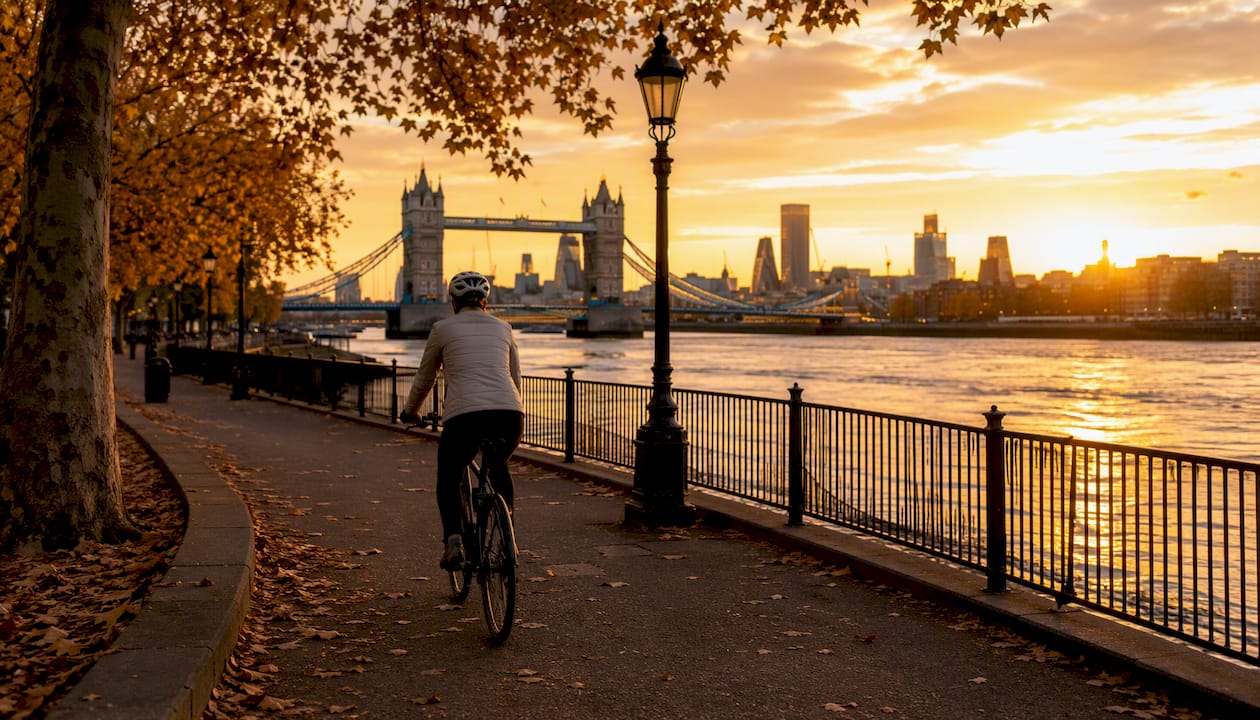
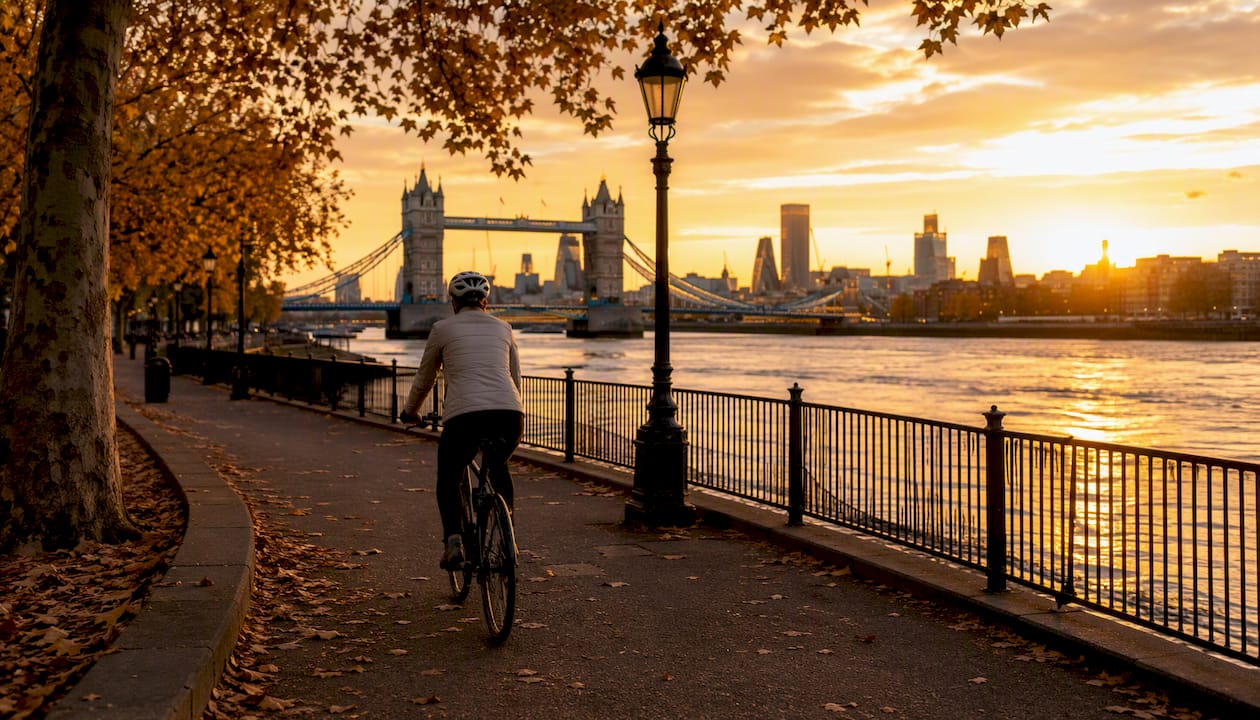
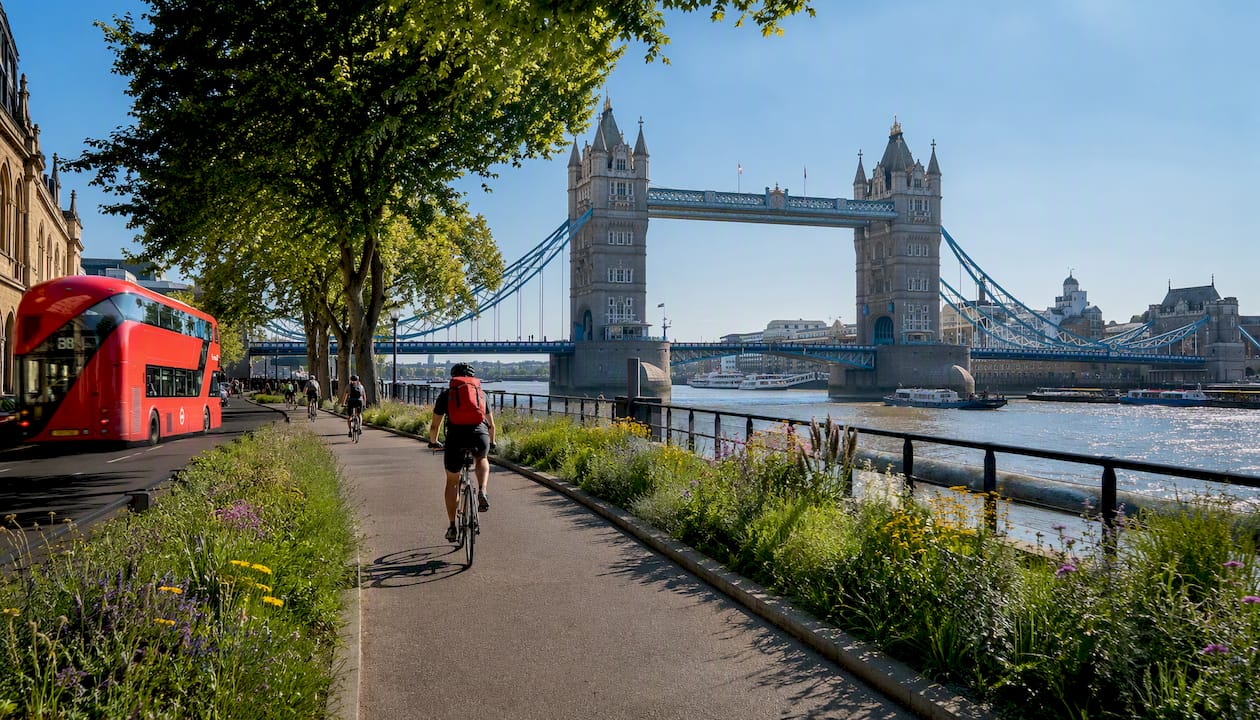
Thames riverside loop. A visitor-focused circular route covering roughly 27 kilometres along both banks of the river, taking in the South Bank, Tower Bridge and Greenwich sightlines. Start near Westminster and ride the loop clockwise so you hit the busier tourist stretches earlier in the day, before the crowds build.
City highlights ride. Cycling UK’s London sightseer route strings together major landmarks on a manageable day route, and Cycling UK specifically recommends booking hire bikes ahead during summer, when demand spikes.
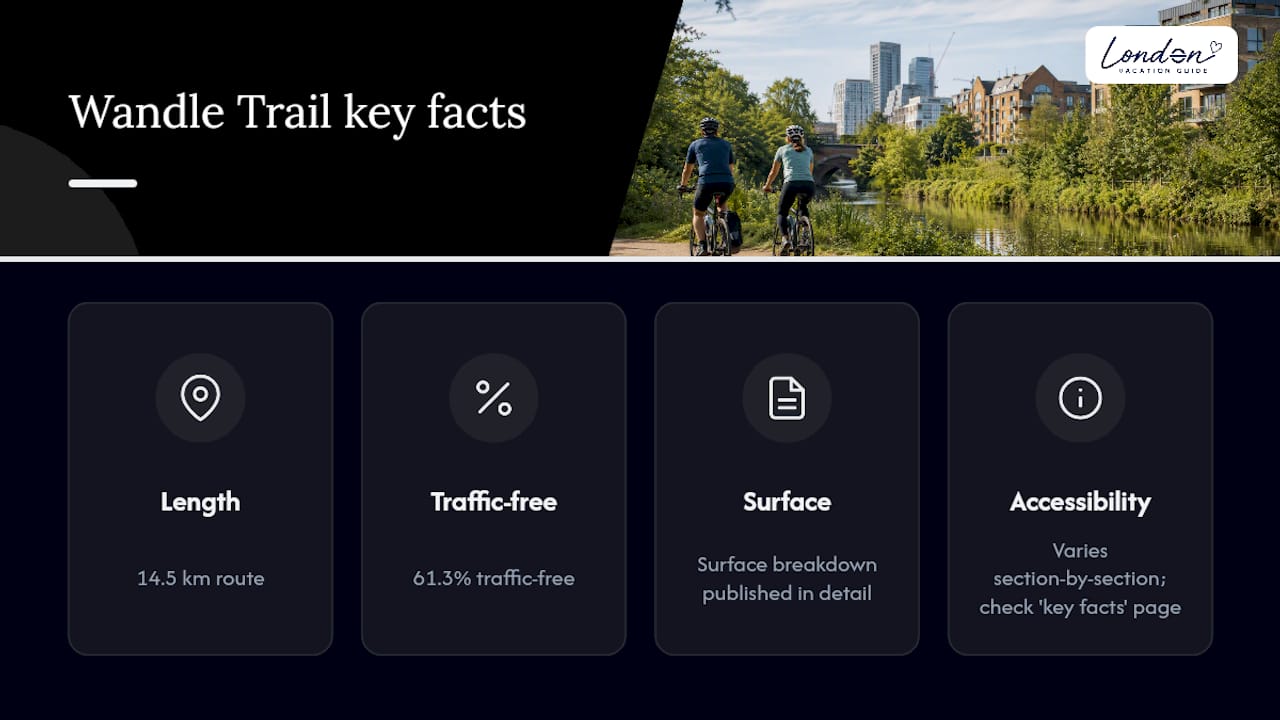
Wandle Trail. A 14.5 kilometre suburban trail running from Wandsworth down towards Carshalton and Farthing Downs, with 61.3% of the route traffic-free. It’s a genuinely different pace from central London riding: more green corridor, fewer buses.
Regent’s Park and royal parks loop. A gentle circuit through Regent’s Park connecting toward Hyde Park via quieter roads, ideal for families or anyone wanting scenery without traffic stress.
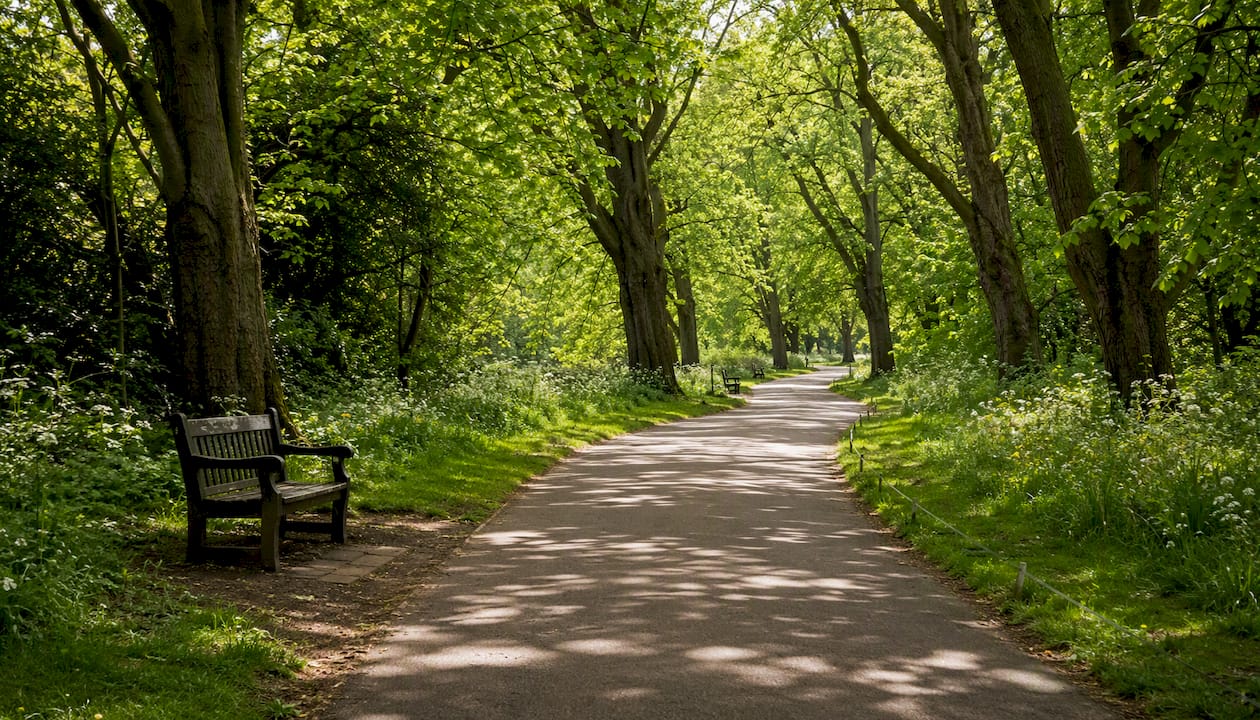
Regent’s Canal towpath. Runs from Little Venice through Camden and out towards the Olympic Park, almost entirely traffic-free but narrow in places, so expect to slow for pedestrians.
Thames Path segments (short version). Shorter sections of the full riverside loop, useful if you only have an hour or two and want river views without committing to the full distance.
Secret gardens themed ride. One of TfL’s printable leisure route guides, built around green spaces most visitors never find on their own.
The Wandle Trail’s surface breakdown is published in far more detail than most central routes, which matters if you’re riding a hybrid or road bike rather than a mountain bike. Accessibility genuinely varies section by section on trails like this, so check each route’s own “key facts” page before committing rather than assuming the whole trail matches its headline traffic-free percentage.
Pro Tip: Ride the Thames riverside loop clockwise starting before 9am on a weekend. You’ll clear Westminster and the South Bank before the pedestrian crowds arrive, and the light on the river is better for photos too.
How do you hire a bike in London?
Santander Cycles work on a docking model: you take a bike from one station and return it to any other station across the network, which suits short point-to-point trips far better than long circular rides. Hire costs are structured around access fees plus time-based charges, and the scheme doesn’t include helmets, so bring your own if you’re using one.
Private hire firms fill the gap Santander Cycles leaves. If you want a full-day ride, a hybrid with proper gears, a child seat, or panniers for luggage, a private rental is usually the better shape. Docking bikes are heavy, single-speed or three-speed, and built for utility rather than comfort over 25 kilometres.
A few practical points worth knowing before you commit:
- Santander Cycles docking stations cluster densely in central and inner London but thin out fast past zones 2 and 3, so a Wandle Trail ride will likely need a private hire or your own bike instead.
- Weekday mornings and Friday evenings see the heaviest docking-station turnover near business districts. Weekend leisure riders rarely hit the same congestion.
- Book private hire bikes ahead for summer weekends. Cycling UK’s own guidance for its London sightseer route specifically flags this, and popular shops sell out of decent hybrids by Saturday morning in July and August.
- Check docking availability in TfL Go before setting off eastward toward Greenwich or the Olympic Park. Stations near major attractions empty out fast on sunny afternoons.
How do you plan a safe cycling route in London?
A safe route isn’t the one with the lowest traffic percentage on paper. It’s the one that matches how confident you actually are at junctions, because that’s where nearly all real risk concentrates.
- Be honest about your skill level. A nervous beginner and a confident commuter should not pick the same route, even if both call themselves “leisure cyclists.”
- Prioritise traffic-free segments using the percentage figures on official route pages, like the Wandle Trail’s published 61.3%.
- Identify junctions and pinch points in advance, particularly where segregated cycle lanes suddenly merge back into shared traffic.
- Plan an exit option, meaning a nearby Tube or rail station where you could bail out if weather, fatigue or a mechanical issue cuts your ride short.
Cycling UK’s guidance on its own sightseer route makes a point worth repeating: even routes billed as beginner-friendly demand alertness at junctions, precisely because riders constantly shift between protected cycle lanes and shared carriageway. That transition point, not the open road itself, is where most near-misses happen.
Use the route key facts, distance, surface and traffic-free percentage, as a filter rather than decoration.
Pro Tip: At any shared path junction, slow down and make eye contact with pedestrians and other cyclists before committing to a direction. It costs you three seconds and avoids the vast majority of towpath and park-path collisions. If junctions still worry you after a few rides, TfL’s Cycle Skills Online training is free and genuinely useful.
Which routes suit your riding ability?
Matching a route to your actual ability, rather than your ambition, is what makes the difference between a good day out and an exhausting one.
- Beginners and families: Regent’s Park loop, short Thames Path segments, and the flatter northern stretch of the Wandle Trail. All three stay mostly traffic-free and offer easy bail-out points.
- Intermediate riders: the full Wandle Trail, Regent’s Canal towpath end to end, and the city highlights ride, provided you’re comfortable at moderate traffic junctions.
- Advanced or road riders: the full 27 kilometre Thames riverside loop in one sitting, especially if you extend it toward Greenwich and back rather than stopping halfway.
If a route feels too long or exposed, shorten it rather than push through. On the Thames loop, riders less confident in traffic can drop off at Tower Bridge and take the Docklands Light Railway or a river boat back to the start rather than riding the return leg. On the Wandle Trail, the southern half near Carshalton is quieter and easier than the northern Wandsworth end, so a nervous rider might start there instead.
Combining public transport with cycling isn’t a compromise, it’s often the smarter plan. Riding out one way and catching a train back means you see twice the ground without doubling the fatigue.
How can you make a London bike ride genuinely memorable?
The routes above get you moving. What turns a ride into a proper day out is stopping in the right places, and London rewards cyclists who build in deliberate pauses rather than treating the bike purely as transport.
Journey through time (riverside). Start at Westminster, ride east along the South Bank past the Globe and Borough Market, cross to Tower Bridge, then continue toward Greenwich. Pit-stops: Borough Market for food, the Hidden London Pubs riverside picks near Bankside, the Golden Hinde replica, and the Old Royal Naval College at Greenwich. Best ridden on a weekday morning, when Borough Market is open but not yet crowded.
Food and markets canal loop. Little Venice to Camden Lock along the Regent’s Canal towpath, then on toward Broadway Market near London Fields. Pit-stops: Camden Lock’s food stalls, a browse through the canal walking guide for detours worth taking on foot, and Broadway Market on a Saturday specifically, since that’s when it runs at full strength.
Parks and palaces royal circuit. Regent’s Park through to Hyde Park via quieter connecting roads, taking in Kensington Palace and the Serengeti-green stretches of Kensington Gardens. Pit-stops: the Kensington neighbourhood for a coffee break, the Diana Memorial Fountain, and Speakers’ Corner on a Sunday if your timing allows it.
Pro Tip: Ride any central themed route before 8am. Streets around Westminster and the South Bank are noticeably emptier at that hour, and you get cleaner light for photos before tour groups and coach traffic build up.
A “journey through time” framing, focusing on historic riverside pubs, market history, and architectural shifts along the route, turns a fitness ride into something closer to a guided walk on wheels. It’s a genuinely different experience from grinding out kilometres, and it’s one locals use to show visiting friends the city without ever setting foot in a museum queue.
What should you pack and know before setting off?
A short kit list solves most mechanical and comfort problems before they start:
- Mini pump or CO2 inflator
- Puncture repair kit or spare inner tube
- Front and rear lights, even for daytime rides in autumn or winter
- A decent lock if you plan to stop anywhere
- Phone mount and a portable charger for longer rides relying on GPS
Combining cycling with public transport extends your range without extending your legs. Folding bikes can travel on the Tube at any time. Standard bikes face restrictions on many Underground lines during peak hours, though most Overground and some National Rail services allow them off-peak. River boats and the Emirates Air Line cable car also carry bikes, which opens up genuinely useful shortcuts across the Thames.
A few seasonal and logistical notes worth knowing before you commit to a route:
- Daylight hours shrink fast in autumn and winter. A ride that’s comfortable at 4pm in July can end in darkness by 4pm in December, so check sunset times and pack lights regardless of season.
- Wet leaves and riverside flooding affect towpaths and Thames Path sections disproportionately. Some stretches genuinely close after heavy rain, so check conditions if you’re riding after a wet week.
- Offline maps matter along canal towpaths and park interiors, where phone signal can drop. Export a GPX file or screenshot your route before leaving reliable coverage.
- Cycling is prohibited inside the Greenwich Foot Tunnel, so if your route crosses the river near Greenwich, plan to use the ferry or a nearby train crossing instead of assuming you can wheel straight through.
Are London’s cycling routes accessible for disabled riders?
Accessibility varies significantly by route and even by section within the same route, so it’s worth checking specifics rather than assuming a “leisure route” label means step-free or wide-path access throughout. Adapted cycles, including hand cycles and trikes, generally need wider paths and gentler gradients than standard bikes, which rules out some narrower canal towpath stretches and favours purpose-built routes like the flatter sections of the Wandle Trail.
The Wandle Trail’s own route pages highlight this directly: accessibility differs by section, and the “key facts” pages exist specifically so riders using mobility aids or adapted cycles can judge suitability before setting off rather than discovering a stile or narrow gate halfway along. Regent’s Park and other royal park loops tend to offer the smoothest, widest surfaces of any central London option, which makes them a sensible starting point for adapted cycles or riders needing level, predictable paths. Always check a route’s specific access notes for gates, barriers and surface changes before relying on it for a mobility-aid-compatible ride.
A local’s take on the best way to spend a cycling day in London
If you only have one day and want maximum reward for minimum planning stress, ride the Thames loop out to Greenwich in the morning, stop for lunch near the Old Royal Naval College, then catch a river boat back rather than cycling the return leg. You get river views both ways, one proper meal stop, and you avoid doubling up on the same scenery twice.
That combination works because London’s geography rewards asymmetry: the ride out has the sights, the ride back is mostly effort. Swapping the return leg for a boat isn’t cutting corners, it’s using the city’s transport network the way it’s actually designed to be used alongside cycling, not instead of it. The same logic applies to the Wandle Trail: ride south from Wandsworth in one direction, then take a train back from Carshalton rather than retracing your tyre tracks.
What most generic cycling guides miss is that London’s best rides aren’t the longest or most technically demanding ones. They’re the ones with a genuine payoff at the midpoint, whether that’s a market, a palace, or a pub with three centuries of history behind the bar. Plan around that payoff, not around hitting a distance target.
How London Vacation Guide can help you plan the perfect cycling day
Picking a route is only half the job. Knowing where to base yourself, where to eat afterwards, and what else is worth seeing nearby is where most cycling guides fall silent, and it’s exactly where London Vacation Guide picks up. Our neighbourhood guides cover the areas that sit closest to the routes above, from lodging near a Thames-side start point to cafés worth detouring for on the Wandle Trail.
If this is your first time building a London itinerary around cycling, or you want to pair a ride with wider sightseeing, our essential guide for first-time visitors lays out a structured day-by-day plan you can slot a cycling route into rather than starting from a blank page. It’s a planning resource, not a sales pitch: check it, take what’s useful, and build your own day around it.
Sources
- Routes & maps
- Wandle Trail: Wandsworth to Carshalton and Farthing Downs - Walk Wheel Cycle Trust
- Weekender: London sightseer | Cycling UK
Check each site for live docking availability, up-to-date route key facts, and any no-cycling zones before you set off, since surfaces and access rules can change seasonally.
FAQ
What is the best cycling route in London for beginners?
The Regent’s Park loop and the northern, flatter half of the Wandle Trail suit beginners best, since both stay largely traffic-free with easy exit points.
How long is the Wandle Trail?
The Wandle Trail runs 14.5 kilometres from Wandsworth to Carshalton and Farthing Downs, with 61.3% of the route traffic-free.
Can I cycle through the Greenwich Foot Tunnel?
No, cycling is prohibited inside the Greenwich Foot Tunnel. Use a river ferry or nearby train crossing instead.
Which app should I use to plan a cycling route in London?
TfL Go is the most practical starting point, since it shows Cycleways, leisure routes and Santander Cycles docking availability in one place.
Do I need to book a hire bike in advance?
During summer weekends, yes. Cycling UK specifically recommends booking hire bikes ahead for its London sightseer route due to high demand.
Where can I find help planning a full day around a cycling route?
London Vacation Guide’s first-time visitors guide and neighbourhood guides help you pair a route with nearby lodging, food and sightseeing.