
Discover the benefits of staying in central London

TL;DR:
- Staying in central London maximizes your time, reduces transportation costs, and immerses you in the city’s vibrant culture.
- Choosing nearby neighborhoods like Covent Garden or Westminster provides easy access to major landmarks, theatres, and dining experiences, enriching your visit.
- Overall, the convenience and spontaneity of a central stay often create a richer, more memorable London experience than outer zones can offer.
Choosing where to stay in London is one of the most important decisions you will make before your trip, yet most first-time visitors get it completely wrong. The instinct to book somewhere cheaper in the outer zones, reasoning that you can simply commute in each day, sounds sensible on paper. In reality, it quietly erodes your time, energy, and budget in ways that are easy to underestimate. Staying in central London is not just a luxury choice. For many tourists, it is the most practical, rewarding, and ultimately cost-effective decision you can make.
Table of Contents
- What does “central London” really mean?
- Top reasons to stay in central London
- Comparing central London with other areas
- Immerse yourself in London’s culture and cuisine
- Practical tips for finding your perfect central London stay
- Our perspective: Does staying in central London make all the difference?
- Plan your perfect London stay with us
- Frequently asked questions
Key Takeaways
| Point | Details |
|---|---|
| Save time and effort | Staying centrally means less commuting and more time for experiences. |
| Access the best of London | Museums, theatres, restaurants, and historical sites are all within easy reach. |
| Variety for every traveller | Central London offers accommodation styles to suit any need and budget. |
| Real value beyond price | The overall experience, convenience, and memories often outweigh any upfront cost difference. |
What does “central London” really mean?
Before you can weigh up the benefits, it helps to understand what people actually mean when they say “central London.” The term is used loosely, but for tourists it almost always refers to the dense, walkable core of the city that sits primarily within Transport for London’s Zone 1. This is where London is at its most recognisable and most alive.
Think of central London as a collection of distinct but closely connected neighbourhoods, each with its own personality. Covent Garden is theatrical and bustling, famous for street performers and independent boutiques. Soho pulses with energy around the clock, offering everything from vintage record shops to acclaimed restaurants. Westminster anchors the political and historic heart of the city, with landmarks including the Houses of Parliament, Westminster Abbey, and Buckingham Palace all within easy walking distance. Bloomsbury is quieter and more literary, home to the British Museum and the University of London. The City of London, just to the east, is where medieval streets meet glass towers.
Key transport hubs tie these areas together. King’s Cross St. Pancras, Waterloo, Paddington, and Victoria are all either within Zone 1 or on its immediate boundary, connecting you to Heathrow Airport, Gatwick Airport, and the rest of Britain with ease.
Here is a quick overview of some popular central London neighbourhoods and what makes each one worth knowing:
| Neighbourhood | Key character | Notable landmarks | Best for |
|---|---|---|---|
| Covent Garden | Lively, artistic | Royal Opera House, market | Theatre, dining, shopping |
| Soho | Eclectic, cosmopolitan | Carnaby Street, Chinatown | Nightlife, food, culture |
| Westminster | Historic, grand | Big Ben, Parliament, Abbey | Sightseeing, history |
| Bloomsbury | Intellectual, calm | British Museum, Russell Square | Museums, quiet walks |
| South Bank | Creative, waterfront | Tate Modern, Shakespeare’s Globe | Arts, riverside dining |
| Marylebone | Elegant, village-like | Wallace Collection, Regent’s Park | Shopping, relaxed cafés |
Understanding these neighbourhoods helps you not only choose where to stay, but also plan your days more intelligently. When your hotel sits in or near one of these areas, you wake up already inside the story of London, rather than commuting towards it.
Top reasons to stay in central London
With central London clearly mapped, here is why choosing it as your base transforms your entire visit.
The most immediate benefit is time. London is a large, sprawling city. The Tube network is excellent, but journeys from outer zones add up fast. A return trip from Zone 3 to Westminster could easily take 45 to 60 minutes each way, costing you 90 minutes or more every single day. Over a week-long trip, that is more than ten hours sitting on a train rather than standing in front of a Rembrandt or sipping a flat white on the Southbank. When you stay centrally, London’s top attractions are frequently within a 10 to 20-minute walk from your door.
The financial logic also works in your favour more often than people realise. A single Zone 1 to 3 return journey on the Tube costs over £4 using an Oyster card. For two people taking two journeys a day, that is more than £112 across a week. That money could easily have offset the difference in accommodation price between a central and an outer-zone hotel.
Beyond money and time, consider the spontaneous moments that make travel memorable. Being centrally based means you can pop out for a morning walk along the Thames, duck into the National Gallery on a whim, or extend an evening because you do not have to worry about missing the last direct train home. Those unplanned experiences are often the ones you remember most vividly.
Here are the headline benefits in brief:
- Walking distance to major museums, West End theatres, and iconic landmarks
- Reduced transport costs by walking rather than using the Tube or buses
- Flexible evenings with no pressure to rush back before late-night services become infrequent
- Safe, busy streets with good lighting, 24-hour services, and high pedestrian footfall
- Greater choice of restaurants, bars, and entertainment within a few minutes on foot
- Easy access to essential London travel tips for navigating the city
Pro Tip: If you plan to visit more than three or four major attractions in a single day, staying centrally almost always makes the logistics simpler. Early morning visits before the crowds arrive and late-night returns after a West End show feel effortless when your hotel is a short stroll away.
Safety is another factor that first-time visitors often overlook until they are navigating an unfamiliar neighbourhood late at night. Central London’s tourist zones are well-monitored, consistently busy, and served by abundant black cabs and rideshare options around the clock. You never feel isolated.

Comparing central London with other areas
To illustrate the value, let us weigh up central London against nearby districts with a clear comparison.
Many visitors consider staying in areas like Stratford, Wembley, or even parts of Zone 3 such as Ealing or Wimbledon. The room prices in those areas can look appealing at first glance. However, the full picture is more complicated once you factor in the time and transport costs involved in every single journey you make.
Here is a side-by-side comparison of what you can expect:
| Factor | Central London (Zone 1) | Outer London (Zone 3+) |
|---|---|---|
| Average nightly cost | Higher | Lower |
| Daily transport cost | Minimal (mostly walking) | £8 to £15+ per person |
| Journey time to landmarks | 5 to 20 minutes on foot | 30 to 60 minutes by Tube |
| Flexibility for spontaneous plans | Very high | Limited by schedules |
| Evening options on your doorstep | Extensive | Limited |
| Overall trip value | Stronger | Often weaker than expected |
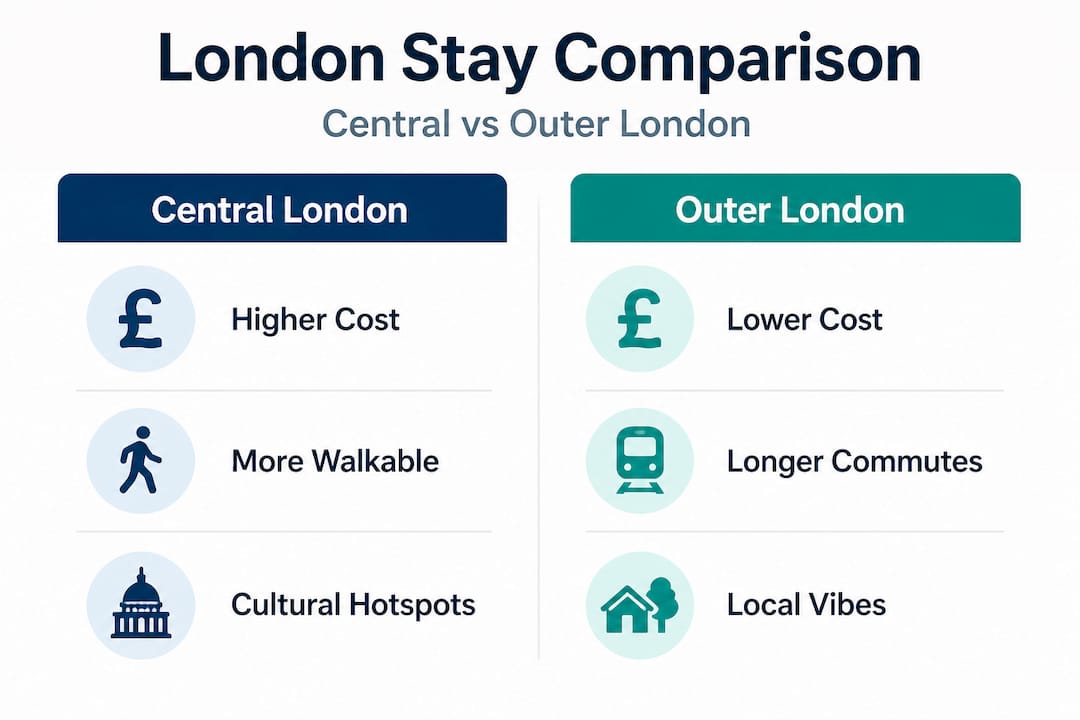
The numbers tell part of the story, but the experience tells the rest. Staying centrally often reduces overall costs and frustration, even if room prices are higher. That is not a marketing line. It is a conclusion drawn from the experiences of thousands of visitors who arrived expecting outer London to save them money, and instead found themselves exhausted and constrained.
The challenges of staying further out are worth spelling out clearly:
- Longer daily commutes mean you begin and end every day already tired, before you have seen a single attraction.
- Less flexibility when plans change. If you want to extend a dinner or catch an unexpected event, you are always watching the clock.
- More planning required for every outing. Nothing is spontaneous when everything requires a 40-minute journey.
- Higher cumulative transport spend than most visitors anticipate, particularly for families or groups.
- Missed late-night options. Some Tube lines reduce significantly after midnight. Central visitors simply walk home. Outer-zone visitors miss shows, dinners, and experiences entirely.
“After years of visitor feedback, the pattern is clear: tourists who stay centrally consistently rate their overall trip experience higher, not because their hotels were fancier, but because they spent their time experiencing London rather than commuting through it.”
Visiting local London neighbourhoods on day trips from a central base also gives you the best of both worlds. You can explore Notting Hill, Shoreditch, or Greenwich without committing to an overnight stay outside the centre.
Immerse yourself in London’s culture and cuisine
Beyond logistics and finances, the real magic is in living amongst London’s vibrant heart. Here is what you will experience when you stay centrally.
London is one of the world’s great cultural cities, and its most celebrated institutions are clustered tightly within the central zone. You can walk from the National Gallery in Trafalgar Square to the Royal Opera House in Covent Garden in under fifteen minutes. The Tate Modern on the South Bank is a leisurely stroll across the Millennium Bridge from St Paul’s Cathedral. The British Museum, the National Portrait Gallery, the Wallace Collection, and the V&A Museum are all within Zone 1 or right on its edge.
The West End is the world’s busiest theatre district. On any given evening, there are more than 40 productions running across Shaftesbury Avenue, the Strand, and the surrounding streets. When your hotel is in Covent Garden or Soho, attending a show requires nothing more than a short walk after dinner. No parking, no Tube anxiety, no rushing.
London’s food scene rewards central visitors enormously. Central London accommodations provide unbeatable access to unique local restaurants and experiences, ranging from Michelin-starred dining rooms to the lively street food markets of Borough Market and the covered stalls of Covent Garden.
Here are just some of the iconic cultural and culinary destinations within easy reach of a central hotel:
- The British Museum in Bloomsbury, one of the world’s great free museums
- The National Gallery on Trafalgar Square, home to Van Gogh, da Vinci, and Turner
- Borough Market near London Bridge, arguably the finest food market in Britain
- Oxford Street and Carnaby Street for shopping from high street to independent boutiques
- Soho and Chinatown for some of London’s most diverse and exciting dining
- The Southbank Centre for art, music, and riverside walks
- Covent Garden Piazza for street performance, independent dining, and afternoon tea
- The best central London restaurants are well within reach, covering every cuisine imaginable
The cultural density of central London is genuinely unlike anywhere else. You could spend two weeks here and still have a full list of things left to do. Every street corner carries history, whether that is a blue plaque on a Georgian townhouse or a pub where Samuel Johnson once held court.
Pro Tip: Build at least one pre-booked experience into each day of your trip. Whether it is a guided tour of the Tower of London, a West End show, or a tasting menu dinner, having one anchor experience each day helps you organise your walking routes and discover what else is nearby. Using a 3-day London itinerary as a starting framework gives you a solid structure to build from.
The diversity of food on offer in central London is staggering. Within a square mile of Covent Garden, you can eat Georgian wine-bar food, modern British tasting menus, authentic Japanese ramen, Nigerian small plates, and classic fish and chips. The city’s cultural mix makes central dining not just convenient, but genuinely exciting in a way that few places in the world can match.
Practical tips for finding your perfect central London stay
Ready to apply this knowledge? Here is how to pick the spot that fits you best.
Finding the right central London accommodation is about more than just picking any hotel in Zone 1. The neighbourhoods feel quite different from one another, and the right choice depends on your travel style, your priorities, and how you like to move through a city.
Follow these steps to make the best decision:
- Identify your anchor attractions. If you are most excited about museums, Bloomsbury and South Kensington are ideal bases. For theatre, Covent Garden or Soho puts you at the heart of it. For history and royal landmarks, Westminster is unbeatable.
- Book early, ideally six to twelve weeks in advance for peak seasons. Summer and December in London are extremely busy, and central hotels sell out fast.
- Check your Tube connections. Even within Zone 1, some hotels are a short walk from multiple Tube lines while others require a longer walk. Check which lines serve your nearest station before booking.
- Look for included amenities that add genuine value: free Wi-Fi, included breakfast, and 24-hour reception are worth prioritising, particularly for first-time visitors navigating a new city.
- Read recent reviews carefully. Focus on noise levels, check-in ease, and comments about location rather than just the star rating. A four-star hotel in a slightly awkward location may serve you far less well than a well-reviewed three-star in the heart of Covent Garden.
- Consider whether to choose a boutique or luxury hotel. Central London offers a wide range of accommodation options, from luxury hotels to charming boutique stays, and both categories have their distinct advantages depending on your budget and preferences.
- Check accessibility requirements in advance. Many of London’s older buildings have limited lift access. If accessibility is a priority, contact hotels directly before booking to confirm what facilities are available.
Pro Tip: Use Google Maps to drop a pin on three or four of the attractions you most want to visit, then look for accommodation in the centre of those pins. This exercise often reveals that Bloomsbury or Holborn sits perfectly between the museums, the West End, and the City, making them underrated bases that still count as very central.
Staying near a major Tube interchange like King’s Cross, Tottenham Court Road, or London Bridge also gives you maximum flexibility to reach anywhere in London quickly. These locations are not as glamorous as Covent Garden on paper, but their transport links are exceptional.
Our perspective: Does staying in central London make all the difference?
With these practical steps in mind, here is our honest take after years of visitor feedback and personal journeys.
The single most common regret we hear from first-time visitors to London is not that they overspent or that they missed a particular sight. It is that they wasted too much time commuting. And almost every time, the story begins with a hotel chosen for its price rather than its position.
We understand the logic entirely. Central London hotel rates can feel significant, especially when you compare them to properties a few stops out on the Overground. But we have consistently found that first-time visitors who prioritise making the most of your first trip by staying centrally leave London with fuller, richer memories.
There is something deeply valuable about waking up inside the city you came to experience. Stepping outside your front door and being three minutes from a centuries-old market or fifteen minutes from a world-class gallery changes how you engage with a place. It invites spontaneity. It removes the mental overhead of planning every movement. It lets London surprise you, which is frankly one of its greatest gifts.
The seasoned travellers who visit London repeatedly almost unanimously choose central accommodation, even when budgets tighten. They have already learned what first-timers must discover for themselves: the extra cost at the hotel is often less than the combined cost of extra transport, extra time, and the experiences you miss because the journey back felt too long.
We are not suggesting that outer London has no merit. Some of the city’s most authentic and underrated neighbourhoods sit beyond Zone 1. But for a first visit, when every day counts and the learning curve is steep, proximity to the centre is not an indulgence. It is a foundation. Evaluate your trip not by what your room cost, but by what you actually experienced. That is where the real value calculation lives.
Plan your perfect London stay with us
If you are inspired to make the most of central London, here is where to start your planning.
At London Vacation Guide, we have curated everything a first-time visitor needs to plan a genuinely brilliant trip. From hand-picked restaurant recommendations to neighbourhood deep-dives and step-by-step itineraries, our resources are designed to save you time and help you experience the city properly. Begin with our essential guide for first-time visitors to build a clear picture of how your days could look. If you are drawn to the museums and literary character of the centre, our Bloomsbury neighbourhood guide offers a detailed look at one of London’s most rewarding areas to base yourself. Explore our full range of guides and let us help you plan a trip you will talk about for years.
Frequently asked questions
Is central London safe for tourists, especially at night?
Central London is generally very safe, particularly in popular tourist areas such as Covent Garden, Westminster, and the South Bank, though exercising common sense with personal belongings is always a good idea.
Will staying centrally save me money on transportation?
Yes, being in central London means you can walk to most major attractions, which makes sightseeing simple and efficient while significantly reducing your daily transport spend.
Are there affordable accommodation options in central London?
Absolutely. Central London has a wide range of accommodation choices from luxury five-star hotels to well-reviewed boutique stays and budget-friendly hostels, making it accessible for most travel budgets.
Will I get an authentic London experience by staying in the centre?
Without question. Central London accommodations provide direct access to a remarkable range of local restaurants, historic pubs, cultural institutions, and neighbourhood life that defines the city’s character.
Recommended
- Why boutique hotels in London offer a truly personal stay - The London Journal | London Vacation Guide
- Explore the best London neighbourhoods for locals - The London Journal | London Vacation Guide
- Discover local London: Why exploring beyond tourist spots matters - The London Journal | London Vacation Guide
- How to experience London like a local: your essential guide - The London Journal | London Vacation Guide
- Why staying central in Greece unlocks more value