Arrive 4:30 to 5:00 AM, Beat The Queue: Wimbledon Guide for Visitors

You get into Wimbledon one of four legitimate ways: the public ballot (apply months ahead), The Queue (same-day, face value, no booking needed), the official resale kiosk or Ticketmaster releases (returned tickets, often cheap), or debentures and hospitality through Keith Prowse (guaranteed seats, premium prices). Set up a myWimbledon account now, before you plan anything else, because every official route runs through it.
TL;DR:
- The public ballot is the cheapest way to secure a show court seat without queuing overnight, but application outcomes vary by court and demand is highest during finals weekends.
- The Queue allows daily ticket purchase in person at Wimbledon Park, where arriving early and camping overnight significantly increases chances for coveted court tickets.
- Last-minute ticket options include resale kiosks for used tickets as low as £10 to £15 and occasional early releases on Ticketmaster up to 48 hours prior to play.
- Getting to Wimbledon by Tube from Southfields is easiest, with a short walk, while driving is discouraged due to limited parking and heavy traffic.
- Packing weather-appropriate clothing, sun protection, and essentials like water and a portable charger is crucial, especially given London’s unpredictable summer weather.
Table of Contents
- Wimbledon ticket guide: ballot, resale, debentures and hospitality explained
- How does The Queue work at Wimbledon?
- What’s the best way to get to Wimbledon by public transport?
- What should you wear and bring to Wimbledon?
- Where’s the best place to watch at Wimbledon?
- What food and facilities are available at Wimbledon?
- Where should you stay for a Wimbledon visit?
- How should you plan a Wimbledon day from start to finish?
- Is Wimbledon accessible for visitors with mobility needs or children?
- Local picks and insider tips from London Vacation Guide
- When does Wimbledon start and what time does play begin each day?
- How do you prepare for Wimbledon weather?
- What health and safety measures are currently in place at Wimbledon?
- What are the key deadlines for buying Wimbledon tickets?
- How much does a Wimbledon day actually cost?
- The Wimbledon experience is worth planning for, not just attending
- Plan the rest of your London trip with London Vacation Guide
- Sources
- FAQ
Wimbledon ticket guide: ballot, resale, debentures and hospitality explained
Most first-time visitors assume there’s one way in. There are five, and they suit wildly different budgets and planning horizons.
The public ballot is the classic route and the cheapest way to guarantee a seat on a show court without queuing overnight. It opens roughly a year in advance through your myWimbledon account, and applications typically close in the autumn before the following summer’s Championships. You don’t choose your day or court; if you’re successful, the AELTC allocates you a date and seat, and you pay only if you accept. Odds vary by court and day, but demand for Centre Court finals weekends dwarfs the No.2 Court midweek allocation.
Beyond the main ballot, the All England Lawn Tennis Club (AELTC) also runs member and debenture-holder allocations, and some tickets get distributed through National Tennis Associations abroad, including the LTA in Britain for grassroots club members. These routes are narrower and mostly out of reach unless you already belong to an affiliated club, so most overseas visitors can skip straight to the ballot or The Queue.
If the ballot fails or you decide late, The Queue is Wimbledon’s great leveller. Every day of the Championships, a set number of Centre Court, No.1 Court and No.2 Court tickets go on sale to whoever is standing in Wimbledon Park that morning, alongside thousands of Grounds Passes priced around £33 in early rounds. No booking, no ballot luck required, just patience and an early alarm.
For late risers or last-minute trips, the resale kiosk inside the grounds sells returned show-court tickets from spectators leaving early, often for as little as £10 to £15, with proceeds going to charity. Ticketmaster occasionally releases a small batch of tickets up to 48 hours before play, so it’s worth checking the app the moment you land in London.
At the top end sit debentures and official hospitality packages through Keith Prowse, Wimbledon’s designated hospitality partner. Debentures guarantee the same seat for five years and get resold on a regulated secondary market at prices far above face value; hospitality packages bundle a guaranteed seat with dining and lounge access. Both suit corporate visitors or anyone prioritising certainty over cost.
Practical moves that actually help:
- Register your myWimbledon account well before ballot season opens, so you’re not creating logins under time pressure.
- Set a phone alert for ballot deadlines, which tend to fall in the autumn of the preceding year.
- Check the official Wimbledon ticket pages directly rather than relying on secondary marketplaces, which frequently overcharge or sell invalid tickets.
- Download the Ticketmaster app before your trip if you’re chasing last-minute releases.
How does The Queue work at Wimbledon?
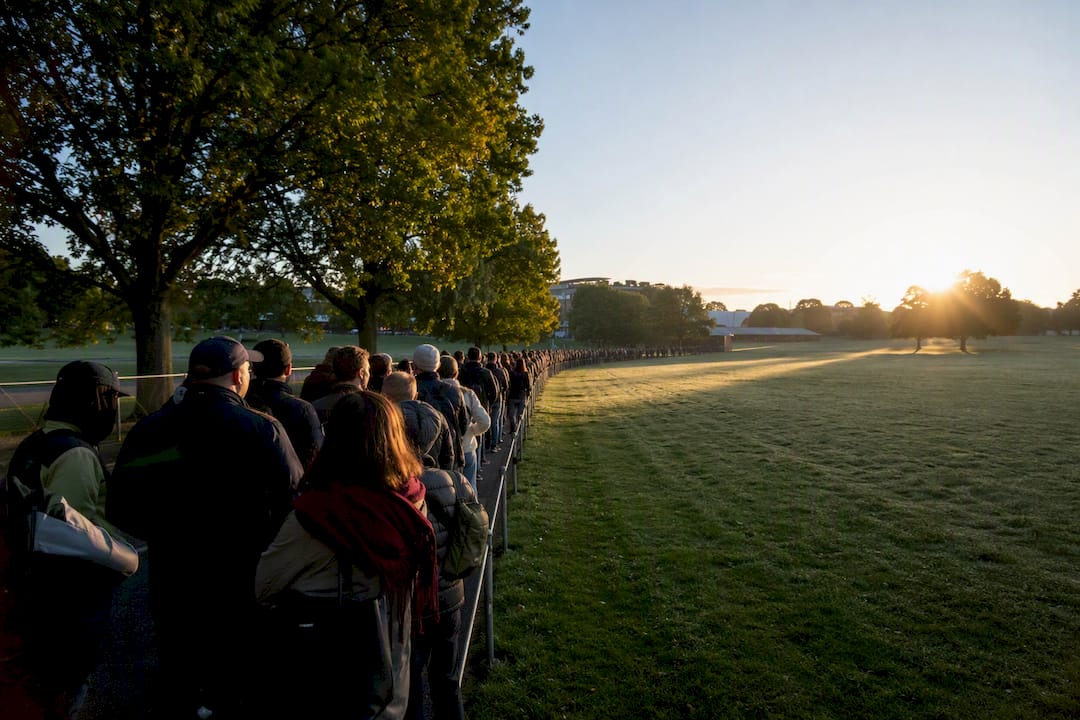
The Queue forms in Wimbledon Park, a short walk from the grounds, and it’s stewarded with genuine precision. On arrival, stewards hand you a numbered Queue Card, which fixes your position in line. It’s non-transferable, so the person whose name is on it must be the one who eventually enters. Lose the card and you lose your place, so treat it like a boarding pass.
Camping overnight is permitted and, for many visitors, part of the fun. The rules are specific: only small, two-person tents are allowed, open flames and barbecues are banned, and at least one member of your group must stay with your tent at all times overnight. Left-luggage facilities near the entrance let you store bags before heading in, which matters once you’re carrying a picnic, waterproofs and a camping chair.
What does your Queue Card number actually buy you? Roughly:
- Arrive by 4:30 to 5:00am on a normal day and you stand a fair chance at a Grounds Pass, according to reporting on how The Queue works in practice.
- Camp overnight if you specifically want a shot at Centre Court, No.1 or No.2 Court tickets, since show-court allocations are limited and go fast once the gates open.
- Arrive mid-morning and you’ll likely still get a Grounds Pass on quieter days, though not on finals weekend or when a British player is in form.
- Check the official queue guide for the current day’s allocation numbers, since they shift slightly year to year and by day of the tournament, detailed in this Wimbledon Queue Guide.
Bring more water than you think you need, snacks that don’t need refrigeration, and a portable power bank. Your phone becomes your ticket, your map and your entertainment for several hours, so a dead battery is a real problem. Keep your Queue Card somewhere you’ll actually remember, not loose in a bag pocket, and be polite to stewards. They control gate timings and will happily point you toward facilities, but they have zero patience for queue-jumping.
Pro Tip: Once you’re inside on a Grounds Pass, don’t assume you’re stuck outside show courts all day. Register interest at the resale kiosk early and check back through the morning. Returned tickets get released in waves, and grounds-pass holders who stay near the kiosk area often land a cheap upgrade to Centre Court by early afternoon.
What’s the best way to get to Wimbledon by public transport?
Southfields on the District line is the simplest approach for almost everyone staying in central or south west London. It’s a 15 to 20 minute walk from the station to the grounds, mostly flat and well signposted, and the whole route fills with a steady stream of fellow spectators, which makes it hard to get lost even at 6am.
Wimbledon station, on the mainline and District line, sits slightly further out, but a shuttle bus runs between the station and the grounds during the Championships. It’s useful if you’re arriving by train from outside London, though expect real crowding around peak arrival and departure times, particularly after the last match finishes on Centre Court.
Driving is the wrong call. Parking near the grounds is extremely limited, residential streets have strict controls, and traffic around Wimbledon during the Championships backs up badly. If you must arrive by car, use an official park-and-ride or get dropped off well away from the immediate area and walk the last stretch.
- Use contactless or an Oyster card on the Tube and buses. Both work identically for fares.
- Southfields is your default choice unless you’re coming from a mainline station that connects directly to Wimbledon.
- Build in an extra 20 to 30 minutes on match days, especially finals weekend, when Tube services get genuinely busy.
- Avoid the very last Tube of the evening if the day’s play has overrun; taxis and rideshares fill the gap but surge in price.
What should you wear and bring to Wimbledon?
Security is thorough but not draconian. Bags are capped at a certain size (roughly A4 folder dimensions, checked at the gate), glass containers are banned, and large shelters, gazebos or golf umbrellas won’t get through. A small backpack, a compact umbrella and a reusable water bottle are all fine.
Pack for a long day outdoors:
- Sun cream and a hat, since outer courts and Henman Hill offer almost no shade at midday.
- Comfortable, broken-in shoes; you’ll walk far more than expected between courts.
- A light rain layer, because Wimbledon fortnight in late June and early July is unpredictable.
- Cash and a card, since some kiosks queue faster with contactless.
Wimbledon’s dress code for spectators is smart casual rather than strict, but it leans conservative: think chinos and a collared shirt rather than shorts and flip-flops, particularly for Centre Court. Sun-exposed seating on outer courts rewards a hat far more than fashion sense.
Etiquette matters more here than at most sports. Phones go silent during play, and movement in and out of seating rows happens only between games, not points. Applause follows long rallies and good shots from either player, not just your favourite. Stewards will ask latecomers to wait at the gangway entrance until a natural break, so build slack into your schedule rather than rushing a changeover.
Pro Tip: Centre Court has a retractable roof, so rain rarely cancels play there entirely, but outer courts stop completely in wet weather. If the forecast looks unsettled, prioritise show-court tickets and treat a grounds pass day as weather-dependent.
Where’s the best place to watch at Wimbledon?
Centre Court delivers the full occasion: the best players, the most atmosphere, and the greatest chance of seeing a genuine box-office match. No.1 Court runs a close second and often hosts quarter-finalists in a more intimate setting. No.2 Court, sometimes called the “Graveyard Court” for its history of shock upsets, rewards spectators who enjoy unpredictability over guaranteed star power.
Outer courts offer a different pleasure entirely: you’re metres from the players, the crowds are thinner, and you can move between matches freely rather than committing to one seat for hours.
Sun and shade shift the calculus. Most outer courts and Henman Hill face largely open sky, so afternoon sessions in July heat get genuinely uncomfortable without a hat and sun cream. Covered seating on the show courts is the more comfortable option on a scorching day.
Henman Hill, officially Aorangi Terrace but never called that by anyone, is where grounds-pass holders gather to watch the big screen showing Centre Court matches. Arrive early for a good grassy spot, bring something to sit on, and treat it as a picnic with tennis rather than a seated match. It fills up fastest whenever a British player or a marquee name is on court.
- Show courts guarantee quality but limit you to one match at a time for hours.
- Outer courts let you sample several matches but come with their own internal queues at the entrance gates.
- Henman Hill suits groups and families who want atmosphere over proximity.
- Expect to realistically see two or three matches properly in a full day, not five or six, once walking and queuing time between courts is factored in.
What food and facilities are available at Wimbledon?
Strawberries and cream remain the signature order, and Pimm’s is the default drink of choice across the grounds, both sold at multiple kiosks so queues rarely get unmanageable outside peak lunch hours. Prices sit at typical major-event levels: expect to pay a premium compared with a normal London café, though not eye-watering by stadium standards.

Picnics are allowed and genuinely worth doing. Bring your own food into the grounds (within the bag-size limit) and find a spot on Henman Hill or one of the quieter grassy areas near the outer courts. Water refill points are dotted around the grounds, so a reusable bottle saves money over a full day.
For a cheap upgrade, register interest at the resale kiosk early, since returned show-court tickets circulate throughout the day. Keep your myWimbledon app open and your phone charged, as some availability gets flagged there first.
- Toilets and baby-change facilities are signposted throughout the grounds, with clusters near the main concourses.
- First aid points are staffed and clearly marked on the site map handed out at entry.
- Water fountains sit near most refreshment kiosks, so you rarely need to buy bottled water twice.
- Kiosks accept contactless almost everywhere, which speeds up the queue considerably.
Where should you stay for a Wimbledon visit?
Proximity wins if your priority is minimising an early alarm. Southfields, Wimbledon Village and Raynes Park all sit within a short Tube or train ride of the grounds, and a base here means you can leave for The Queue at 4am without a long commute beforehand. These areas skew residential rather than tourist-heavy, so expect B&Bs and smaller guesthouses over big hotel chains.
If you’d rather balance Wimbledon with a broader London holiday, Putney offers riverside charm and easy transport links, while Richmond gives you a genuinely relaxed base with its own riverside walks and green spaces, worth considering if you’re staying several days and want evenings away from the tournament buzz. Central London locations trade a longer commute for far more restaurant and evening options once play finishes.
Accommodation types range from simple B&Bs near Wimbledon Village to mid-range hotels and serviced apartments closer to central London. Booking windows tighten fast during the Championship fortnight, so aim to book at least two to three months ahead if you want a choice of price points rather than whatever’s left. For a full breakdown of options and booking advice, London Vacation Guide’s complete accommodation guide covers the trade-offs by area in detail, and the Richmond neighbourhood guide is worth a look if a riverside stay appeals.
- Southfields, Wimbledon Village or Raynes Park for the shortest possible commute on Queue mornings.
- Putney or Richmond for a quieter evening base with good transport back into the tournament.
- Central London for visitors combining Wimbledon with a wider London trip and late dinners.
How should you plan a Wimbledon day from start to finish?
Your ideal schedule depends entirely on which ticket route you’re using, so here are three realistic versions.
- Grounds Pass day: Arrive by Queue between 6am and 8am for a reasonable position, enter mid-morning, head straight for Henman Hill to claim a spot before the crowds build, then register at the resale kiosk by early afternoon for a possible show-court upgrade.
- Overnight Queue camper aiming for a show court: Arrive the evening before, pitch your small tent by early evening, keep one person with the tent overnight, wake by 6am to pack down, and be ready at the gate with your Queue Card and wristband well before the official opening.
- Hospitality or debenture visitor: Arrive closer to your seat time, usually mid-morning, enjoy a relaxed dining window through Keith Prowse facilities, and take your guaranteed seat without any queuing at all.
Whichever plan you follow, pack a rain layer regardless of forecast, charge your phone fully the night before, and keep a printed or screenshotted copy of any ticket confirmation as backup in case signal drops near the grounds.
Is Wimbledon accessible for visitors with mobility needs or children?
Accessible entry can be requested in advance through the AELTC’s accessibility services, and designated accessible seating is available on the show courts as well as around several outer courts. Book this well ahead of your visit, since allocation is limited and demand is high across the fortnight.

For visitors with reduced mobility, hospitality packages and reserved seating routes suit far better than The Queue, which involves standing for extended periods and, for overnight campers, sleeping on the ground. If Queue tickets are your only realistic option, aim for a Grounds Pass rather than committing to an overnight camp.
Families will find baby-change facilities and quieter seating areas away from the busiest concourses, and pushchairs are permitted around the grounds, though expect tighter manoeuvring near popular courts at peak times.
- Agree a fixed meeting point with your group before splitting up, since mobile signal can be patchy in crowded areas.
- Keep phones charged and carry a portable power bank for a full day out.
- Pace hydration and shade breaks carefully with children or anyone sensitive to heat, particularly on Henman Hill.
Local picks and insider tips from London Vacation Guide
A short walk from the grounds, Wimbledon Village has a handful of independent cafés worth the detour for a coffee before you join The Queue at dawn. For dinner after play finishes, the high street around Wimbledon station has a good spread of casual Italian and Thai spots that don’t need a booking on a Tuesday night. If you’re staying near Richmond, a short riverside stroll along the Thames the following morning makes a genuinely relaxing contrast to a long day standing in a queue.
- Coffee: independent cafés around Wimbledon Village open early enough for pre-Queue caffeine.
- Dinner: casual, no-booking-needed restaurants along Wimbledon high street for after the last match.
- Wind-down: a Richmond riverside walk if you’re based nearby, ideal the morning after a Centre Court day.
Wimbledon fortnight is one of the busiest windows on the calendar for exactly this kind of local planning.
When does Wimbledon start and what time does play begin each day?
The Championships run for two weeks from late June into early July, with Wimbledon 2026 following that same established window. Gates typically open at 10am, and play on the show courts usually starts at 11am on the middle Saturday onwards, with earlier starts on some days during the first week.
Outer courts often begin play slightly earlier than the show courts, so if your priority is catching as much tennis as possible rather than a specific star player, arrive as close to gate-opening as you can manage. The last matches on Centre Court can run well into the evening, particularly during the second week when best-of-five-set men’s matches go the distance.
Grounds close a set time after the final match ends, giving you a defined window to finish food, souvenirs or a last lap of Henman Hill. Exact daily start times shift slightly year to year and get published on the official Wimbledon site closer to the tournament, so check before you travel rather than relying on last year’s schedule.
If you’re planning a single-day visit, treat 10am to 11am as your realistic arrival target for a Grounds Pass day, and remember that finding a tennis partner can make the experience even better — check out Find a Tennis Partner Near You for casual sessions before or after Wimbledon.
How do you prepare for Wimbledon weather?
Late June and early July in London swing between genuine heat and sudden showers, sometimes within the same afternoon. Centre Court’s retractable roof means rain rarely stops play there, but every outer court halts completely once the covers come out, so a wet forecast should push you toward show-court tickets if you have the choice.
Sun protection matters more than most visitors expect. Henman Hill and the outer courts offer almost no shade, and a full day outside in July sun without a hat or sun cream leads to sunburn faster than people anticipate on a day that starts overcast.
Practical weather prep:
- Check the forecast the night before and again on the morning you queue, since London weather shifts fast.
- Pack a compact, foldable umbrella rather than a full-size one, since large umbrellas aren’t permitted through security.
- Bring a light waterproof jacket even on a sunny forecast; London showers arrive with little warning.
- Reapply sun cream through the day if you’re on Henman Hill or an outer court for several hours.
- Layer clothing so you can adjust as temperatures shift between morning queue and afternoon sun.
Overnight Queue campers face the toughest weather exposure, since tents offer only basic shelter. A groundsheet, a warm layer for the small hours, and a backup plastic sheet for sudden rain make a real difference to comfort if you’re camping the night before.
What health and safety measures are currently in place at Wimbledon?
Wimbledon has returned to standard pre-pandemic operations, with no COVID-19-specific entry requirements such as vaccination proof or mandatory testing currently in place for spectators. Bag checks and security screening remain the main entry procedure, consistent with major UK sporting events generally.
General hygiene measures like hand sanitiser stations remain available around the grounds as a standard courtesy rather than a specific health mandate. If you’re feeling unwell, the same common sense applies as at any large gathering: consider whether attending is fair on fellow spectators packed closely on Henman Hill or in queue lines.
Given how quickly official guidance can shift, check the official Wimbledon ticket and help pages shortly before travelling, particularly if you’re arriving from outside the UK and want the current word on any entry requirements tied to your journey rather than the tournament itself.
What are the key deadlines for buying Wimbledon tickets?
Timing separates a smooth ticket-buying experience from a stressful one. Here’s the realistic sequence:
Roughly a year ahead, the public ballot opens through your myWimbledon account, usually in the autumn preceding the Championships. Applications typically close within a few weeks, and results get sent out over the following months, so registering your account the moment ballot season opens avoids a last-minute scramble.
If you miss the ballot window or weren’t successful, your next checkpoint is the Championships fortnight itself. The Queue requires no advance booking at all, just physical presence on the day, which makes it the fallback for anyone who didn’t plan a year out.
In the days just before and during the tournament, watch the Ticketmaster app for occasional last-minute releases, sometimes appearing up to 48 hours before play, and keep the resale kiosk in mind once you’re inside the grounds on any day.
For hospitality and debentures, timelines run differently again. Official Keith Prowse hospitality packages typically go on sale well over a year in advance and sell out for popular days quickly, while debentures trade on a regulated resale market year-round rather than through a single application window.
The practical takeaway: decide your route by early autumn the year before you want to attend, since the ballot deadline is the one truly fixed date in this whole process.
How much does a Wimbledon day actually cost?
Costs vary enormously depending on your ticket route, but here’s a realistic breakdown by category.
Tickets range from a Grounds Pass at around £33 in early rounds via The Queue, up through ballot-allocated show-court seats at higher face value, to resale-kiosk bargains as low as £10 to £15 for returned tickets, all the way to hospitality packages and debentures costing many times face value for guaranteed premium seating.
Travel on the Tube using contactless or Oyster typically costs a few pounds each way depending on your starting zone, making public transport by far the cheapest and most reliable option compared with taxis, which climb sharply during peak arrival and departure surges.
Food inside the grounds runs at standard major-event pricing: expect a premium over typical London café prices for strawberries and cream, Pimm’s, and light meals, though bringing a picnic cuts this considerably.
Accommodation swings the most based on choice and timing. A B&B in Southfields booked months ahead costs far less than a last-minute hotel in central London during the Championship fortnight, when demand across the whole area spikes.
Budget-conscious visitors can realistically manage a full Wimbledon day, Grounds Pass, Tube fare and a packed picnic, for a modest total. Visitors chasing show-court tickets through the ballot or resale, plus a hotel stay, should expect the cost to climb substantially higher across the same categories.
The Wimbledon experience is worth planning for, not just attending
There’s a particular kind of camaraderie that builds among strangers standing in a field at 5am, swapping stories about which court they’re hoping for while the queue slowly shuffles forward. Henman Hill on a warm afternoon, a plastic bowl of strawberries balanced on your knee, a match you didn’t plan to watch turning into the best one of the day. The logistics matter, and getting them right makes the day run smoothly, but don’t let the planning crowd out the part where you just sit on the grass and enjoy it.
— Matt
Plan the rest of your London trip with London Vacation Guide
Sorting your Wimbledon tickets and Queue strategy is only half the job. Where you sleep, how you get between your hotel and Southfields at dawn, and what you do with the rest of your London trip all shape whether the fortnight feels smooth or exhausting. Neighbourhood and accommodation guides can help cover the practical details that generic travel sites skip: which areas cut your commute, which give you evening options once play ends, and how to book before the fortnight’s demand spike pushes prices up.
- Start with the London for first-time visitors guide for a full planning framework, then browse the neighbourhood guides for Richmond, Victoria or Kensington to pick a base that matches your Wimbledon route and budget.
Sources
- Tickets - The Championships, Wimbledon
- Wimbledon Queue Guide 2026: How It Works, & Ticket Prices
- Everything you need to know about The Queue and why it’s the most fun way to do Wimbledon
- How to Get Wimbledon Tickets in 2026 and 2027: Every Option Explained
FAQ
How do I get tickets to Wimbledon?
Enter the public ballot through your myWimbledon account roughly a year ahead, queue on the day for on-sale tickets, check the resale kiosk and Ticketmaster for returned tickets, or buy official hospitality through Keith Prowse.
What time should I arrive for The Queue?
Arriving between 4:30am and 5am gives you a fair chance at a Grounds Pass on a normal day, while a genuine shot at a show-court ticket usually means camping overnight.
Can I bring food into Wimbledon?
Yes, picnics are permitted within the bag-size limit, and Henman Hill and the quieter grassy areas near outer courts are the best spots to eat them.
Which Tube station is best for Wimbledon?
Southfields on the District line is the simplest option for most visitors, roughly a 15 to 20 minute walk from the grounds along a well-signposted route.
Is driving to Wimbledon a good idea?
No, parking is extremely limited and traffic around the grounds is heavy during the Championships, so public transport or a drop-off well away from the venue works far better.
How much does a Grounds Pass cost?
A Grounds Pass typically costs around £33 in the early rounds, sold each morning through The Queue alongside show-court allocations.